
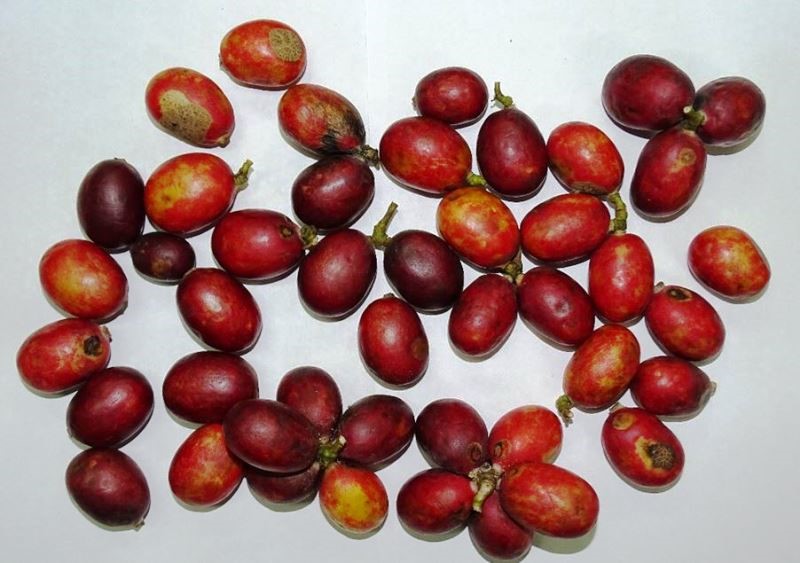
Freshly harvested fruits

Wild Blood Fruit A Source of Natural Red Colourant May Be Domesticated

  • Research Stash
  • News
  • 2.9K

Blood fruit is a woody climber and it is very popular among tribes in the Northeastern states, Andaman and Nicobar Islands and Bangladesh. The fruit is not only tasty and rich in anti-oxidant but is also a good source of dye for the local handicraft industry.  Now researchers have developed a standard nursery protocol for its propagation.

Freshly harvested fruits

IMAGE Freshly harvested fruits

The plant grows wild in forests and over the years, due to growing demand for its fruit, it has been indiscriminately harvested from natural forests. This has affected natural regeneration and it is now considered a critically endangered species. The new research will help in blood fruit to be grown in agricultural fields or home gardens so that it is conserved even while being continued to be used as a source of nutrition and dye.

The nursery protocol has been developed by researchers from Central Island Agricultural Research Institute, Port Blair; ICAR Research Complex for North Eastern Hill Region, Barapani and College of Agriculture in Tripura.
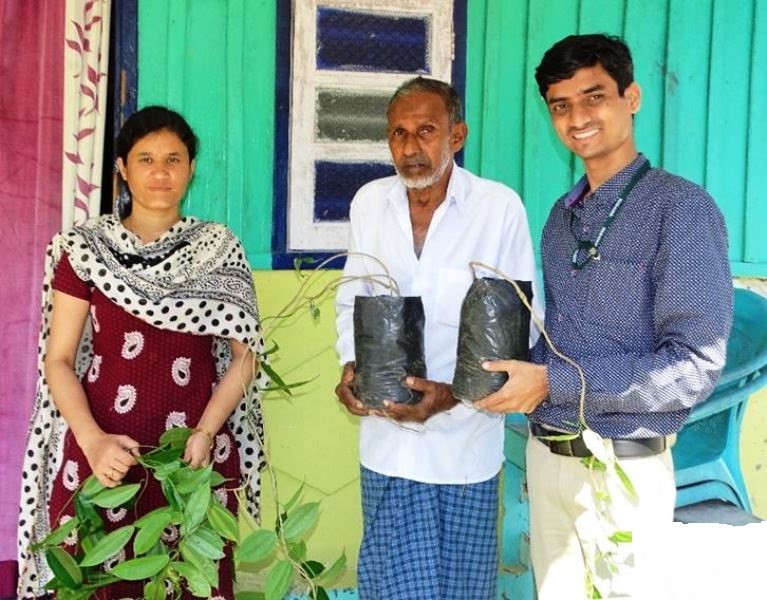
Pooja Bohra and Ajit Arun Waman distributing the blood fruit seedlings to a farmer

IMAGE Pooja Bohra and Ajit Arun Waman distributing the blood fruit seedlings to a farmer

Due to its limited distribution, researchers collected fruits from the Middle Andaman Islands and Tripura to conducted seed germination studies. They found that seeds had dormancy issues and had to be treated for obtaining healthy seedlings in large numbers.

The scientists also extracted and studied pigmentation in blood fruit. Among the different solvents tried for extraction, they found that dimethylsulphoxide was the best solvent to extract chlorophylls and total carotenoids. More studies are underway to characterize the red color property of the fruit, said Dr. Pooja Bohra, a member of the research team, while speaking to India Science Wire.

The group is also working on methods to improve seed longevity and post-harvest storability of fruits. “We are already distributing seedling to farmers in Andaman and Nicobar Islands to promote commercial scale cultivation”, she added.

The plant, which goes by the biological name of Haematocarpusvalidus, flowers once in a year. The main fruiting season is from April to June. Initially, the fruits are green in color and they turn blood red on ripening giving the name ‘Blood Fruit’. Generally, the fruits from the Andaman Islands are much darker in color compared to other sources. The gene pool in the Andaman Islands can be lost due to natural calamities and promoting its cultivation can ensure the conservation of this species.

Besides Dr. Pooja, the research team included Ajit Arun Waman, and Debabrata Basantia (ICAR-Central Island Agricultural Research Institute, Port Blair); Hidangmayum Lembisana Devi (ICAR Research Complex for North Eastern Hill Region) and Ezekiel Reang (College of Agriculture, Tripura). The findings have been published in journal Current Science. (India Science Wire)

By S Suresh Ramanan

If you liked this article, then please subscribe to our YouTube Channel for the latest Science & Tech news. You can also find us on Twitter & Facebook.

The plant grows wild in forests and over the years, due to growing demand for its fruit, it has been indiscriminately harvested from natural forests. This has affected natural regeneration and it is now considered a critically endangered species. The new research will help in blood fruit to be grown in agricultural fields or home gardens so that it is conserved even while being continued to be used as a source of nutrition and dye.

The nursery protocol has been developed by researchers from Central Island Agricultural Research Institute, Port Blair; ICAR Research Complex for North Eastern Hill Region, Barapani and College of Agriculture in Tripura.

Pooja Bohra and Ajit Arun Waman distributing the blood fruit seedlings to a farmer

IMAGE Pooja Bohra and Ajit Arun Waman distributing the blood fruit seedlings to a farmer

Due to its limited distribution, researchers collected fruits from the Middle Andaman Islands and Tripura to conducted seed germination studies. They found that seeds had dormancy issues and had to be treated for obtaining healthy seedlings in large numbers.

The scientists also extracted and studied pigmentation in blood fruit. Among the different solvents tried for extraction, they found that dimethylsulphoxide was the best solvent to extract chlorophylls and total carotenoids. More studies are underway to characterize the red color property of the fruit, said Dr. Pooja Bohra, a member of the research team, while speaking to India Science Wire.

The group is also working on methods to improve seed longevity and post-harvest storability of fruits. “We are already distributing seedling to farmers in Andaman and Nicobar Islands to promote commercial scale cultivation”, she added.

The plant, which goes by the biological name of Haematocarpusvalidus, flowers once in a year. The main fruiting season is from April to June. Initially, the fruits are green in color and they turn blood red on ripening giving the name ‘Blood Fruit’. Generally, the fruits from the Andaman Islands are much darker in color compared to other sources. The gene pool in the Andaman Islands can be lost due to natural calamities and promoting its cultivation can ensure the conservation of this species.

Besides Dr. Pooja, the research team included Ajit Arun Waman, and Debabrata Basantia (ICAR-Central Island Agricultural Research Institute, Port Blair); Hidangmayum Lembisana Devi (ICAR Research Complex for North Eastern Hill Region) and Ezekiel Reang (College of Agriculture, Tripura). The findings have been published in journal Current Science. (India Science Wire)

By S Suresh Ramanan

If you liked this article, then please subscribe to our YouTube Channel for the latest Science & Tech news. You can also find us on Twitter & Facebook.

" }
A Controlled-Release Oral Pill for Kala Azar and Fungal Infections

A Controlled-Release Oral Pill for Kala Azar and Fungal Infections

Researchers have developed a method to produce controlled-release oral tablets for treating fungal infections and kala-azar. The tablets were found to release the drug Amphotericin B in a sustained and controlled manner over a period of 10 days

  • News
  • 2K
Read more

India May Not Achieve SDG Targets on Reducing Child Mortality

A new study has warned that over two-thirds of the districts in the country are unlikely to achieve the UN Sustainable Development Goal (SDG) target of reducing deaths to 25 or less per 1000 live births in under 5-year old children and 12 or less per 1000 live births for newborns by 2030

  • News
  • 2.1K
Read more
Evergreen Shrub May Be a Source of New Cancer Diagnostic Agent

Evergreen Shrub May Be a Source of New Cancer Diagnostic Agent

A team of researchers at the Indian Institute of Technology-Roorkee, have developed a set of fluorescent carbon nano-dots that promises to serve as a diagnostic-cum- therapeutic agent for cancer

  • News
  • 3.1K
Read more

Internet is huge! Help us find great content

Newsletter

Never miss a thing! Sign up for our newsletter to stay updated.

About

Research Stash is a curated collection of tools and News for S.T.E.M researchers

Have any questions or want to partner with us? Reach us at [email protected]

Navigation

Submit