
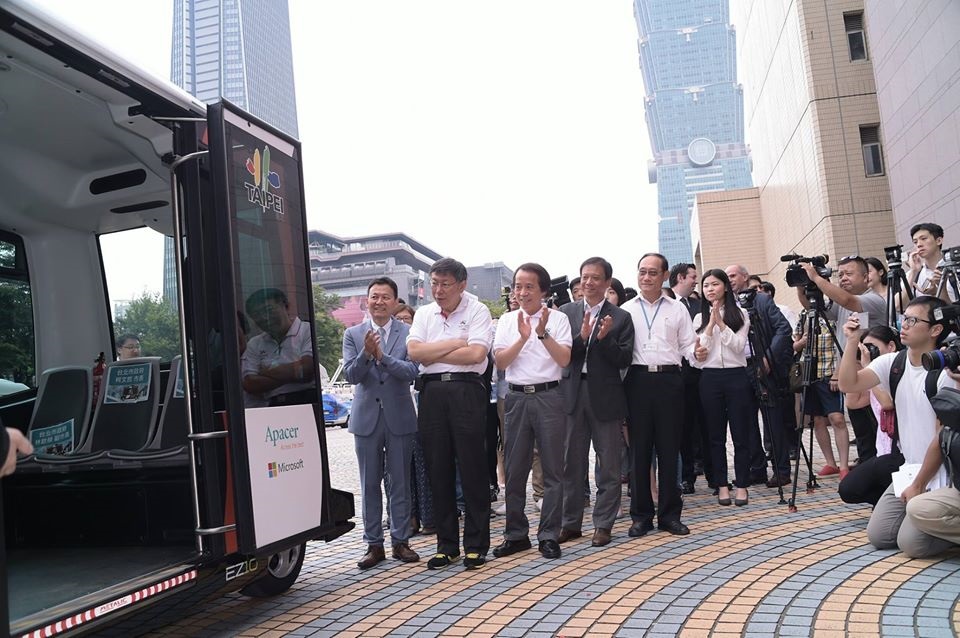
Self-driving bus set for testing in Taipei

  • Research Stash
  • News
  • 2K

A self-driving bus will be put through its paces Aug. 1-5 in Taipei as part of local government efforts to spur the metropolis’s smart city development and further enhance the quality of life for residents.

Manufactured by France-headquartered Ligier Group, the battery-powered EZ10 driverless vehicle can carry a maximum of 12 passengers, reach speeds of up to 40 kph and operate for 14 hours on a single charge. It will run from 1 a.m. to 4 a.m. along the designated bus lane on Xinyi Road between Dunhua South and Fuxing South roads.

Taipei Mayor Ko Wen-je said July 27 that the bus is a strong step in the right direction when it comes to solving the city’s and country’s transportation challenges using innovative solutions.

Self-driving vehicle programs are key planks in Taipei’s smart city development strategy, Ko said, adding that they underscore the value of the local government’s open-minded approach to formulating viable transportation policies for the 21st century.

But the mayor said a great deal needs to be accomplished before such services are greenlighted and underway, citing regulatory amendments and requisite infrastructure development.

According to Taipei City Government’s Department of Information Technology, the first three days of testing will be dedicated to gathering data for adjusting the existing transportation system and route planning. The final two are reserved for focus groups, with the vehicle restricted to a top speed of 20 kph so as to ensure safety.

The bus, which moves autonomously via a GPS tracking system and six light-detecting and ranging sensors, was successfully tested earlier this month at Taipei-based National Taiwan University’s downtown Shuiyuan Campus. It is expected to provide shuttle services during the Eco Mobility World Festival running Oct. 1-31 in Kaohsiung City, southern Taiwan. (SFC-E)

Taiwan today

Rate

Manufactured by France-headquartered Ligier Group, the battery-powered EZ10 driverless vehicle can carry a maximum of 12 passengers, reach speeds of up to 40 kph and operate for 14 hours on a single charge. It will run from 1 a.m. to 4 a.m. along the designated bus lane on Xinyi Road between Dunhua South and Fuxing South roads.

Taipei Mayor Ko Wen-je said July 27 that the bus is a strong step in the right direction when it comes to solving the city’s and country’s transportation challenges using innovative solutions.

Self-driving vehicle programs are key planks in Taipei’s smart city development strategy, Ko said, adding that they underscore the value of the local government’s open-minded approach to formulating viable transportation policies for the 21st century.

But the mayor said a great deal needs to be accomplished before such services are greenlighted and underway, citing regulatory amendments and requisite infrastructure development.

According to Taipei City Government’s Department of Information Technology, the first three days of testing will be dedicated to gathering data for adjusting the existing transportation system and route planning. The final two are reserved for focus groups, with the vehicle restricted to a top speed of 20 kph so as to ensure safety.

The bus, which moves autonomously via a GPS tracking system and six light-detecting and ranging sensors, was successfully tested earlier this month at Taipei-based National Taiwan University’s downtown Shuiyuan Campus. It is expected to provide shuttle services during the Eco Mobility World Festival running Oct. 1-31 in Kaohsiung City, southern Taiwan. (SFC-E)
Taiwan today
" }
From Hypertension to Cancers –Alarm Bells Ringing in India’s Tribal Belts

From Hypertension to Cancers –Alarm Bells Ringing in India’s Tribal Belts

A new investigation into tribal health has revealed that non-communicable diseases now constitute a major health burden across Indian tribal communities

  • News
  • 2.5K
Read more
NBRI Establishes Advanced Virology Lab For COVID-19 Testing

NBRI Establishes Advanced Virology Lab For COVID-19 Testing

The National Botanical Research Institute has established an “Advanced Virology Lab” for testing COVID-19. The facility has been developed based on the guidelines of the Indian Council Medical Research, World Health Organisation, and the Ministry of Health and Family Welfare.

  • News
  • 1.4K
Read more
Drug-Coated Bone Implants May Help Tackle Post-Surgery Infections

Drug-Coated Bone Implants May Help Tackle Post-Surgery Infections

Researchers have now come up with a method to localize the drug delivery to the surgery site. This has been achieved by modifying the surface of metallic implants by loading them with an antibacterial drug that gets released gradually over a period of one week at the implant site to prevent infections.

  • News
  • 1.8K
Read more

Internet is huge! Help us find great content

Newsletter

Never miss a thing! Sign up for our newsletter to stay updated.

About

Research Stash is a curated collection of tools and News for S.T.E.M researchers

Have any questions or want to partner with us? Reach us at hello@researchstash.com

Navigation

Submit