
Scientists Complete Genetic Sequencing of Chickpea

  • Research Stash
  • News
  • 2.2K

After three years of rigorous research, a team of scientists from International Crops Research Institute for the Semi-Arid Tropics (ICRISAT) here and 21 research institutions across the world has successfully completed the sequencing of 429 chickpea lines from 45 countries.
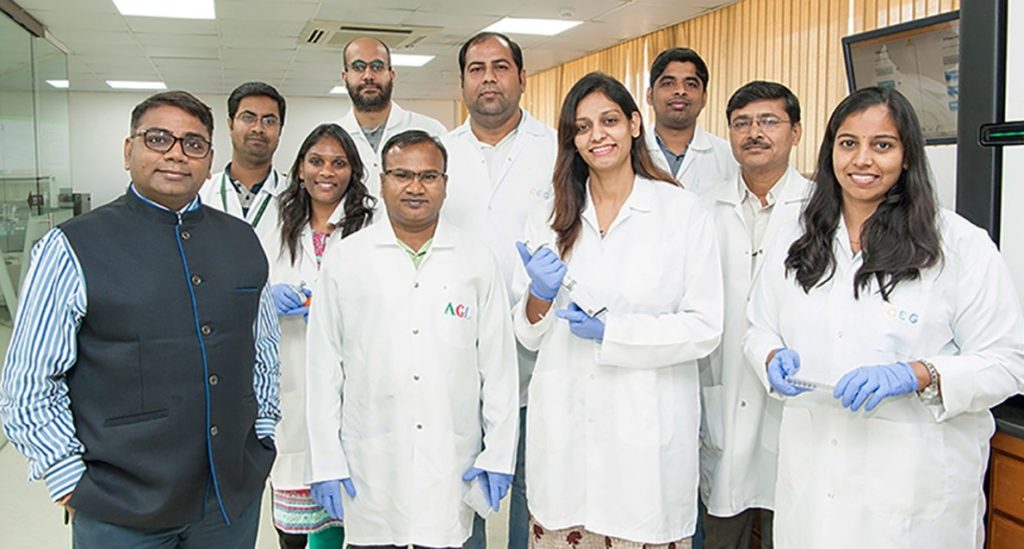
Team of researchers at ICRISAT

The new development assumes importance as chickpea is an important crop with high nutrient value and there is a need to generate new varieties with better traits including heat, drought, pests and disease resistance, besides higher yield and productivity particularly in the context of the growing global population and threats posed by climate change.

The genome-wide association studies have identified several candidate genes for 13 agronomic traits. For example, “we could identify genes, which can help the crop tolerate temperatures up to 38 degrees Celsius and provide higher productivity,” said project leader Dr. Rajeev Varshney.

The study lays the foundation for large-scale characterization of the germplasm, population genetics and crop breeding of chickpea and helps understand domestication and post-domestication divergence of chickpea.

“The new knowledge from the sequencing will enable breeders to enhance the use of diverse germplasm and candidate genes in developing improved climate-change ready varieties that will contribute significantly to increase in productivity and sustainability of agricultural development in developing countries,” said ICRISAT Director General, Dr. Peter Carberry.

Among the research institutions that participated in the study are Indian Agricultural Research Institute, Indian Institute of Pulses Research, Osmania University and University of Agricultural Sciences, Bengaluru. BGI Research, a Chinese genome sequencing company was also involved in the project.  The study results have been published in journal Nature Genetics.  (India Science Wire)

By Chand Ahmed

If you liked this article, then please subscribe to our YouTube Channel for the latest Science & Tech news. You can also find us on Twitter & Facebook.
Rate

The study lays the foundation for large-scale characterization of the germplasm, population genetics and crop breeding of chickpea and helps understand domestication and post-domestication divergence of chickpea.

“The new knowledge from the sequencing will enable breeders to enhance the use of diverse germplasm and candidate genes in developing improved climate-change ready varieties that will contribute significantly to increase in productivity and sustainability of agricultural development in developing countries,” said ICRISAT Director General, Dr. Peter Carberry.

Among the research institutions that participated in the study are Indian Agricultural Research Institute, Indian Institute of Pulses Research, Osmania University and University of Agricultural Sciences, Bengaluru. BGI Research, a Chinese genome sequencing company was also involved in the project.  The study results have been published in journal Nature Genetics.  (India Science Wire)

By Chand Ahmed

If you liked this article, then please subscribe to our YouTube Channel for the latest Science & Tech news. You can also find us on Twitter & Facebook.

" }
The Weizmann Institute of Science and Mohamed bin Zayed University in the UAE to Collaborate on Artificial Intelligence Research

The Weizmann Institute of Science and Mohamed bin Zayed University in the UAE to Collaborate on Artificial Intelligence Research

A memorandum of understanding between the Weizmann Institute of Science in Israel and the Mohamed bin Zayed University of Artificial Intelligence (MBZUAI) in the United Arab Emirates was signed yesterday

  • News
  • 1.8K
Read more
Satellite-Based Advisory Service Launched for Deep Sea Fishermen

Satellite-Based Advisory Service Launched for Deep Sea Fishermen

The Indian National Centre for Ocean Information Services and Airport Authority of India on Wednesday launched a new system that expands the scope for disseminating alerts and other messages to fishermen who go for multi-day fishing and other such activities deep inside the seas

  • News
  • 2.1K
Read more
Super Tiny Particles Derived From Table Sugar Can Detect Lead in Water

Super Tiny Particles Derived From Table Sugar Can Detect Lead in Water

Nanotechnology deals with particles that are several thousand times smaller than a human hair, and it is being put to use in a variety of applications such as drug delivery and diagnostic tests.

  • News
  • 5.5K
Read more

Internet is huge! Help us find great content

Newsletter

Never miss a thing! Sign up for our newsletter to stay updated.

About

Research Stash is a curated collection of tools and News for S.T.E.M researchers

Have any questions or want to partner with us? Reach us at hello@researchstash.com

Navigation

Submit