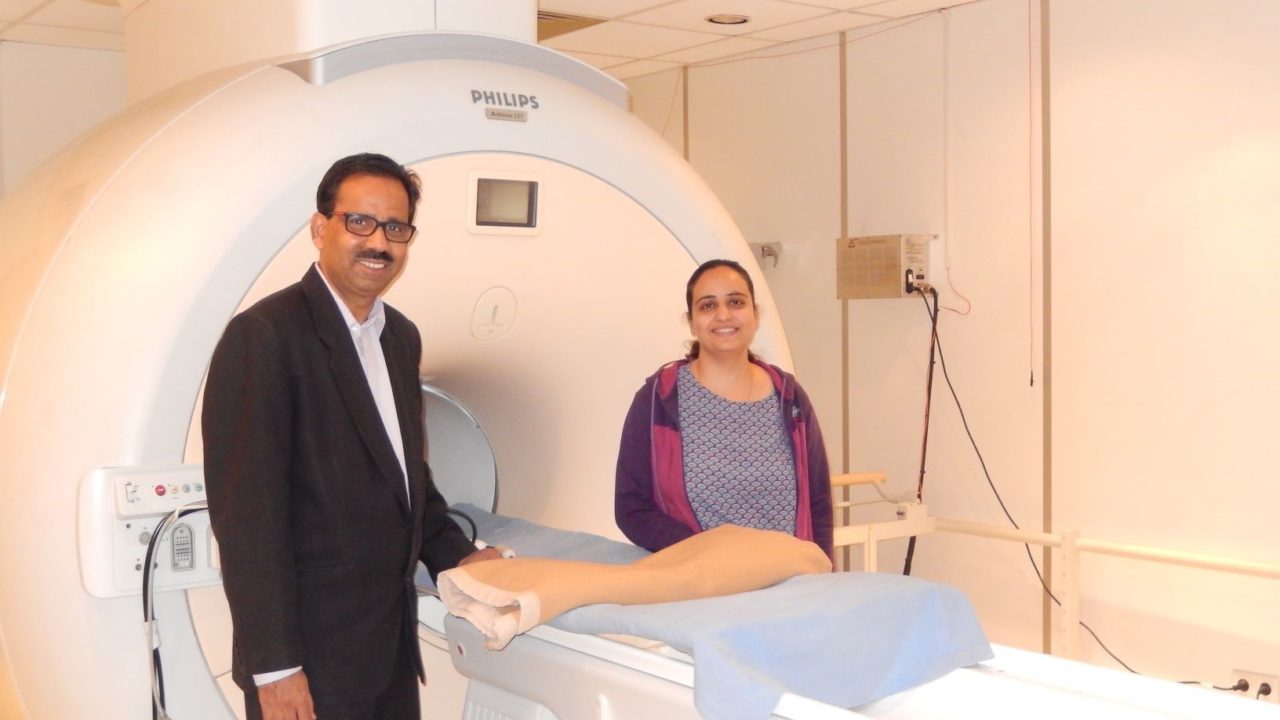
Dr Pravat Mandal and Dr. Deepika Shukla at NBRC

Big Data May Help Get New Clues to Alzheimer’s

  • Research Stash
  • News
  • 2.4K

Despite rapid developments in medicine, early detection of neurodegenerative disorders remains a challenge. Now a group of Indian researchers has sought to apply Big Data analytics to hunt for early signatures of the Alzheimer’s.

Researchers at the National Brain Research Centre (NBRC), Manesar, have developed a Big Data Analytics framework that will use non-invasive imaging and other test data to look for early diagnostic biomarkers of the Alzheimer’s disease.

The data framework, based on open source data software platform called Hadoop, integrates data from brain scans in the form of non-invasive tests – magnetic resonance imaging (MRI), magnetic resonance spectroscopy (MRS) as well as neuropsychological test results. The framework deploys data mining, machine learning, and statistical modeling algorithms.

“With this Big Data Analytics Framework, we are trying to address three Vs – volume, variety, and velocity. Each brain scan using MRI or MRS yields enormous amounts of data and it is not manually feasible to study data from multiple patients to see if any patterns are emerging. Machine learning can help us do this fast,” explained Dr. Pravat Kumar Mandal, a lead scientist of the research team, while speaking to India Science Wire.

Researchers used data about various features of the brain – structural, neurochemical and behavioral – collected through MRI, MRS and neuropsychological scores respectively. These features are identified and classified into groups for arriving at a diagnosis by clinicians. The new framework is multi-modalities-based decision framework for classification of early Alzheimer’s, scientists have noted in their study published in journal Frontiers in Neurology. The model has been named BHARAT and has been tested with brain scans of Indians.

The data analytics framework integrates structured and unstructured data organization, storage, processing, and is capable of analyzing a vast volume of complex data. It makes use of data organization, parallel computing, distributed storage techniques, besides machine learning algorithms for fast and scalable data processing. It is multi-modal meaning it can classify between healthy old persons, those with mild cognitive impairment and patients of Alzheimer’s.

“Other such big data tools for early diagnostics are only based on MRI images of patients. Our model incorporates neurochemical-like antioxidant glutathione depletion analysis from brain hippocampal regions. This data is extremely sensitive and specific. This makes our framework close to the disease process and presents a realistic approach,” said D.r Mandal.

The research team included D.r Mandal, D.r Deepika Shukla, Ankita Sharma, and Tripti Goel. The study was supported by the Ministry of Department of Science and Technology. (India Science Wire)

By Dinesh C Sharma

If you liked this article, then please subscribe to our YouTube Channel for the latest Science & Tech news. You can also find us on Twitter & Facebook.

Rate

“With this Big Data Analytics Framework, we are trying to address three Vs – volume, variety, and velocity. Each brain scan using MRI or MRS yields enormous amounts of data and it is not manually feasible to study data from multiple patients to see if any patterns are emerging. Machine learning can help us do this fast,” explained Dr. Pravat Kumar Mandal, a lead scientist of the research team, while speaking to India Science Wire.

Researchers used data about various features of the brain – structural, neurochemical and behavioral – collected through MRI, MRS and neuropsychological scores respectively. These features are identified and classified into groups for arriving at a diagnosis by clinicians. The new framework is multi-modalities-based decision framework for classification of early Alzheimer’s, scientists have noted in their study published in journal Frontiers in Neurology. The model has been named BHARAT and has been tested with brain scans of Indians.

The data analytics framework integrates structured and unstructured data organization, storage, processing, and is capable of analyzing a vast volume of complex data. It makes use of data organization, parallel computing, distributed storage techniques, besides machine learning algorithms for fast and scalable data processing. It is multi-modal meaning it can classify between healthy old persons, those with mild cognitive impairment and patients of Alzheimer’s.

“Other such big data tools for early diagnostics are only based on MRI images of patients. Our model incorporates neurochemical-like antioxidant glutathione depletion analysis from brain hippocampal regions. This data is extremely sensitive and specific. This makes our framework close to the disease process and presents a realistic approach,” said D.r Mandal.

The research team included D.r Mandal, D.r Deepika Shukla, Ankita Sharma, and Tripti Goel. The study was supported by the Ministry of Department of Science and Technology. (India Science Wire)

By Dinesh C Sharma

If you liked this article, then please subscribe to our YouTube Channel for the latest Science & Tech news. You can also find us on Twitter & Facebook.
" }
A Peel-Off Graphene Sheet Fabricated from Camphor

A Peel-Off Graphene Sheet Fabricated from Camphor

Researchers have now developed a new method to fabricate graphene sheets from camphor — a readily available ingredient often used in religious rituals.

  • News
  • 2.9K
Read more
Mangrove Fungi Isolated from India’s West Coast Munches On Polythene

Mangrove Fungi Isolated from India’s West Coast Munches On Polythene

Fungi are said to be grand recyclers of the planet and are considered vanguard species in habitat restoration. Now Indian scientists have found that they may also be the answer to one of the biggest environmental problems – plastic pollution. They have identified fungi which can potentially help degrade polythene

  • News
  • 2.9K
Read more
Records of Historical Supernova Found in Karnataka

Records of Historical Supernova Found in Karnataka

Imagine walking at dusk under a blue sky that is gradually turning black. Twinkling stars are beginning to appear here and there. And suddenly you discover new star dazzling that was not there the previous night. Could it be Venus or perhaps a comet?

  • News
  • 3.1K
Read more

Internet is huge! Help us find great content

Newsletter

Never miss a thing! Sign up for our newsletter to stay updated.

About

Research Stash is a curated collection of tools and News for S.T.E.M researchers

Have any questions or want to partner with us? Reach us at hello@researchstash.com

Navigation

Submit