Popular Vegetable Can Help Prepare a Cure for Kala Azar

Popular Vegetable Can Help Prepare a Cure for Kala Azar

  • Research Stash
  • News
  • 2.4K

A popular vegetable helps in preparation of an effective nanoparticle-based formulation to treat Kala Azar, which is caused by Leishmania donovani.

Researchers at the Indian Institute of Technology, Guwahati used Sechium edule or Chayote to prepare nanosilver particles that proved toxic to Leishmania. Nanosilver particles are tiny particles of silver and are known to be lethal to microorganisms.
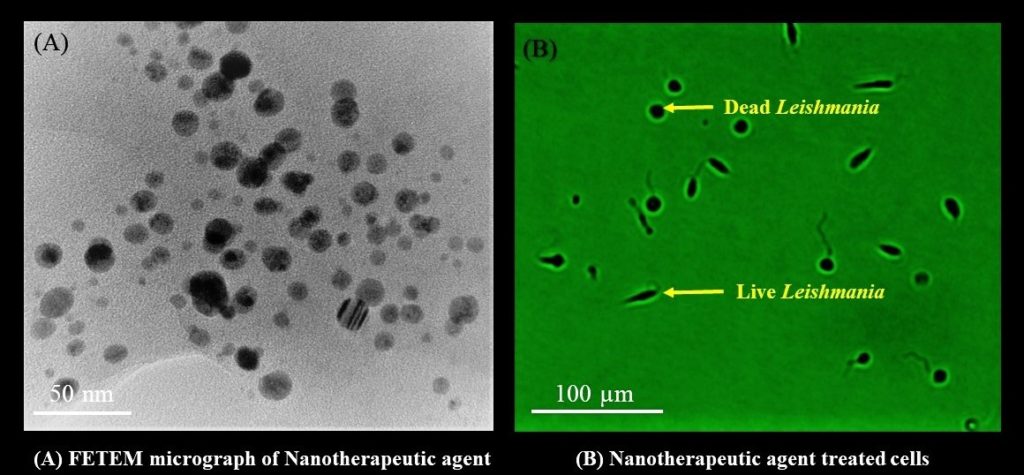
Leishmania donovani killed by nanosilver particles as seen under the microscope

Leishmania donovani killed by nanosilver particles as seen under the microscope

Chayote is grown widely in Assam and other regions in the country. “We chose it as a phyto-resource because it is readily available, is inexpensive, and has not been explored before. Extracts of tea and guava leaves are well-explored phyto-resources for nanoparticle preparations,” explained Dr. Pranjal Chandra, who led the research, while speaking to Indian Science Wire.

There are just five drugs used for the treatment of Kala-Azar and some of them are turning ineffective due to drug resistance. Although nanosilver formulations have been tried earlier against Kala Azar, a natural and easy way of producing them was lacking.

For preparing the formulation, researchers extracted the juice of Chow-Chow, mixed it with an equal amount of silver nitrate solution. Various tests for the formation of nanosilver particles showed that by about 18 hours, almost all silver nitrate had been reduced to silver particles, demonstrating the efficiency of the procedure. The team used advanced techniques like UV-Vis spectroscopy to confirm the growth of nanosilver particles.

The researchers tested the toxicity of nanosilver on Leishmania donovani grown in the lab.  A solution containing just 50 micrograms of nanosilver per ml was sufficient to kill almost half of all parasites.  Moreover, the concentration was nearly one and a half times more effective when compared with drugs currently in use. Tests on monocytes, a part of blood, showed that nanosilver particles were not mortal to monocytes even at double the concentration that was potent to kill all Leishmania thus demonstrating its safety to humans.

“We believe nanoparticles will behave with similar efficiency in vivo, in animals. However, this should be tested. If not, the nanoparticles can be encapsulated in liposomes and delivered,” said Dr. Chandra. “We anticipate the production cost of this would be less costly than of other anti-leishmania drugs as the procedure is very simple and the raw materials required can be easily procured in lesser cost”.

“Kala-azar is endemic in parts of Bihar and no transmission is known in South India. As of now, there are no silver-containing products used as medications for internal use,” says Dr. Srinivas Kakkillaya, a physician from Mangalore who is not associated with this study.

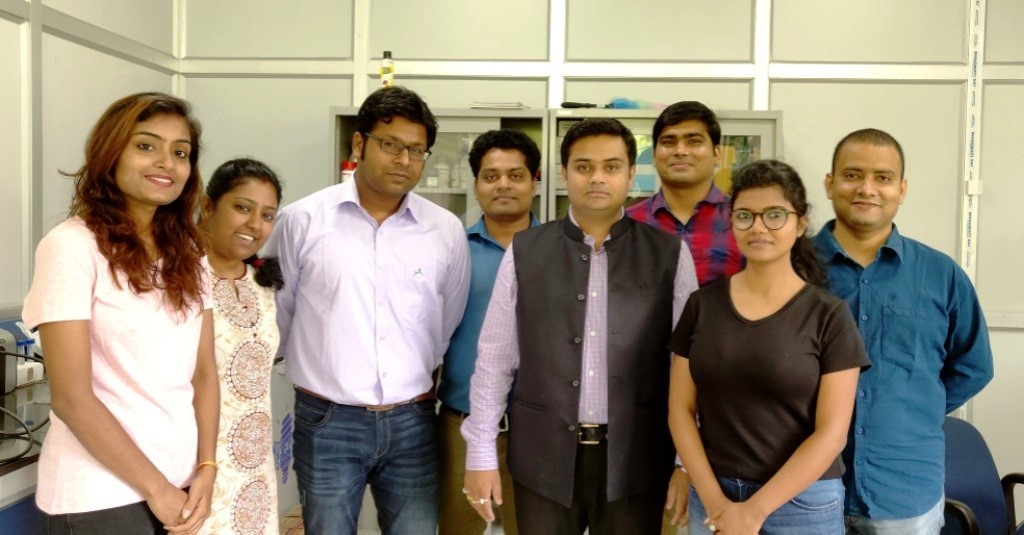
The findings have been published in journal Scientific Reports. The team included Dr. Pranjal Chandra (DST Ramanujan Fellow), Anupriya Baranwal, Adarsh Kumar Chiranjivi, Ashutosh Kumar, Vikash Kumar Dubey from the Department of Biosciences & Bioengineering, IIT, Guwahati. (India Science Wire)

By Kollegala Sharma

Journal Reference

Design of commercially comparable nanotherapeutic agent against human disease-causing parasite, Leishmania

If you liked this article, then please subscribe to our YouTube Channel for the latest Science and Tech news. You can also find us on Twitter and Facebook.
Rate

Leishmania donovani killed by nanosilver particles as seen under the microscope

Chayote is grown widely in Assam and other regions in the country. “We chose it as a phyto-resource because it is readily available, is inexpensive, and has not been explored before. Extracts of tea and guava leaves are well-explored phyto-resources for nanoparticle preparations,” explained Dr. Pranjal Chandra, who led the research, while speaking to Indian Science Wire.

There are just five drugs used for the treatment of Kala-Azar and some of them are turning ineffective due to drug resistance. Although nanosilver formulations have been tried earlier against Kala Azar, a natural and easy way of producing them was lacking.

For preparing the formulation, researchers extracted the juice of Chow-Chow, mixed it with an equal amount of silver nitrate solution. Various tests for the formation of nanosilver particles showed that by about 18 hours, almost all silver nitrate had been reduced to silver particles, demonstrating the efficiency of the procedure. The team used advanced techniques like UV-Vis spectroscopy to confirm the growth of nanosilver particles.

The researchers tested the toxicity of nanosilver on Leishmania donovani grown in the lab.  A solution containing just 50 micrograms of nanosilver per ml was sufficient to kill almost half of all parasites.  Moreover, the concentration was nearly one and a half times more effective when compared with drugs currently in use. Tests on monocytes, a part of blood, showed that nanosilver particles were not mortal to monocytes even at double the concentration that was potent to kill all Leishmania thus demonstrating its safety to humans.

“We believe nanoparticles will behave with similar efficiency in vivo, in animals. However, this should be tested. If not, the nanoparticles can be encapsulated in liposomes and delivered,” said Dr. Chandra. “We anticipate the production cost of this would be less costly than of other anti-leishmania drugs as the procedure is very simple and the raw materials required can be easily procured in lesser cost”.

“Kala-azar is endemic in parts of Bihar and no transmission is known in South India. As of now, there are no silver-containing products used as medications for internal use,” says Dr. Srinivas Kakkillaya, a physician from Mangalore who is not associated with this study.

The findings have been published in journal Scientific Reports. The team included Dr. Pranjal Chandra (DST Ramanujan Fellow), Anupriya Baranwal, Adarsh Kumar Chiranjivi, Ashutosh Kumar, Vikash Kumar Dubey from the Department of Biosciences & Bioengineering, IIT, Guwahati. (India Science Wire)

By Kollegala Sharma

Journal Reference

Design of commercially comparable nanotherapeutic agent against human disease-causing parasite, Leishmania

If you liked this article, then please subscribe to our YouTube Channel for the latest Science and Tech news. You can also find us on Twitter and Facebook.
" }

USC Stem Cell scientists obtain “how to” guide for producing hair follicles

How does the skin develop follicles and eventually sprout hair? A USC-led study, published in the Proceedings of the National Academy of Sciences (PNAS), addresses this question using insights gleaned from organoids, 3D assemblies of cells possessing rudimentary skin structure and function--including the ability to grow hair.

  • News
  • 1.9K
Read more
Scientists find Link Between Oxidative Stress And Neurological Disorders

Scientists find Link Between Oxidative Stress And Neurological Disorders

Indian scientists have found a new function of a gene which is already known to play a role in neurological disorders

  • News
  • 2.3K
Read more
This Sensor May Help Detect Early Stages of Diabetes

This Sensor May Help Early Detection of Diabetes

Early detection of diabetes may become possible with a new sensor developed by Indian scientists to detect low levels of Retinol Binding Protein 4, a biomarker for early diabetes

  • News
  • 2.7K
Read more

Internet is huge! Help us find great content

Newsletter

Never miss a thing! Sign up for our newsletter to stay updated.

About

Research Stash is a curated collection of tools and News for S.T.E.M researchers

Have any questions or want to partner with us? Reach us at hello@researchstash.com

Navigation

Submit