
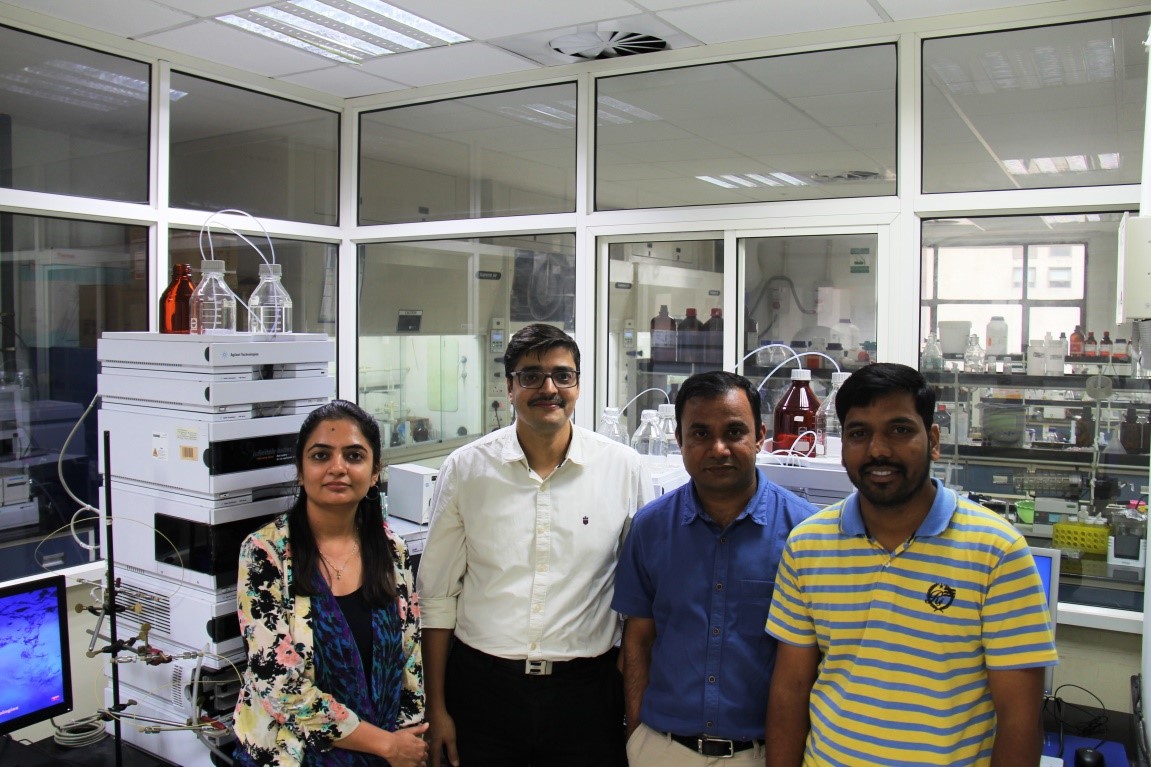
Drs. Neetu Kalra, Vishal Rai, Sanjeev Shukla, Maheshwer reddy Chilamari (Left to Right)

Scientists Develop New Method to Synthesize Bio-Conjugates

  • Research Stash
  • News
  • 2.7K

In a promising development in the area of targeted treatment of cancer, a team of researchers at the Indian Institute of Science Education and Research (IISER), Bhopal, have developed a new method to synthesize antibody-drug conjugates (ADC) using the chemical route.

Antibody-drug conjugates combine drugs with antibodies that specifically target tumor markers in cancer cells. When administered to patients, antibodies in conjugate track tumor markers and attach themselves to the surface of cancer cells. The antibody-market reaction triggers a signal in tumor cells which absorbs antibodies together with the drug.

However, the difficulty is that several amino acid residues in antibodies like lysine, tyrosine, tryptophan, cysteine, and histidine compete during installation of drugs. Amino acid residues also have multiple copies, each having a different level of reactivity making it difficult to identify the right one.
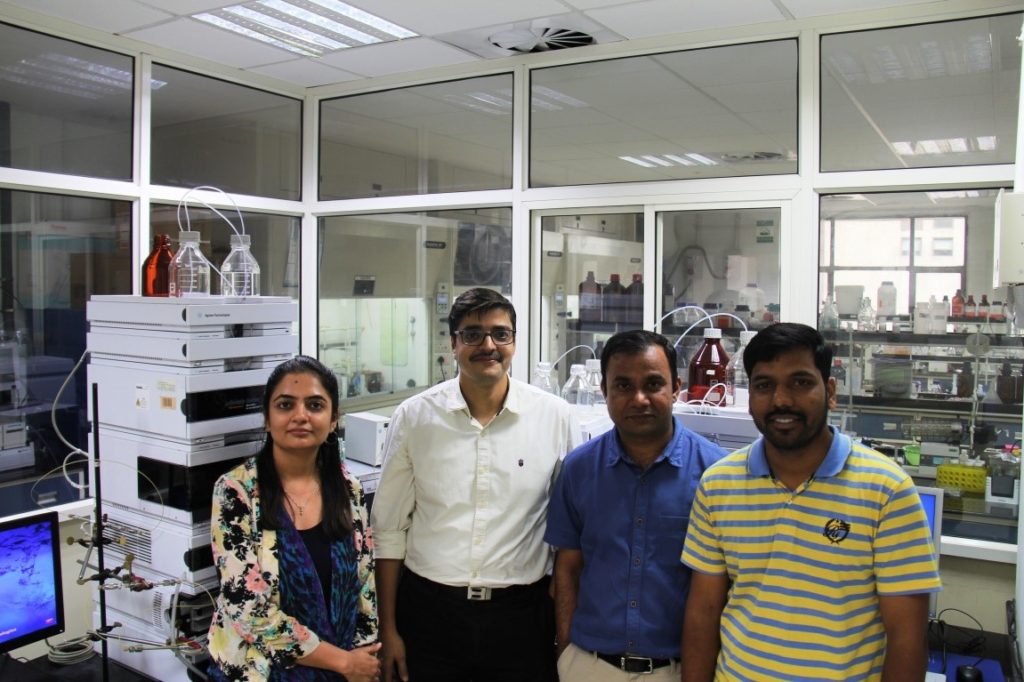
Drs. Neetu Kalra, Vishal Rai, Sanjeev Shukla, Maheshwer reddy Chilamari (Left to Right)

Drs. Neetu Kalra, Vishal Rai, Sanjeev Shukla, Maheshwer reddy Chilamari (Left to Right)

The researchers at IISER have now demonstrated that it was possible to synthesize an effective conjugate with lysine without much of a problem. The process makes use of 4-acetyl benzaldehyde, an electron-rich aromatic aldehyde, and triethyl phosphate, which is an organo-phosphorous compound used as a reagent.

“We had earlier demonstrated that it was possible to differentiate various copies of lysine for a level of reactivity and to selectively pick up the desired one, but we still could not develop a conjugate as we had used a metal-complex. Now the reaction is metal-free. A sequential formation of C-N bond and a C-P bond results in the labeling of lysine which is followed by installation of the drug,” explained Dr. Vishal Rai, leader of the team, while speaking to India Science Wire.

The team has developed conjugate of breast cancer drug, Trastuzumab, and anti-cancer drug Doxorubicin and tested its anti-proliferative effect on a HER2 over-expressing cancer cell line. After two days of treatment, the conjugate showed significant inhibition of SKBR3 breast cancer cell proliferation.

For evaluating selectivity of the conjugate, the researchers compared its anti-proliferative effect against a direct dose of Doxorubicin for effect on SKBR3 breast cancer cells and on the non-pathogenic HER2 negative MDA-MB-231 cells.

“The anti-proliferative activity towards breast cancer cells holds promise for further pre-clinical evaluation,” commented Dr. S. Chandrasekaran from Indian Institute of Science, Bangalore, who was not associated with this study. Dr.T. Govindaraju from Jawaharlal Nehru Centre for Advanced Scientific Research, Bangalore, said, “specific advantage of this bio-conjugation technique is that it is metal-free.”

The technology is being transferred for commercial use through the IISER Bhopal based startup, Plabeltech. The research team included M. Chilamari, Neetu Kalra, and Sanjeev Shukla besides Dr. Vishal Rai.

The results of the study, funded by the Science and Engineering Research Board (SERB), have been published in journal Chemical Communications. (India Science Wire)

By Ratneshwar Thakur

Journal Article

Single-site labeling of lysine in proteins through a metal-free multicomponent approach

If you liked this article, then please subscribe to our YouTube Channel for the latest Science and Tech news. You can also find us on Twitter and Facebook.

Rate

Drs. Neetu Kalra, Vishal Rai, Sanjeev Shukla, Maheshwer reddy Chilamari (Left to Right)

Drs. Neetu Kalra, Vishal Rai, Sanjeev Shukla, Maheshwer reddy Chilamari (Left to Right)

The researchers at IISER have now demonstrated that it was possible to synthesize an effective conjugate with lysine without much of a problem. The process makes use of 4-acetyl benzaldehyde, an electron-rich aromatic aldehyde, and triethyl phosphate, which is an organo-phosphorous compound used as a reagent.

“We had earlier demonstrated that it was possible to differentiate various copies of lysine for a level of reactivity and to selectively pick up the desired one, but we still could not develop a conjugate as we had used a metal-complex. Now the reaction is metal-free. A sequential formation of C-N bond and a C-P bond results in the labeling of lysine which is followed by installation of the drug,” explained Dr. Vishal Rai, leader of the team, while speaking to India Science Wire.

The team has developed conjugate of breast cancer drug, Trastuzumab, and anti-cancer drug Doxorubicin and tested its anti-proliferative effect on a HER2 over-expressing cancer cell line. After two days of treatment, the conjugate showed significant inhibition of SKBR3 breast cancer cell proliferation.

For evaluating selectivity of the conjugate, the researchers compared its anti-proliferative effect against a direct dose of Doxorubicin for effect on SKBR3 breast cancer cells and on the non-pathogenic HER2 negative MDA-MB-231 cells.

“The anti-proliferative activity towards breast cancer cells holds promise for further pre-clinical evaluation,” commented Dr. S. Chandrasekaran from Indian Institute of Science, Bangalore, who was not associated with this study. Dr.T. Govindaraju from Jawaharlal Nehru Centre for Advanced Scientific Research, Bangalore, said, “specific advantage of this bio-conjugation technique is that it is metal-free.”

The technology is being transferred for commercial use through the IISER Bhopal based startup, Plabeltech. The research team included M. Chilamari, Neetu Kalra, and Sanjeev Shukla besides Dr. Vishal Rai.

The results of the study, funded by the Science and Engineering Research Board (SERB), have been published in journal Chemical Communications. (India Science Wire)

By Ratneshwar Thakur

Journal Article

Single-site labeling of lysine in proteins through a metal-free multicomponent approach

If you liked this article, then please subscribe to our YouTube Channel for the latest Science and Tech news. You can also find us on Twitter and Facebook.
" }
New Study to Help Develop Salt-Tolerant Plants

New Study to Help Develop Salt-Tolerant Plants

Efforts to make use of mangrove plants to meet the increasing need for food production in the wake of a growing world population could get a major boost with a team of Indian researchers reporting a reference-grade genome of a highly salt-tolerant mangrove species called Avicennia marina. It grows optimally in 75% seawater and can tolerate even 250% seawater.

  • News
  • 2.1K
Read more

CircRNA – A Key to Unlocking Pluripotent Stem Cells for Regenerative Medicine or Other Innovative Medical Technologies

When cells in the human body become aged or injured, pluripotent stem cells may provide a means for repair. These cells can be induced to form a variety of different cell types and may be able to replace dysfunctional cells or regrow damaged tissues.

  • News
  • 3.5K
Read more
Computex 2019 - Get ready for Asia’s largest IoT show

Computex 2019 – Get ready for Asia’s largest IoT show

With a strong R&D and manufacturing capabilities and IPR protection, Taiwan is a strategic destination for foreign companies and investors looking for partners in global technology ecosystems. The 2019 Computex is scheduled to be held from 28th of March to 1st June in Taipei

Read more

Internet is huge! Help us find great content

Newsletter

Never miss a thing! Sign up for our newsletter to stay updated.

About

Research Stash is a curated collection of tools and News for S.T.E.M researchers

Have any questions or want to partner with us? Reach us at [email protected]

Navigation

Submit