
Europe-Origin Pathogen Poses Big Threat to Potato Crop in India

Europe-Origin Pathogen Poses Big Threat to Potato Crop in India

  • Research Stash
  • News
  • 2.8K

A rapidly evolving pathogen from Europe may spell doom for India’s potato yield, an essential staple crop that also fetches good income to millions of farmers.
800px-Phytophtora_infestans-effects

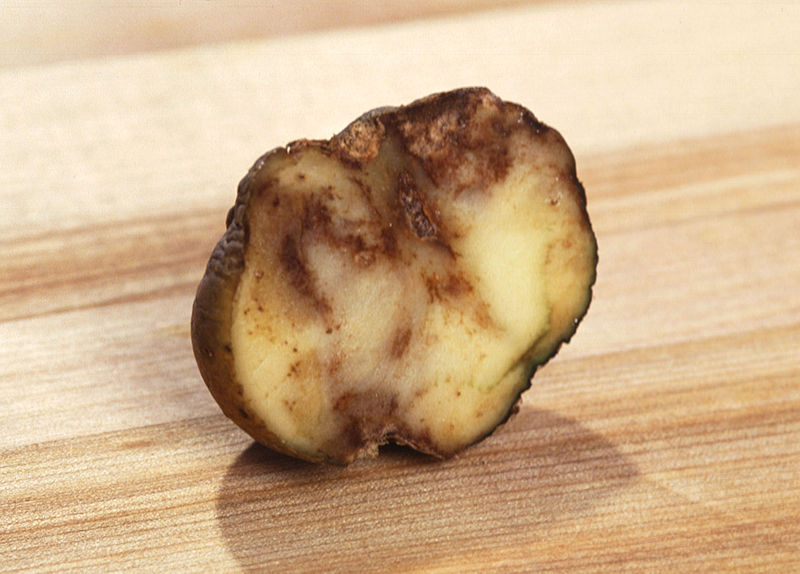
Scientists at the West Bengal State University have found 19 unique and highly aggressive variants of Phytophthora infestans, a microorganism that causes late blight disease in potato shrinking it from outside and rotting inside. These variants are from the lineage of European 13_A2 genotype and were responsible for the 2013-14 epidemic of late blight in West Bengal that shrank potato yield by 8,000 kg per hectare resulting in many indebted farmers ending their lives.
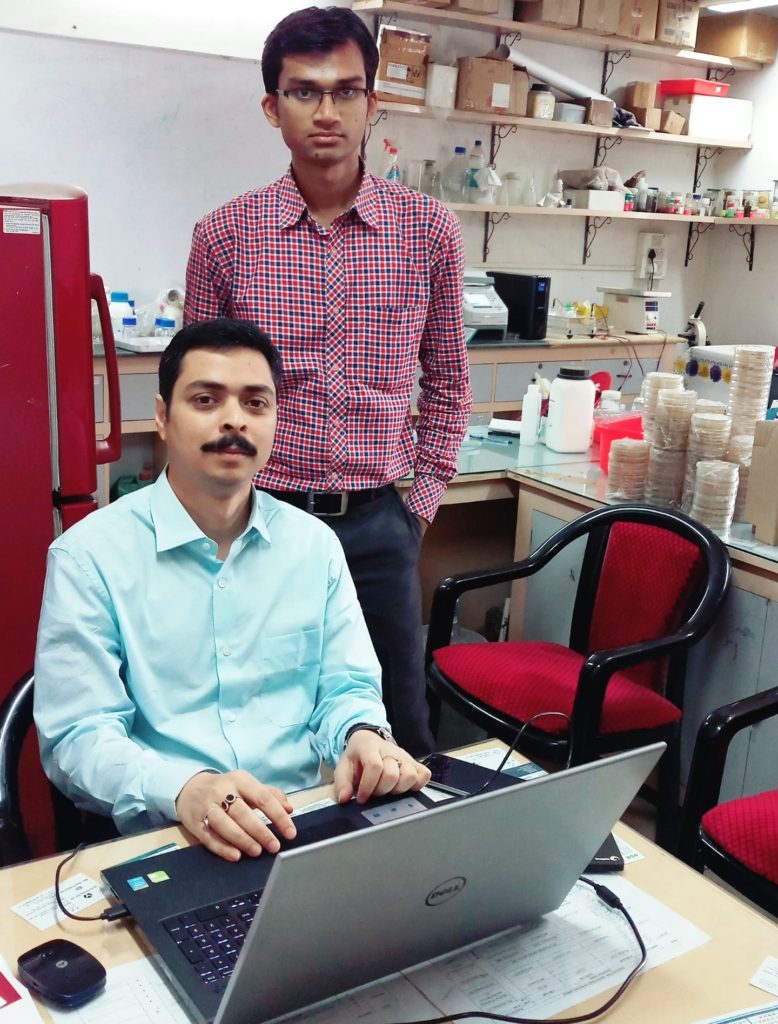
Dr Sanjoy Guha Roy (Sitting) and Tanmoy Dey in the research lab.

Dr Sanjoy Guha Roy (Sitting) and Tanmoy Dey in the research lab.

Pathogen population diversity, studied in eastern and northeastern India, was found to be highest in areas near international borders with Bangladesh and Nepal. Both these countries regularly import potatoes from outside.

Earlier, a 2012 study by the Bengaluru-based Indian Institute of Horticultural Research had found European 13_A2 pathogen imported with a consignment of potato from Europe and UK to be responsible for late blight outbreaks in parts of south India.

India produced over 43 million tonnes of potato in 2015-16 with West Bengal accounting for 19.41 percent of the produce. The crop is not only a mainstay of millions of farmers but also a staple across the country. Late blight can destroy a field of potato within 2-3 days and its most devastating impact is known as the Irish potato famine of the 1840s, which affected over 2 million people in Ireland.

The study suggests effective surveillance and detection measures in India because the newly-evolved pathogens are not only more aggressive but also evolving with every season. Most of the variants were found to be resistant to metalaxyl, a commonly used fungicide.

“There is a possibility that the pathogen traveled from south to east India while similar pathogens from Bangladesh and Nepal also made their way into the region. They all adapted to local conditions and evolved into 19 unique and stronger variants,” Dr. Sanjoy Guha Roy of the botany department at West Bengal State University, who was part of the research team, told India Science Wire.

The study also shows that there are regional variations in the pathogen and hence there can’t be a uniform control measure across India. The research team is now screening the variants for seven different fungicides and plans to build a database of all the variants and their characteristics including response to currently used fungicides.

“The database will help identify the variant infecting any field and ensure a quick and appropriate response. We also need to update the database regularly to match the speed at which the pathogen is evolving to avoid massive crop loss,” said Dr. Roy.

P. infestans, the organism that causes late blight, has the largest genome among its category of pathogens. Expanding to the size of 240 Mb, the genome mostly consists of repetitive DNA that aids in adaptation and thus makes the pathogen difficult to control.

“The new study builds upon previous research on European 13_A2 in India and also maps its variants to regions. It’s essential to constantly monitor the pathogen for effective control of late blight,” commented Dr. P. Chowdappa, Director of Central Plantation Crops Research Institute, who was part of the research team that studied late blight in south India.

Stronger phytosanitary measures to screen the seeds imported from other countries for any pathogen, and safety measures to prevent transmission of late blight from across the borders can help curb the disease, the study said.

“We need to collaborate with other countries through knowledge sharing platforms like Asia Blight and Euro Blight, to monitor spread and control of this widespread disease,” said Dr. Roy.

Besides Dr. Roy, the research team included Tanmoy Dey, Amanda Saville, Kevin Myers, Susanta Tewari, David E. L. Cooke, Sucheta Tripathy, William E. Fry, and Jean B. Ristaino. The study has been published in the journal Scientific Reports. (India Science Wire)

By Manu Moudgil

Journal Article

Large sub-clonal variation in Phytophthora infestans from recent severe late blight epidemics in India

For the latest Science, Tech news and conversations, follow Research Stash on TwitterFacebook, and subscribe to our YouTube channel 

Rate

Dr Sanjoy Guha Roy (Sitting) and Tanmoy Dey in the research lab.

Dr Sanjoy Guha Roy (Sitting) and Tanmoy Dey in the research lab.

Pathogen population diversity, studied in eastern and northeastern India, was found to be highest in areas near international borders with Bangladesh and Nepal. Both these countries regularly import potatoes from outside.

Earlier, a 2012 study by the Bengaluru-based Indian Institute of Horticultural Research had found European 13_A2 pathogen imported with a consignment of potato from Europe and UK to be responsible for late blight outbreaks in parts of south India.

India produced over 43 million tonnes of potato in 2015-16 with West Bengal accounting for 19.41 percent of the produce. The crop is not only a mainstay of millions of farmers but also a staple across the country. Late blight can destroy a field of potato within 2-3 days and its most devastating impact is known as the Irish potato famine of the 1840s, which affected over 2 million people in Ireland.

The study suggests effective surveillance and detection measures in India because the newly-evolved pathogens are not only more aggressive but also evolving with every season. Most of the variants were found to be resistant to metalaxyl, a commonly used fungicide.

“There is a possibility that the pathogen traveled from south to east India while similar pathogens from Bangladesh and Nepal also made their way into the region. They all adapted to local conditions and evolved into 19 unique and stronger variants,” Dr. Sanjoy Guha Roy of the botany department at West Bengal State University, who was part of the research team, told India Science Wire.

The study also shows that there are regional variations in the pathogen and hence there can’t be a uniform control measure across India. The research team is now screening the variants for seven different fungicides and plans to build a database of all the variants and their characteristics including response to currently used fungicides.

“The database will help identify the variant infecting any field and ensure a quick and appropriate response. We also need to update the database regularly to match the speed at which the pathogen is evolving to avoid massive crop loss,” said Dr. Roy.

P. infestans, the organism that causes late blight, has the largest genome among its category of pathogens. Expanding to the size of 240 Mb, the genome mostly consists of repetitive DNA that aids in adaptation and thus makes the pathogen difficult to control.

“The new study builds upon previous research on European 13_A2 in India and also maps its variants to regions. It’s essential to constantly monitor the pathogen for effective control of late blight,” commented Dr. P. Chowdappa, Director of Central Plantation Crops Research Institute, who was part of the research team that studied late blight in south India.

Stronger phytosanitary measures to screen the seeds imported from other countries for any pathogen, and safety measures to prevent transmission of late blight from across the borders can help curb the disease, the study said.

“We need to collaborate with other countries through knowledge sharing platforms like Asia Blight and Euro Blight, to monitor spread and control of this widespread disease,” said Dr. Roy.

Besides Dr. Roy, the research team included Tanmoy Dey, Amanda Saville, Kevin Myers, Susanta Tewari, David E. L. Cooke, Sucheta Tripathy, William E. Fry, and Jean B. Ristaino. The study has been published in the journal Scientific Reports. (India Science Wire)

By Manu Moudgil

Journal Article

Large sub-clonal variation in Phytophthora infestans from recent severe late blight epidemics in India

For the latest Science, Tech news and conversations, follow Research Stash on TwitterFacebook, and subscribe to our YouTube channel 
" }
Scientific Departments to Get a New Home

Scientific Departments to Get a New Home

It is not enough that scientists and technologists keep gaining new knowledge and developing new products useful to society. They should also have a workplace befitting their work profile.

  • News
  • 2K
Read more
Soaking Seeds in Selenium Reduces Arsenic Content in Rice

Soaking Seeds in Selenium Reduces Arsenic Content in Rice

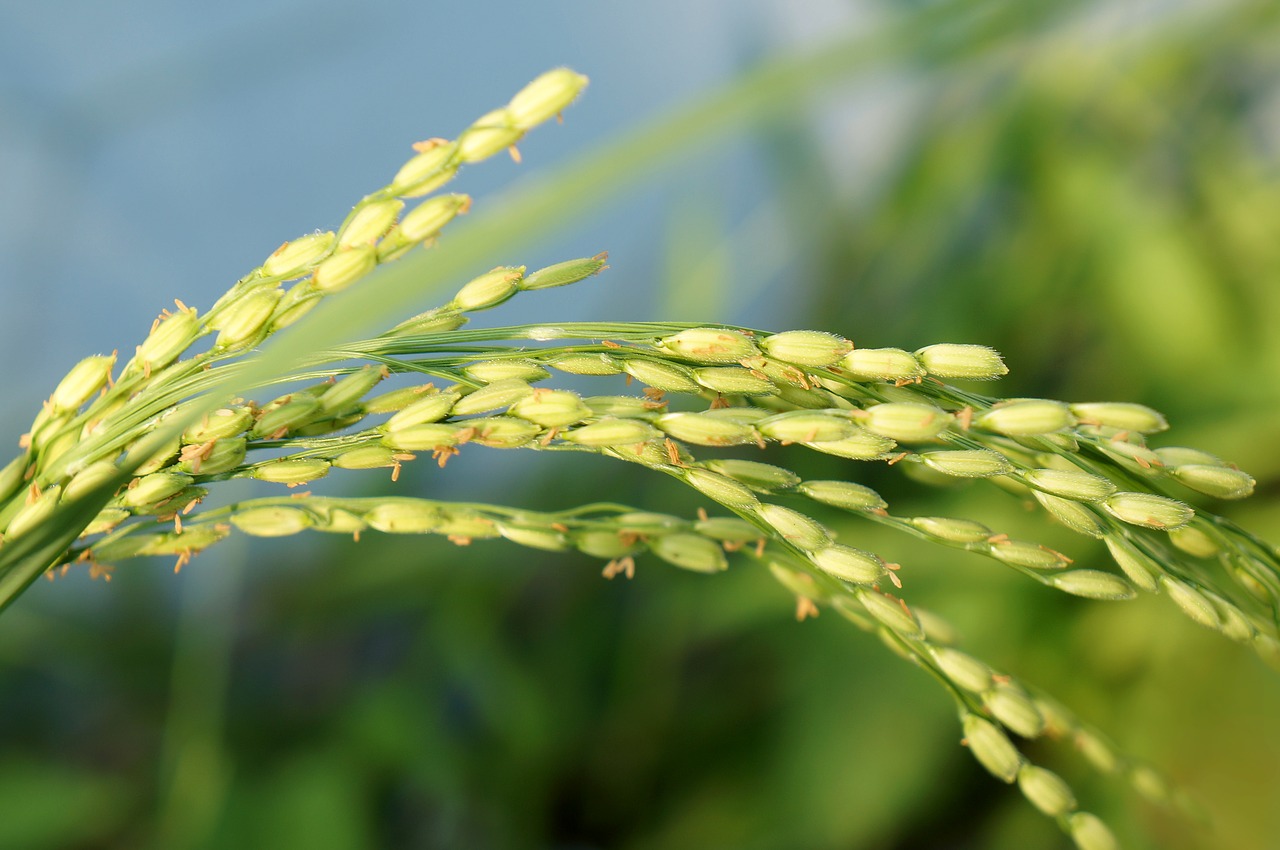
The presence of arsenic traces in rice is a major problem in several parts of the country. Now scientists have found that soaking rice seeds in selenium can mitigate adverse effects on rice plants grown in arsenic-contaminated soils and can arsenic accumulation in rice grains.

  • News
  • 3.1K
Read more

Taiwan’s National Health Insurance Reduces Suicide Risk among Newly Diagnosed Cancer Patients

The launch of National Health Insurance (NHI) in Taiwan in 1995 has led to an average of 20% reduction of the relative magnitude of suicide mortality in newly diagnosed cancer patients versus the general population, according to a new study by researchers at National Taiwan University (NTU). This study has been published online on 2 March 2017 in Psycho-Oncology.

  • News
  • 2.2K
Read more

Internet is huge! Help us find great content

Newsletter

Never miss a thing! Sign up for our newsletter to stay updated.

About

Research Stash is a curated collection of tools and News for S.T.E.M researchers

Have any questions or want to partner with us? Reach us at [email protected]

Navigation

Submit