
Scientific Departments to Get a New Home

Scientific Departments to Get a New Home

  • Research Stash
  • News
  • 1.9K

It is not enough that scientists and technologists keep gaining new knowledge and developing new products useful to society. They should also have a workplace befitting their work profile.

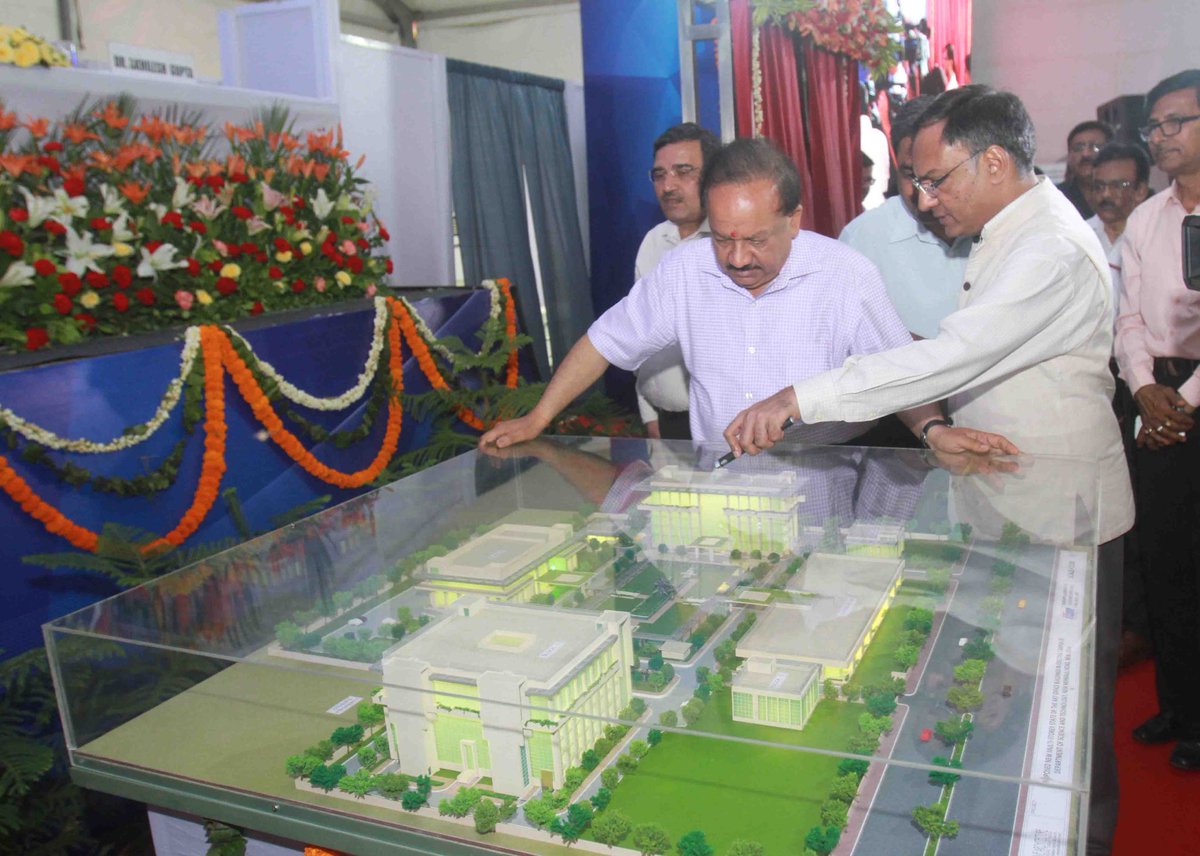
Keeping this in mind, the Ministry of Science and Technology has set out to construct a modern building complex for two of its wings – Department of Science and Technology (DST) and Department of Scientific and Industrial Research (DSIR) – as well as autonomous institutions under them. The new building complex will come up at Qutab Institutional Area here at a cost of Rs. 192 crore.
Scientific Departments to Get a New Home

The highlight of the new complex would be that it would be environment-friendly. It would have a 110-kilo liter per day sewerage treatment plant and treated water would be used for horticulture works. In addition, light fixtures would be LED-based for the external area and for building façade. There would be a 300 kwp capacity grid interactive solar power generation system and rainwater harvesting pits would be set up in different parts of the campus to help recharge groundwater.

The campus would also have a large green landscaped central courtyard with sculptured works of arts at the center and sit-out areas. The campus would be barrier-free to ensure easy movement for the differently abled persons.

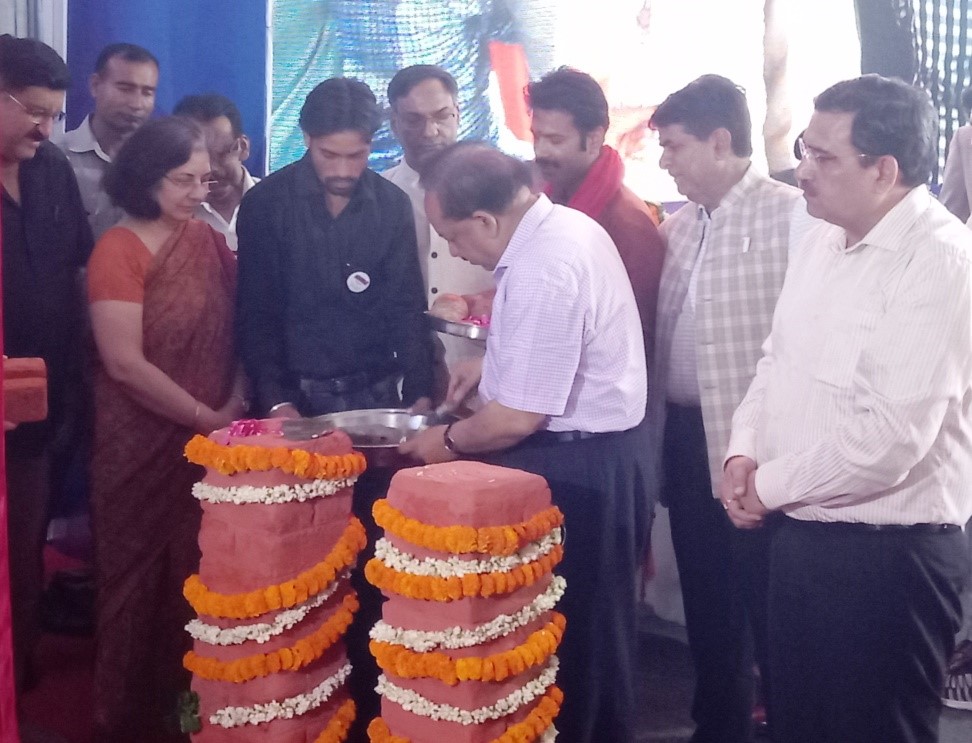
Minister for Science and Technology Dr. Harsh Vardhan, while laying the foundation stone for the new campus, expressed confidence that it would turn out to be an iconic building, reflecting the role being played by Indian science and technology in the socio-economic development of the country.

DST Secretary Dr. Ashutosh Sharma said the campus would be built on a plot of about nearly nine acres, with a ground coverage of 22 percent and a green cover of 52 percent. The complex will have a total office space measuring 16,500 sq.m.

Among other things, the campus would feature an auditorium with a capacity for 500 and a bank and a post office. The parking lot would be able to accommodate about 640 vehicles on surface and basement.

The campus will come up in two phases. In the first phase, two blocks would be constructed with five floors each. One block would house offices of DST and DSIR and other block offices of Science and Engineering Research Board, Vigyan Prasar, Technology Information, Forecasting, and Assessment Council (TIFAC), and Technology Development Board. In the second phase, the auditorium and other facilities would be constructed. The project will be implemented by Ircon Infra and Services. (India Science Wire)

By Sunderarajan Padmanabhan

For the latest Science, Tech news and conversations, follow Research Stash on TwitterFacebook, and subscribe to our YouTube channel 

Rate

The highlight of the new complex would be that it would be environment-friendly. It would have a 110-kilo liter per day sewerage treatment plant and treated water would be used for horticulture works. In addition, light fixtures would be LED-based for the external area and for building façade. There would be a 300 kwp capacity grid interactive solar power generation system and rainwater harvesting pits would be set up in different parts of the campus to help recharge groundwater.

Laid the foundation stone for a new state-of-the-art building for @IndiaDST. The building will be completed by May 2021. It will be a green building & #IRCON is the construction agency. The new bldg. will accommodate #DST & #DSIR & some autonomous bodies located in Delhi. pic.twitter.com/NpJEJMNwAv

— Dr Harsh Vardhan (Modi Ka Pariwar) (@drharshvardhan) May 3, 2018

The campus would also have a large green landscaped central courtyard with sculptured works of arts at the center and sit-out areas. The campus would be barrier-free to ensure easy movement for the differently abled persons.

Minister for Science and Technology Dr. Harsh Vardhan, while laying the foundation stone for the new campus, expressed confidence that it would turn out to be an iconic building, reflecting the role being played by Indian science and technology in the socio-economic development of the country.

DST Secretary Dr. Ashutosh Sharma said the campus would be built on a plot of about nearly nine acres, with a ground coverage of 22 percent and a green cover of 52 percent. The complex will have a total office space measuring 16,500 sq.m.

Among other things, the campus would feature an auditorium with a capacity for 500 and a bank and a post office. The parking lot would be able to accommodate about 640 vehicles on surface and basement.

The campus will come up in two phases. In the first phase, two blocks would be constructed with five floors each. One block would house offices of DST and DSIR and other block offices of Science and Engineering Research Board, Vigyan Prasar, Technology Information, Forecasting, and Assessment Council (TIFAC), and Technology Development Board. In the second phase, the auditorium and other facilities would be constructed. The project will be implemented by Ircon Infra and Services. (India Science Wire)

By Sunderarajan Padmanabhan

For the latest Science, Tech news and conversations, follow Research Stash on TwitterFacebook, and subscribe to our YouTube channel 
" }
The 36th annual conference of astronomical society of India to begin in 6th Feb.

A Four-Day Meet on Astronomy Begins At Hyderabad on February 6

About 400 astronomers are gathering at Hyderabad for a stimulating four-day discussion on a range of topics in astronomy being organized by the Astronomical Society of India beginning tomorrow, Tuesday, February 6 at Osmania University in the southern metropolitan city.

  • News
  • 2.2K
Read more
This Is How Nutrition May Help Overcome Genetic Risk of Diabetes

This Is How Nutrition May Help Overcome Genetic Risk of Diabetes

For years, scientists have been engaged in finding human genes associated with lifestyle diseases like diabetes and heart disease to know if certain population groups are prone to these disorders.

  • News
  • 2.2K
Read more
How Dust Storms Are Adding to Pollution Woes of North India

How Dust Storms Are Adding to Pollution Woes of North India

During May 2018, the national capital region and parts of North India were lashed by three strong dust storms in quick succession. In addition to widespread damage they caused to property and human life, these storms affected changes in air quality and atmospheric chemistry which may be harmful to human health, a new study has reported.

  • News
  • 2.1K
Read more

Internet is huge! Help us find great content

Newsletter

Never miss a thing! Sign up for our newsletter to stay updated.

About

Research Stash is a curated collection of tools and News for S.T.E.M researchers

Have any questions or want to partner with us? Reach us at hello@researchstash.com

Navigation

Submit