
Scientists find Link Between Oxidative Stress And Neurological Disorders

Scientists find Link Between Oxidative Stress And Neurological Disorders

  • Research Stash
  • News
  • 2.3K

Indian scientists have found a new function of a gene which is already known to play a role in neurological disorders.
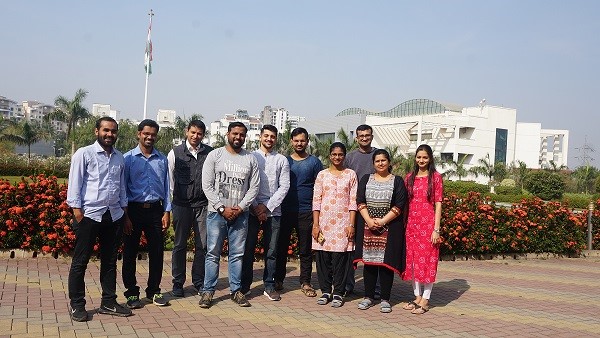
Ajay Kumar Sharma, Ravikumar Govindan, Harinath Chakrapani, Amol Mhetre, Neelay Mehendale, Shubham Singh, Abinaya Rajendran, Siddhesh Kamat, Dhanashree Kelkar, Alaumy Joshi.

Scientists at the Indian Institute of Science Education and Research (IISER) Pune have found that the gene, ABHD12, is involved in mitigating oxidative stress-induced cell death in brain cells by breaking down the oxidized state of a lipid, phosphatidylserine, found in the cell membrane.

Given the known function of this gene in neurological disorders, the new finding indicates plausible connections between oxidative stress and neurological disorders, according to results published in journal Nature Chemical Biology.

A cell has a finite lifetime and it is driven to death when there is an overproduction of reactive oxygen species (ROS) leading to oxidative stress. ROS is a byproduct of the functioning of mitochondria – a powerhouse of the cell. ROS damages lipid membranes or boundary of the cell, DNA as well as proteins of the cell.

Earlier studies have shown that phosphatidylserine, a class of lipids found in the cell membrane, when oxidized by ROS, flip their direction from inner of the cell to the outside which triggers cell death.

IISER study has revealed that ABHD12, a gene encoding serine hydrolase lipase, can breakdown the oxidized form of lipid phosphatidylserine, preventing the cell from death.

“Mutation in ABHD12 results in a human neurological disorder called PHARC (an acronym for polyneuropathy, hearing loss, ataxia, retinitis pigmentosa and cataract). Our findings will enable the study of PHARC, the progression of disease pathology and possibly develop new therapeutic interventions towards the treatment of this early onset disorder,” said Dr. Siddhesh Kamat, leader of the research team, while talking to India Science Wire.

For this study, scientists first synthesized a chemical moiety which could release ROS in cultured mammalian cells, thus mimicking oxidative stress environment in the cell. After administering this ROS stress, scientists measured oxidized PS levels.

To get lipase enzyme that metabolizes the oxidized PS, scientists used various lipase inhibitors and found that three inhibitors whose application increases the oxidized PS in the cell. Proteome analysis helped researchers conclude that a lipase encoded by the gene ABHD12 mitigates cell death by breaking down oxidized PS.

The research team led by Dr. Siddhesh Kamat included Dhanashree S. Kelkar, Neelay Mehendale, Shubham Singh and Alaumy Joshi , Amol Mhetre, Abinaya Rajendran, Govindan Ravikumar, Ajay Kumar Sharma and Harinath Chakrapani. (India Science Wire)

By Dr. Aditi Jain

Journal Article

A chemical-genetic screen identifies ABHD12 as an oxidized-phosphatidylserine lipase.

If you liked this article, then please subscribe to our YouTube Channel for the latest Science & Tech news. You can also find us on Twitter & Facebook.
A cell has a finite lifetime and it is driven to death when there is an overproduction of reactive oxygen species (ROS) leading to oxidative stress. ROS is a byproduct of the functioning of mitochondria – a powerhouse of the cell. ROS damages lipid membranes or boundary of the cell, DNA as well as proteins of the cell.

Earlier studies have shown that phosphatidylserine, a class of lipids found in the cell membrane, when oxidized by ROS, flip their direction from inner of the cell to the outside which triggers cell death.

IISER study has revealed that ABHD12, a gene encoding serine hydrolase lipase, can breakdown the oxidized form of lipid phosphatidylserine, preventing the cell from death.

“Mutation in ABHD12 results in a human neurological disorder called PHARC (an acronym for polyneuropathy, hearing loss, ataxia, retinitis pigmentosa and cataract). Our findings will enable the study of PHARC, the progression of disease pathology and possibly develop new therapeutic interventions towards the treatment of this early onset disorder,” said Dr. Siddhesh Kamat, leader of the research team, while talking to India Science Wire.

For this study, scientists first synthesized a chemical moiety which could release ROS in cultured mammalian cells, thus mimicking oxidative stress environment in the cell. After administering this ROS stress, scientists measured oxidized PS levels.

To get lipase enzyme that metabolizes the oxidized PS, scientists used various lipase inhibitors and found that three inhibitors whose application increases the oxidized PS in the cell. Proteome analysis helped researchers conclude that a lipase encoded by the gene ABHD12 mitigates cell death by breaking down oxidized PS.

The research team led by Dr. Siddhesh Kamat included Dhanashree S. Kelkar, Neelay Mehendale, Shubham Singh and Alaumy Joshi , Amol Mhetre, Abinaya Rajendran, Govindan Ravikumar, Ajay Kumar Sharma and Harinath Chakrapani. (India Science Wire)

By Dr. Aditi Jain

Journal Article

A chemical-genetic screen identifies ABHD12 as an oxidized-phosphatidylserine lipase.

If you liked this article, then please subscribe to our YouTube Channel for the latest Science & Tech news. You can also find us on Twitter & Facebook.

" }
New Analysis Says Puga Has Highest Geothermal Potential

New Analysis Says Puga Has Highest Geothermal Potential

A team of researchers from Birla Institute of Technology and Science, Pilani have used nine parameters to analyse data relating to Puga in Ladakh, Chhumathang in Jammu and Kashmir, Manikaran in Himachal Pradesh, Tattapani in Chhattisgarh, Unhavre Khed in Maharashtra and Tapoban in Uttarakhand. Based on this analysis, they have concluded that Puga has the most potential.

  • News
  • 4K
Read more
This Silk Protein Can Help Make Beauty and Skincare Products

This Silk Protein Can Help Make Beauty and Skincare Products

Scientists have discovered that a protein produced by silkworms can be used to develop a range of beauty and skincare products

  • News
  • 2.1K
Read more

New functions of hippocampus unveiled to bring insights to causes and treatments of brain diseases

A research team led by Lam Woo Professor of Biomedical Engineering Ed X. Wu of the Department of Electrical and Electronic Engineering at the University of Hong Kong has made a major breakthrough in unveiling the mysteries of the brain

  • News
  • 2K
Read more

Internet is huge! Help us find great content

Newsletter

Never miss a thing! Sign up for our newsletter to stay updated.

About

Research Stash is a curated collection of tools and News for S.T.E.M researchers

Have any questions or want to partner with us? Reach us at [email protected]

Navigation

Submit