
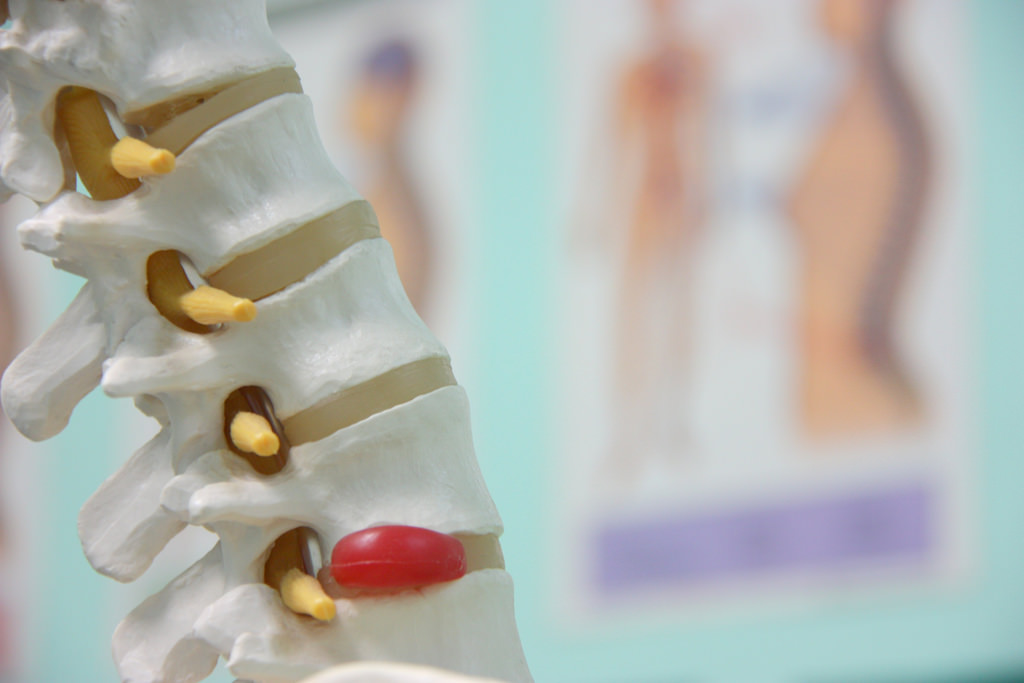
Scientists Use Silk Polymer to Develop Artificial Vertebral Disc

  • Research Stash
  • News
  • 2.1K

Degenerative disc disease is a major cause of low back pain affecting the mobility of people. A group of Indian scientists have developed a silk-based bioartificial disc that may find use in disc replacement therapy in future.

At present, therapeutic treatment for degenerative disc disease can only provide symptomatic relief of pain without restoring the functions of discs, while disc replacement surgery is very costly.

The use of a silk biopolymer to fabricate a biocompatible disc can reduce the cost of artificial discs in future, claim researchers from the Department of Biomaterial and Tissue Engineering at Indian Institute of Technology, Guwahati, who have developed the new technology.
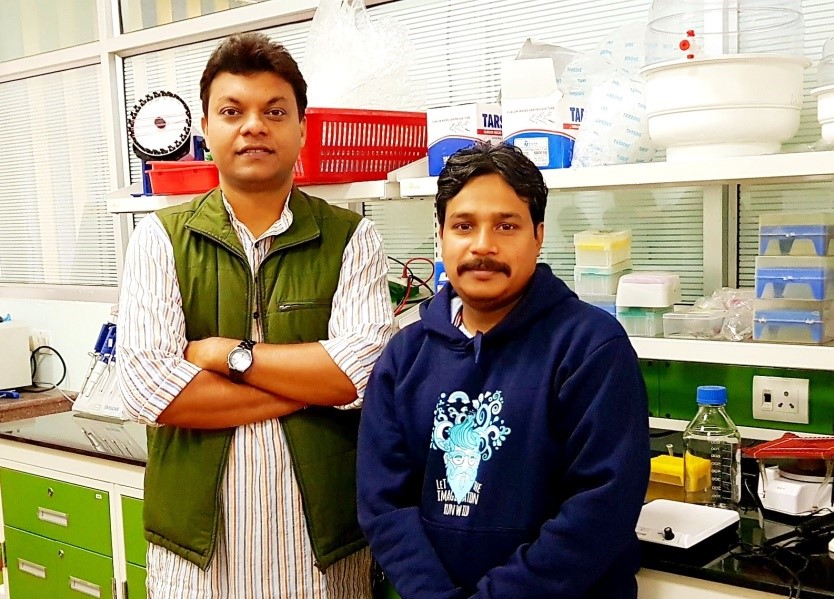
Dr. Biman B. Mandal and Bibhas K. Bhunia.

The group has developed a fabrication procedure for a silk-based bioartificial disc adopting a “directional freezing technique”. The disc mimics internal intricacy of the human disc and its mechanical properties too are similar to those of the native ones, according to research results published in international scientific journal Proceedings of the National Academy of Sciences (PNAS).

The fabricated discs supported primary annulus fibrosus or human mesenchymal stem cell proliferation, differentiation, and matrix deposition of a sufficient amount. The annulus fibrosus is a specialized tissue having a complex, multilamellar, hierarchical structure consisting of collagen, proteoglycans and elastic fibers.

“Major challenges toward successful intervertebral disc tissue engineering remain elusive, mainly because of tremendous complexity of annulus fibrosus tissues. We have successfully recapitulated its internal intricacy – angle-ply construct, which is critical for the proper biomechanical functioning of the disc,” Dr. Biman B. Mandal, who led the research team, told India Science Wire.

Degenerative disc disease affects intervertebral discs, which are soft pillow-like cushions between interlocking bones that structure human spine. These discs act as shock absorbers for the spine and support weight and complex motions of the spine.

With growing age, these discs change from a flexible state that allows the smooth fluid motion of a stiff and rigid state restricting movement and resulting in discomfort or pain. “Our construct mimics native structure-function attributes of the disc and provides sufficient mechanical strength to function in load-bearing activities,” explained Bibhas K. Bhunia, co-author of the study.

The new disc has been tested in laboratory mice and scientists observed the negligible immune response. “We believe if the silk-based bio-discs transcends clinical translation, it can be an affordable option for disc replacement therapy in future,” said Dr. Mandal.

The research team included Bibhas K. Bhunia, Biman B. Mandala (IIT Guwahati) and David L. Kaplan (Tufts University, Medford). This work was supported by grants from the Department of Science and Technology (DST) and the Department of Biotechnology (DBT).  (India Science Wire)

By Ratneshwar Thakur

Journal Article

Silk-based multilayered angle-ply annulus fibrosus construct to recapitulate form and function of the intervertebral disc

For the latest Science and Tech news and conversations, follow Research Stash on TwitterFacebook, and subscribe to our YouTube channel 

Rate

Dr. Biman B. Mandal and Bibhas K. Bhunia.

The group has developed a fabrication procedure for a silk-based bioartificial disc adopting a “directional freezing technique”. The disc mimics internal intricacy of the human disc and its mechanical properties too are similar to those of the native ones, according to research results published in international scientific journal Proceedings of the National Academy of Sciences (PNAS).

The fabricated discs supported primary annulus fibrosus or human mesenchymal stem cell proliferation, differentiation, and matrix deposition of a sufficient amount. The annulus fibrosus is a specialized tissue having a complex, multilamellar, hierarchical structure consisting of collagen, proteoglycans and elastic fibers.

“Major challenges toward successful intervertebral disc tissue engineering remain elusive, mainly because of tremendous complexity of annulus fibrosus tissues. We have successfully recapitulated its internal intricacy – angle-ply construct, which is critical for the proper biomechanical functioning of the disc,” Dr. Biman B. Mandal, who led the research team, told India Science Wire.

Degenerative disc disease affects intervertebral discs, which are soft pillow-like cushions between interlocking bones that structure human spine. These discs act as shock absorbers for the spine and support weight and complex motions of the spine.

With growing age, these discs change from a flexible state that allows the smooth fluid motion of a stiff and rigid state restricting movement and resulting in discomfort or pain. “Our construct mimics native structure-function attributes of the disc and provides sufficient mechanical strength to function in load-bearing activities,” explained Bibhas K. Bhunia, co-author of the study.

The new disc has been tested in laboratory mice and scientists observed the negligible immune response. “We believe if the silk-based bio-discs transcends clinical translation, it can be an affordable option for disc replacement therapy in future,” said Dr. Mandal.

The research team included Bibhas K. Bhunia, Biman B. Mandala (IIT Guwahati) and David L. Kaplan (Tufts University, Medford). This work was supported by grants from the Department of Science and Technology (DST) and the Department of Biotechnology (DBT).  (India Science Wire)

By Ratneshwar Thakur

Journal Article

Silk-based multilayered angle-ply annulus fibrosus construct to recapitulate form and function of the intervertebral disc

For the latest Science and Tech news and conversations, follow Research Stash on TwitterFacebook, and subscribe to our YouTube channel 
" }
A New Paradigm for Better Drug Discovery Targeting GPCRs

A New Paradigm for Better Drug Discovery Targeting GPCRs

Researchers from the Indian Institute of Technology-Kanpur have found structural differences between beta-arrestin Isoforms 1 and 2 upon their interaction with receptors. Beta-arrestin is a cellular protein that acts as a universal regulator of GPCRs, and this finding may help in designing novel therapeutic targets.

  • News
  • 1.7K
Read more
Cancer Cells Manipulate Immune System for Their Survival

Cancer Cells Manipulate Immune System for Their Survival

Researchers have found that tumor cells in the body manipulate the immune system for their survival and tumor growth expansion

  • News
  • 3.1K
Read more

Science publishes Super Steel breakthrough developed by HKU-led Beijing-HK-Taiwan team at low cost

Automotive, aerospace and defense applications require metallic materials with ultra-high strength. However, in some particular high-loading structural applications, metallic materials shall also have large ductility and high toughness to facilitate the precise forming of structural components and to avoid the catastrophic failure of components during service.

  • News
  • 2.1K
Read more

Internet is huge! Help us find great content

Newsletter

Never miss a thing! Sign up for our newsletter to stay updated.

About

Research Stash is a curated collection of tools and News for S.T.E.M researchers

Have any questions or want to partner with us? Reach us at hello@researchstash.com

Navigation

Submit