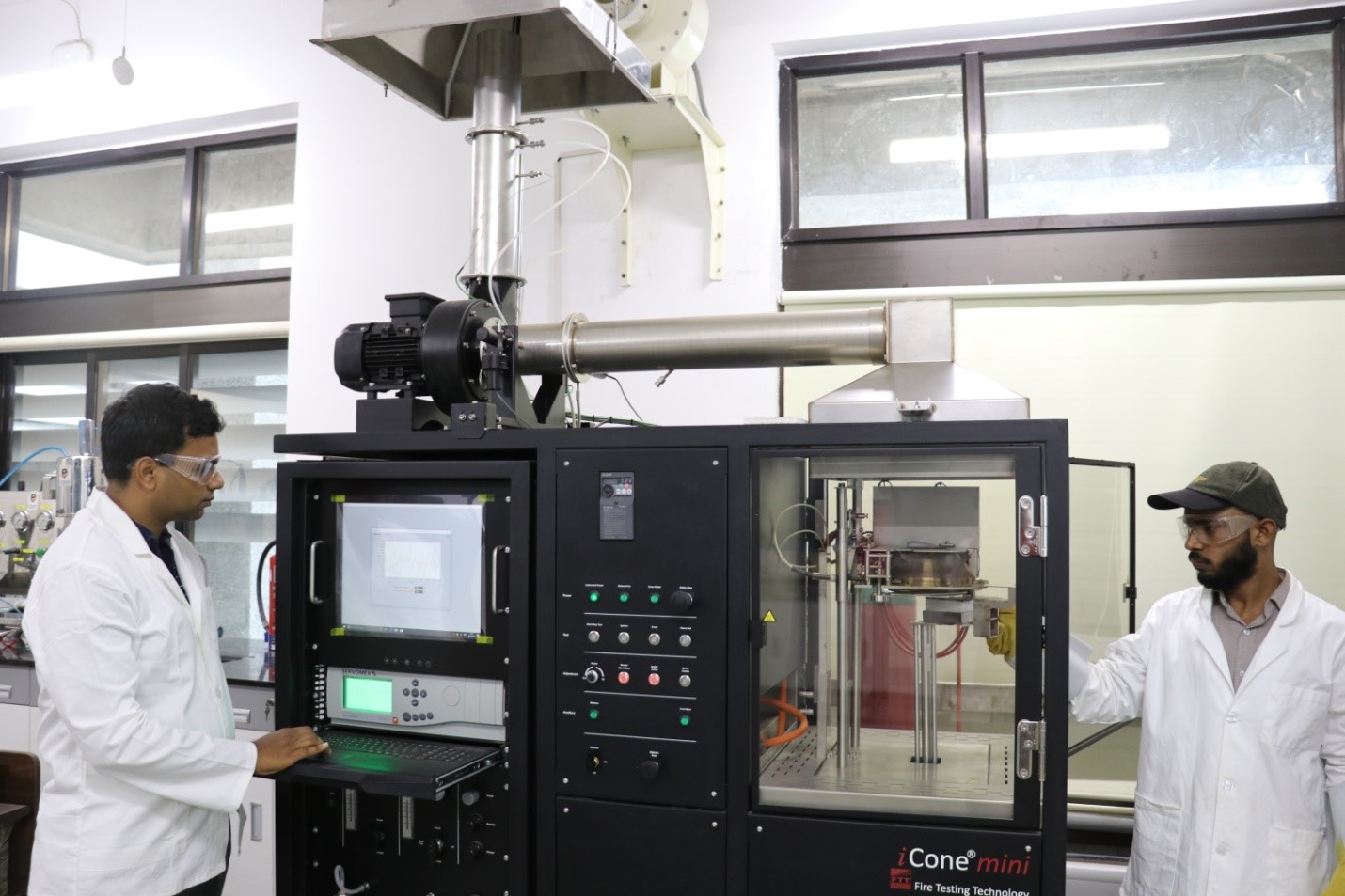
Dr. Gaurav Srivastava and Nasar Ahmad Khan in their laboratory with a Cone Calorimeter, which is used to measure combustion properties of materials

Fire Load of Buildings on the Rise According To a New Study

  • Research Stash
  • News
  • 2.8K

A new study by researchers at the Indian Institute of Technology, Gandhinagar, has warned that the fire load in modern day buildings in India is three times greater than what was even as late as the 1990s.

In the last few decades, lifestyles have changed significantly due to changes in socio-economic and cultural factors, resulting in newer office and residential cultures and luxuries. Modern-day buildings sport corrugated plastic roofs, partition walls, plastic doors, false ceiling panels, interior finish material, and have equipment like washing machines, refrigerators, air-conditioners, televisions, mobile electronic gadgets and computer hardware.

These new amenities have, no doubt, made life easier. However, they also pose higher fire risk since many of them are made of a material that has higher calorific values and thus more inflammable. For instance, paperwork has given way to digital records in offices and homes. This has meant that less cellulose and more plastic, which has higher calorific value, is being and stored and used. Though agencies involved in fire safety are aware of this, there is not much data available.
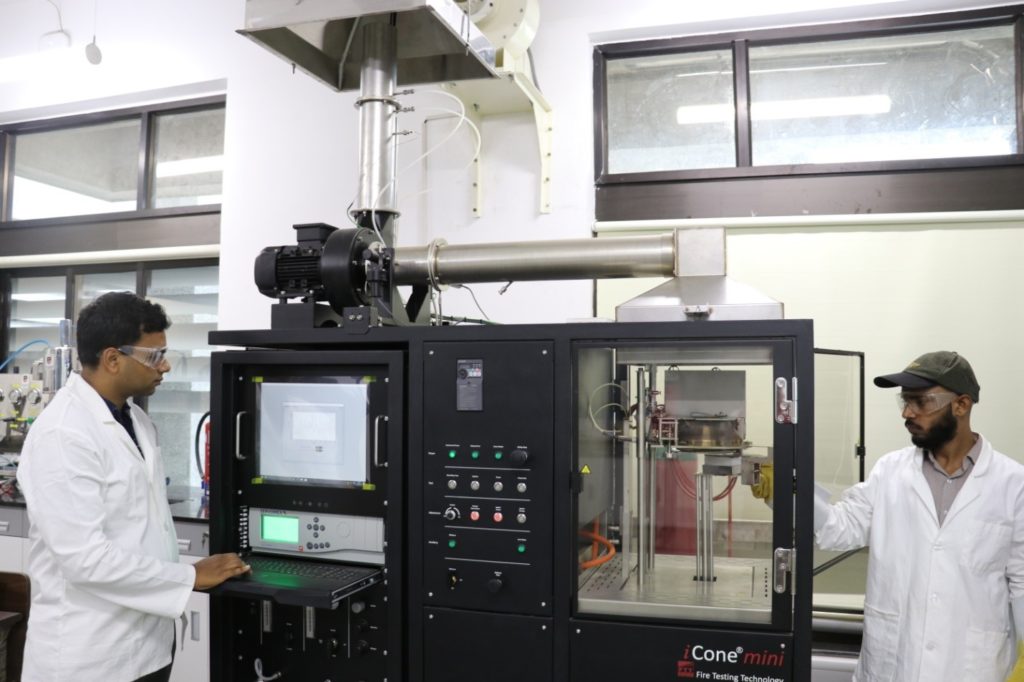
Dr. Gaurav Srivastava and Nasar Ahmad Khan in their laboratory with a Cone Calorimeter, which is used to measure combustion properties of materials

Dr. Gaurav Srivastava and Nasar Ahmad Khan in their laboratory with a Cone Calorimeter, which is used to measure combustion properties of materials

The researchers conducted a detailed survey covering a total of 105 office rooms and 202 students’ dormitory units in Ahmedabad. They found that average fire load energy density (FLED), which characterizes fire loads of these units, was found to be around 1400 Mega Joules per square meter, which is about three times the average of 487 MJ/ sq. m found during a study done conducted just 20 years ago in Kanpur. The maximum expected temperatures in the first one hour were also much higher than in the previous study.

Gaurav Srivastava, Assistant Professor at the Department of Civil Engineering at IIT-Gandhinagar, who conducted the study along with research scholar Nasar Ahmad Khan, said there was a need for thorough review of certain aspects of the Indian standards for fire safety, which are presently based on data obtained in the 1970s and 1980s.

“Safety of buildings depends on ensuring that the temperatures of their structural components remained below critical levels. The components are given fire ratings as per the expected critical temperature levels. We have found that the level of severity of fires as also maximum temperatures in the first hour has gone up substantially. That’s why there is perhaps a need to relook at fire rating in the standards,” Srivastava explained while speaking to India Science Wire.

The researchers found that cellulosic materials (wood and paper) accounted for the maximum proportion among all the combustibles at 54-69 %, followed by plastics (18-22%), textiles (7-8 %) and leather (4-6 %) for office rooms; and textiles (26-35%), plastics (6-8%) and leather (2-3%) for dormitories.

In the earlier study, cellulose material was almost the only combustible material in office and residential buildings at 98.6 percent. The study has been published in journal Current Science. (India Science Wire)

By Sunderarajan Padmanabhan

If you liked this article, then please subscribe to our YouTube Channel for the latest Science and Tech news. You can also find us on Twitter and Facebook.

Dr. Gaurav Srivastava and Nasar Ahmad Khan in their laboratory with a Cone Calorimeter, which is used to measure combustion properties of materials

Dr. Gaurav Srivastava and Nasar Ahmad Khan in their laboratory with a Cone Calorimeter, which is used to measure combustion properties of materials

The researchers conducted a detailed survey covering a total of 105 office rooms and 202 students’ dormitory units in Ahmedabad. They found that average fire load energy density (FLED), which characterizes fire loads of these units, was found to be around 1400 Mega Joules per square meter, which is about three times the average of 487 MJ/ sq. m found during a study done conducted just 20 years ago in Kanpur. The maximum expected temperatures in the first one hour were also much higher than in the previous study.

Gaurav Srivastava, Assistant Professor at the Department of Civil Engineering at IIT-Gandhinagar, who conducted the study along with research scholar Nasar Ahmad Khan, said there was a need for thorough review of certain aspects of the Indian standards for fire safety, which are presently based on data obtained in the 1970s and 1980s.

“Safety of buildings depends on ensuring that the temperatures of their structural components remained below critical levels. The components are given fire ratings as per the expected critical temperature levels. We have found that the level of severity of fires as also maximum temperatures in the first hour has gone up substantially. That’s why there is perhaps a need to relook at fire rating in the standards,” Srivastava explained while speaking to India Science Wire.

The researchers found that cellulosic materials (wood and paper) accounted for the maximum proportion among all the combustibles at 54-69 %, followed by plastics (18-22%), textiles (7-8 %) and leather (4-6 %) for office rooms; and textiles (26-35%), plastics (6-8%) and leather (2-3%) for dormitories.

In the earlier study, cellulose material was almost the only combustible material in office and residential buildings at 98.6 percent. The study has been published in journal Current Science. (India Science Wire)

By Sunderarajan Padmanabhan

If you liked this article, then please subscribe to our YouTube Channel for the latest Science and Tech news. You can also find us on Twitter and Facebook.

" }
Technology to Improve Life of Thermal Power Plant Boilers

Technology to Improve Life of Thermal Power Plant Boilers

A new laser-based clad coating technology has been developed that promises to help enhance the life of boilers used in thermal power plants by two to three times compared to currently used surfacing technologies

  • News
  • 1.7K
Read more

Scientists to Culture Novel Coronavirus in Human Lung Epithelial Cell

Centre for Cellular and Molecular Biology (CCMB), Hyderabad has tied up with a Bengaluru-based company, Eyestem Research Private Limited, to take up research activities on COVID-19. Through this research collaboration, an attempt will be made to grow novel coronavirus in human cell lines, which will enable in vitro testing of potential drugs and vaccines against […]

  • News
  • 1.6K
Read more
Astrosat Unravels How Hot Stars Evolve In Globular Clusters in the Milky Way

Astrosat Unravels How Hot Stars Evolve In Globular Clusters

Indian astronomers have peered deep into the Globular Cluster NGC 288, using the Ultraviolet Imaging Telescope (UVIT) on AstroSat to uncover the nature of special kinds of stars

  • News
  • 3.3K
Read more

Internet is huge! Help us find great content

Newsletter

Never miss a thing! Sign up for our newsletter to stay updated.

About

Research Stash is a curated collection of tools and News for S.T.E.M researchers

Have any questions or want to partner with us? Reach us at [email protected]

Navigation

Submit