
Smart Device Developed For Precise Use of Herbicides

Smart Device Developed For Precise Use of Herbicides

  • Research Stash
  • News
  • 2.6K

India loses agriculture produce worth several hundred crores of rupees every year to weeds. While removing weeds manually is laborious, use of chemicals to destroy them is hazardous to environment and crops. A group of Indian and American researchers have developed a weed removal device for precise application of herbicide that can reduce crop damage and contamination.
Weed eradicator

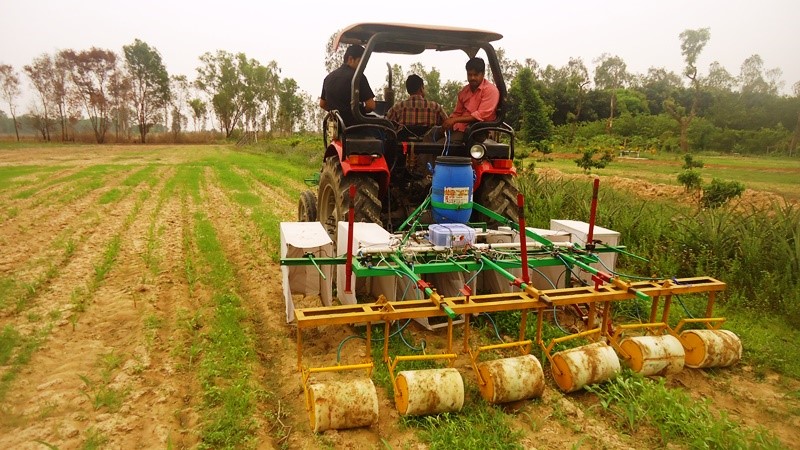
The tractor-mounted device releases the precise amount of herbicide after sensing weed density through image analysis. Amount of herbicide varies for every 5 percent change in weed infestation, unlike the conventional system that uses the same amount of chemical on a given plot. The device has been developed for crops with a row-to-row spacing of 350-450 millimeters.

Field experiments on dry land with groundnut and maize crops have shown that the use of the device increased production, reduced crop damage and also saved around 80 percent of the herbicide as compared to conventional systems of herbicide use.

“We have used sponge rollers which apply the herbicide through contact with weeds instead of spray done by conventional devices. This technique overcomes losses due to chemical drift and soil percolation resulting, which reduces environmental contamination,” explained Abhilash Kumar Chandel, a member of the research team, while talking to India Science Wire.

While contact-type weed eradicators have been developed in the past, this device introduces variability to the dose of herbicide in proportion to weed density. The apparatus includes a storage tank, pipelines, cameras, deflectors, ground wheel and sponge rollers, all connected to the back of a tractor moving at a speed of 2.1 km per hour. The processing unit consists of a laptop with digital image analyzer application.

The herbicide can be applied simultaneously in six parallel rows which are served by a camera and sponge roller each. The main crop is restricted from the field of view of the camera through deflectors so that only weeds appearing between the rows is captured by the cameras and treated with the herbicide thus ensuring minimum crop damage.

The field experiments showed that groundnut plant damage with the device was 3.6 times less than constant spray application (CSA) and 1.37 times less than constant contact application (CCA). In the case of maize, the plant damage was 2.72 times less that CSA and 1.33 times less than CCA.

The yield coefficient of the plots of two crops treated with the device was higher than the plots where CSA and CCA were used. The results have been published in journal Current Science.

The device is not yet ready for the market as researchers still need to evaluate the prototype and make its processing unit more robust. “We want to replace the laptop with a small analytical device which will also reduce the cost. The reliability and feasibility of the weed eradicator need to be tested for other crops as well,” said Chandel. The research team also wants to offer a variant of the device which can be handheld since many farmers can’t afford to use tractors.

“The actual efficiency of the device will only be known when it comes to the field as there are several factors beyond technology which can determine its performance. It also needs to be affordable for the farmers,” commented Vikram Ahuja of Zamindara Farm Solutions, a Punjab-based farm equipment company.

The research team included A K Chandel from Washington State University; V. K. Tewari and Aditya Agarwal (Indian Institute of Technology, Kharagpur); Satya Prakash Kumar (Central Institute of Agricultural Engineering, Bhopal); and Brajesh Nare (Central Potato Research Institute, Shimla). (India Science Wire)

By Manu Moudgil

For the latest Science, Tech news and conversations, follow Research Stash on TwitterFacebook, and subscribe to our YouTube channel 
Rate

Field experiments on dry land with groundnut and maize crops have shown that the use of the device increased production, reduced crop damage and also saved around 80 percent of the herbicide as compared to conventional systems of herbicide use.

“We have used sponge rollers which apply the herbicide through contact with weeds instead of spray done by conventional devices. This technique overcomes losses due to chemical drift and soil percolation resulting, which reduces environmental contamination,” explained Abhilash Kumar Chandel, a member of the research team, while talking to India Science Wire.

While contact-type weed eradicators have been developed in the past, this device introduces variability to the dose of herbicide in proportion to weed density. The apparatus includes a storage tank, pipelines, cameras, deflectors, ground wheel and sponge rollers, all connected to the back of a tractor moving at a speed of 2.1 km per hour. The processing unit consists of a laptop with digital image analyzer application.

The herbicide can be applied simultaneously in six parallel rows which are served by a camera and sponge roller each. The main crop is restricted from the field of view of the camera through deflectors so that only weeds appearing between the rows is captured by the cameras and treated with the herbicide thus ensuring minimum crop damage.

The field experiments showed that groundnut plant damage with the device was 3.6 times less than constant spray application (CSA) and 1.37 times less than constant contact application (CCA). In the case of maize, the plant damage was 2.72 times less that CSA and 1.33 times less than CCA.

The yield coefficient of the plots of two crops treated with the device was higher than the plots where CSA and CCA were used. The results have been published in journal Current Science.

The device is not yet ready for the market as researchers still need to evaluate the prototype and make its processing unit more robust. “We want to replace the laptop with a small analytical device which will also reduce the cost. The reliability and feasibility of the weed eradicator need to be tested for other crops as well,” said Chandel. The research team also wants to offer a variant of the device which can be handheld since many farmers can’t afford to use tractors.

“The actual efficiency of the device will only be known when it comes to the field as there are several factors beyond technology which can determine its performance. It also needs to be affordable for the farmers,” commented Vikram Ahuja of Zamindara Farm Solutions, a Punjab-based farm equipment company.

The research team included A K Chandel from Washington State University; V. K. Tewari and Aditya Agarwal (Indian Institute of Technology, Kharagpur); Satya Prakash Kumar (Central Institute of Agricultural Engineering, Bhopal); and Brajesh Nare (Central Potato Research Institute, Shimla). (India Science Wire)

By Manu Moudgil

For the latest Science, Tech news and conversations, follow Research Stash on TwitterFacebook, and subscribe to our YouTube channel 

" }

Repurposed Asthma Drug Shows Blood Sugar Improvement among Some Diabetics

After 12 weeks of taking an anti-asthma drug, a subset of patients with type 2 diabetes showed a clinically significant reduction in blood glucose during a randomized, double-blind, placebo-controlled clinical trial, report University of California San Diego School of Medicine and University of Michigan researchers.

  • News
  • 1.7K
Read more
Science Is Not for Children Alone but Is a Way of Life

Science Is Not for Children Alone but Is a Way of Life

Eminent physicist, Sir C.V.Raman was the toast of the day as Department of Science and Technology (DST) and Jawaharlal Nehru University (JNU) jointly celebrated the National Science Day to mark the discovery of Raman Effect which won him Nobel Prize and helped place India in the global map of science.

  • News
  • 2K
Read more
Research Stash Weekly Review #51

Research Stash Weekly Review #51

Weekly Review #51 – Summary of the latest news in science and technology research across the world, carefully handpicked by team Research Stash

  • News
  • 1.7K
Read more

Internet is huge! Help us find great content

Newsletter

Never miss a thing! Sign up for our newsletter to stay updated.

About

Research Stash is a curated collection of tools and News for S.T.E.M researchers

Have any questions or want to partner with us? Reach us at hello@researchstash.com

Navigation

Submit