

IMD Finding Ways to Improve Impact Based Weather Forecast

IMD Finding Ways to Improve Impact Based Weather Forecast

  • Research Stash
  • News
  • 2K

Impact based weather forecast is a technique that helps in monitoring the impact of rainfall and helps authorities to take real-time decisions.  Indian Meteorological Department (IMD) has developed this technology to assess the rise of water levels in rivers. “IMD is trying to find new ways to improve impact-based weather forecasts. We also need to improve on flash floods and thunderstorms predictions” said Dr. M Rajeevan, Secretary, Ministry of Earth Sciences while speaking on the 145th IMD Foundation Day Celebration.
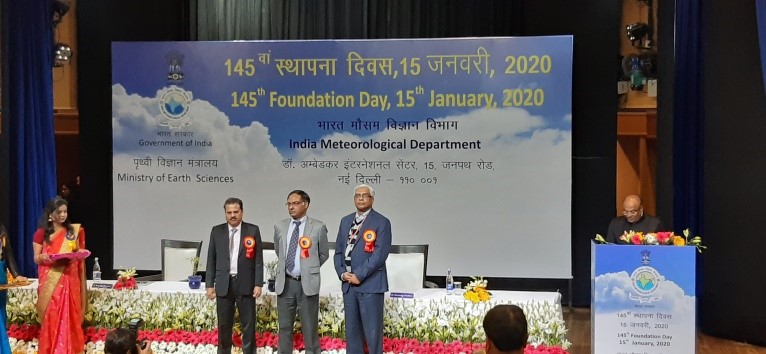
Dr. Mrutyunjay Mohapatra, Prof Ashutosh Sharma and Dr. M Rajeevan (L-R)

Further improvement in the technique will help to avoid a disastrous situation similar to Kerala floods. It can generate a scenario to help make decisions to release water or not from reservoirs after a heavy downpour and help every state authority to take the decision. This system can be run in a pre-event scenario.

He said that in cities like Mumbai where there is the unequal spell of rainfalls the department is trying to give accurate and timely forecasts. “We have installed four radars to monitor the rainfall spells so that better prediction can be made. And soon we are going to launch an app for this” said Dr. Rajeevan.  A pilot project on block-level weather forecast has been launched for 1000 blocks and now 730 more blocks have been added to this.

Dr. Rajeevan has said that the department has improved a lot in the area of weather forecasting but there is a huge scope of improvement. Agreements have been made with Kendriya Vidhalayas so that students may be involved in automatic weather stations (AWS).

Three transmissometer- RVR (Drishti System) have been installed at Kochi, Thiruvananthapuram and Bhubaneswar and two hundred sixty-one more stations were added on Nowcast Warning Page of Newly launched IMD website for issue of three hourly nowcast warnings for severe weather and now in total 694 stations are there told Dr. Mrutyunjay Mohapatra, Director General of Meteorology, IMD.

Jyoti Singh

If you liked this article, then please subscribe to our YouTube Channel for the latest Science & Tech news. You can also find us on Twitter & Facebook.
Rate

He said that in cities like Mumbai where there is the unequal spell of rainfalls the department is trying to give accurate and timely forecasts. “We have installed four radars to monitor the rainfall spells so that better prediction can be made. And soon we are going to launch an app for this” said Dr. Rajeevan.  A pilot project on block-level weather forecast has been launched for 1000 blocks and now 730 more blocks have been added to this.

Dr. Rajeevan has said that the department has improved a lot in the area of weather forecasting but there is a huge scope of improvement. Agreements have been made with Kendriya Vidhalayas so that students may be involved in automatic weather stations (AWS).

Three transmissometer- RVR (Drishti System) have been installed at Kochi, Thiruvananthapuram and Bhubaneswar and two hundred sixty-one more stations were added on Nowcast Warning Page of Newly launched IMD website for issue of three hourly nowcast warnings for severe weather and now in total 694 stations are there told Dr. Mrutyunjay Mohapatra, Director General of Meteorology, IMD.

Jyoti Singh

If you liked this article, then please subscribe to our YouTube Channel for the latest Science & Tech news. You can also find us on Twitter & Facebook.

" }
A New Paradigm for Better Drug Discovery Targeting GPCRs

A New Paradigm for Better Drug Discovery Targeting GPCRs

Researchers from the Indian Institute of Technology-Kanpur have found structural differences between beta-arrestin Isoforms 1 and 2 upon their interaction with receptors. Beta-arrestin is a cellular protein that acts as a universal regulator of GPCRs, and this finding may help in designing novel therapeutic targets.

  • News
  • 1.7K
Read more
Scientists Develop New Ceramic-Based Piezoelectric Material

Scientists Develop New Ceramic-Based Piezoelectric Material

Researchers at Bengaluru-based Indian Institute of Science have developed piezo-electric material using ceramic. Piezo-electric materials, which change their shape when an electric field is applied, have a wide range of applications from use in inkjet printers to ultrasound machines.

  • News
  • 3.1K
Read more
ASHAs Help Bring Dramatic Reduction in Malaria Cases in Odisha

ASHAs Help Bring Dramatic Reduction in Malaria Cases in Odisha

Involving Accredited Social Health Activists in the malaria eradication programme has proved to be fruitful in bringing down the number of malaria cases in Odisha.

  • News
  • 2.6K
Read more

Internet is huge! Help us find great content

Newsletter

Never miss a thing! Sign up for our newsletter to stay updated.

About

Research Stash is a curated collection of tools and News for S.T.E.M researchers

Have any questions or want to partner with us? Reach us at hello@researchstash.com

Navigation

Submit