
Fireflies Emit Light Similar to Lasers

Fireflies Emit Light Similar to Lasers

  • Research Stash
  • News
  • 2.3K

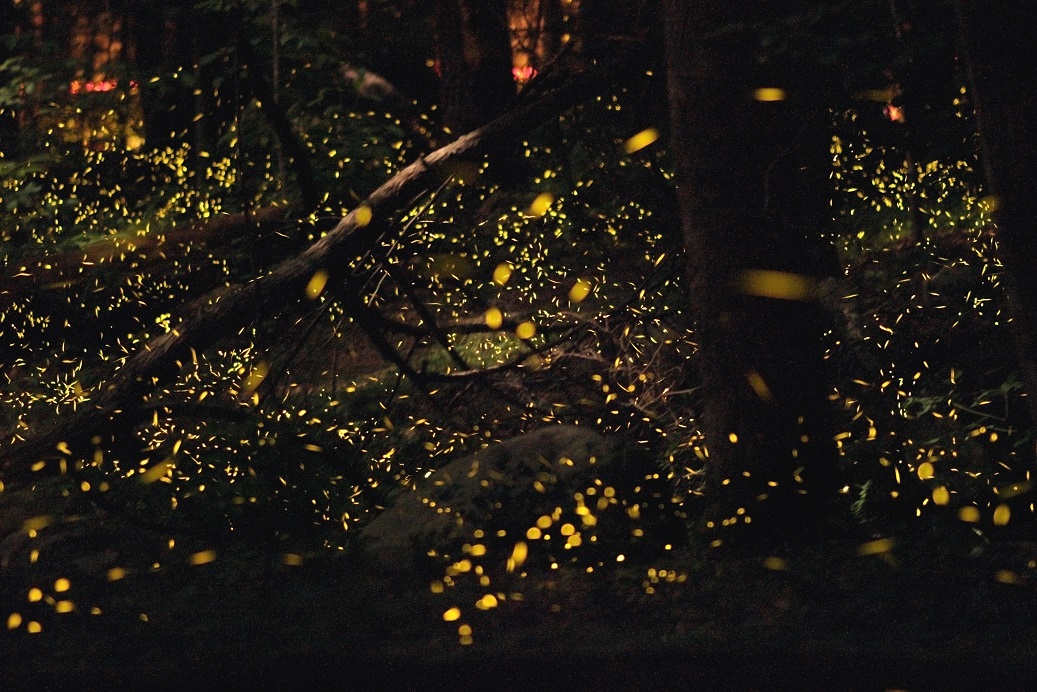
Fireflies are known for the light they emit during nights. A new study has analyzed the light emitted from fireflies and found a certain portion of it to be similar to laser beams.

A laser light is different from an ordinary light. It is usually single-colored and is emitted in the form of a narrow beam that can be focused to very tiny spots. This way a laser beam shines very brightly and is capable of intense heat if targeted on a small area. Laser beams can also be used to measure distances.

The study led by Dr. Anurup Gohain Barua from Department of Physics, Gauhati University, analyzed the light emitted from fireflies. It was found that though the light from fireflies usually falls between the range of 490 and 680 nanometers (between green and red), the emissions have a tendency for being within the narrow yellow sector of the spectrum. This feature is similar to the single-color property of most laser beams. Like visible lasers, the light from fireflies does not have any infrared or ultraviolet frequencies. Both lasers and fireflies emit a light that is highly directional, which means it does not diverge or spread much and goes as a narrow bright beam.

Data was collected using Michelson interferometer and Young’s double-slit experiment. The results of the study have been published in journal Current Science.

It is known that light from fireflies is primarily used for attracting mates or prey, like a signal to communicate with other fireflies. “An efficient laser system could be constructed in the model of the firefly light-emitting system. In firefly biology, the yellow could possibly be the real-coded signal. In future, this should even be extended to other bioluminescent systems in the world,” said Dr. Barua.

The research team also included Upamanyu Sharma and Angana Goswami from the Department of Physics, Gauhati University, Guwahati.

By: Monika Kundu Srivastava, IMAGE by Ryan Atkins/Flickr

For the latest Science, Tech news and conversations, follow Research Stash on TwitterFacebook, and subscribe to our YouTube channel 

Rate

Data was collected using Michelson interferometer and Young’s double-slit experiment. The results of the study have been published in journal Current Science.

It is known that light from fireflies is primarily used for attracting mates or prey, like a signal to communicate with other fireflies. “An efficient laser system could be constructed in the model of the firefly light-emitting system. In firefly biology, the yellow could possibly be the real-coded signal. In future, this should even be extended to other bioluminescent systems in the world,” said Dr. Barua.

The research team also included Upamanyu Sharma and Angana Goswami from the Department of Physics, Gauhati University, Guwahati.

By: Monika Kundu Srivastava, IMAGE by Ryan Atkins/Flickr

For the latest Science, Tech news and conversations, follow Research Stash on TwitterFacebook, and subscribe to our YouTube channel 
" }
Climate Vulnerability Maps Developed for Himalayan States

Climate Vulnerability Maps Developed for Himalayan States

Indian scientists have developed a common framework for the assessment of climate change vulnerability in all the states in the Himalayan region

  • News
  • 2.6K
Read more
Sensors at Chandmari Village in Sikkim’s Gangtok District

Sikkim Gets Real-Time Landslide Warning System

A real-time landslide warning system has been set up in the Sikkim-Darjeeling belt of the north-eastern Himalayas which is highly vulnerable to landslides

  • News
  • 2.5K
Read more

Osteoporosis Drug May Find Use in Cancer Therapy

A team of researchers at Icahn School of Medicine at Mount Sinai in the U.S. led by Mone Zaidi, a scientist of Indian origin, has found that a group of drugs called bisphosphonates, which are used for the treatment of osteoporosis, could also be used for treating some lung, breast and colon cancers.

  • News
  • 1.5K
Read more

Internet is huge! Help us find great content

Newsletter

Never miss a thing! Sign up for our newsletter to stay updated.

About

Research Stash is a curated collection of tools and News for S.T.E.M researchers

Have any questions or want to partner with us? Reach us at hello@researchstash.com

Navigation

Submit