
New Technology May Help Scale Up Memory Storage Capacity

New Technology May Help Scale Up Memory Storage Capacity

  • Research Stash
  • News
  • 2.5K

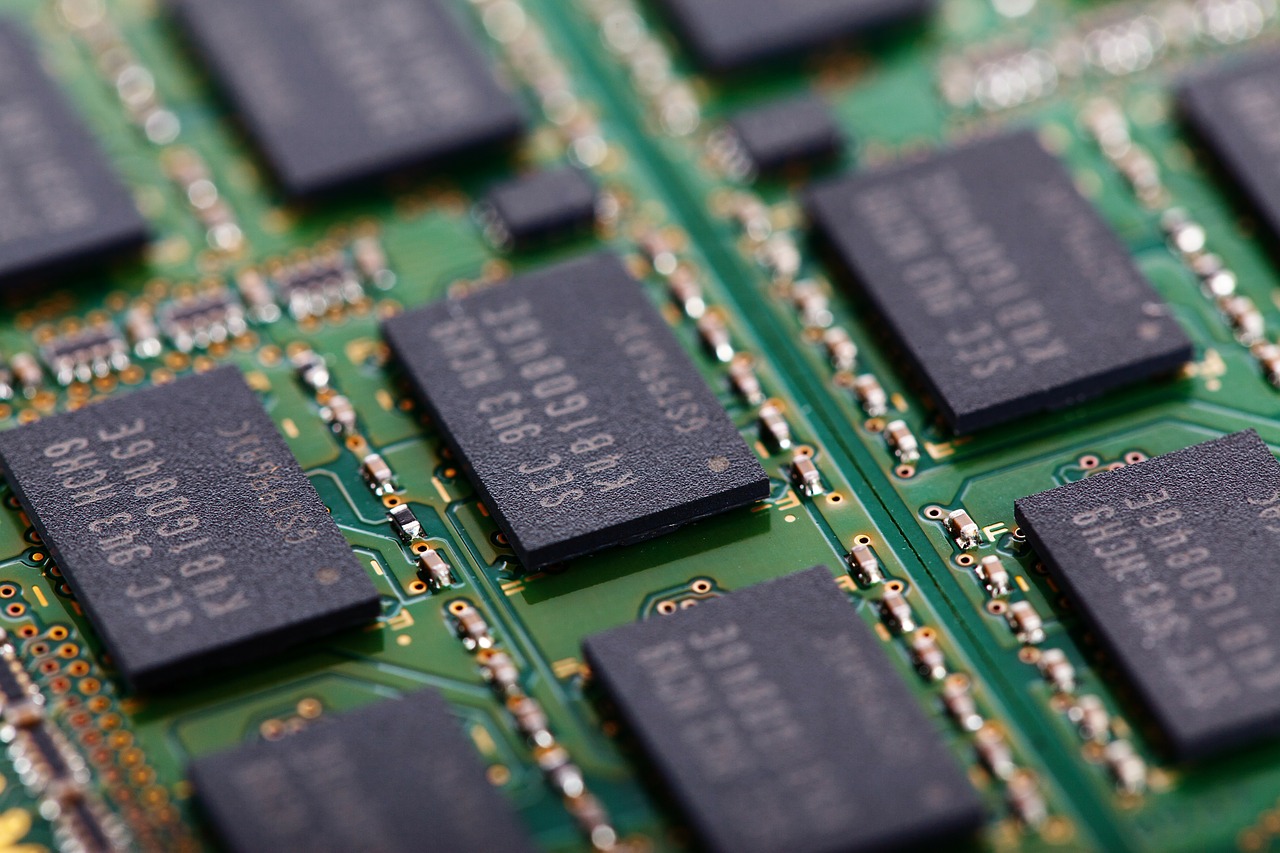
Silicon-based memory devices such as hard drives and flash drives are in high demand for gadgets that require storage. Conventional semiconductor material-based memory devices have limited scale-up ability to increase their storage capacity.  Hence, there is a quest in developing new memory technologies with superior characteristics. In this direction, a group of Indian researchers has developed a new type of resistive random access memory (RRAM) device that can be controlled with magnetic fields.

Researchers at Indian Institute of Technology Hyderabad have demonstrated the control of resistive switching characteristics of titanium dioxide- based resistive random access memory device with a magnetic field. The team has designed a memory device which is made up of silver, titanium dioxide and fluorine doped Tin oxide (FTO).
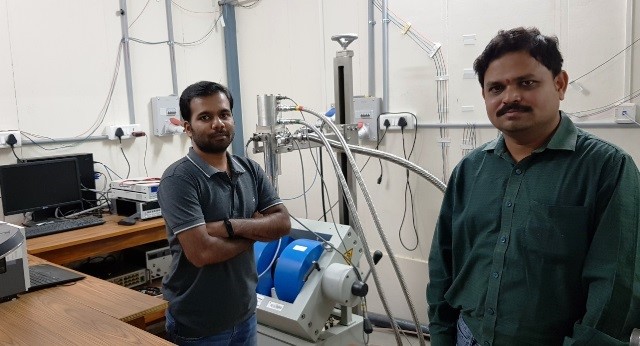
Researchers at Indian Institute of Technology, Hyderabad

Researchers at Indian Institute of Technology, Hyderabad

Nonvolatile memory devices such as flash memory and magnetic random access memory (MRAM) are key components in many technological devices like hard drives on a computer and memory cards in a phone. Non-volatile memory is typically used for storing information that would be retained even after power is switched off. Ideally, a good memory device should be able to operate with high speed, low power consumption and must possess high density.

The study suggests that the data transport properties (resistive switching behavior) in the currently available RRAM based device are mainly controlled by voltage. It would help if resistance switching behavior can be controlled with magnetic field, light, and temperature. Researchers say they are exploring magnetic fields because that would give an opportunity to control transport in a remote way.

According to researchers, RRAM devices were fabricated on FTO substrate to study the resistive switching behavior in the newly designed device. To build this new device, titanium dioxide paste was used to prepare a thin film on FTO substrate which was followed by heating of film at a very high temperature (400 degrees C). “We used silver as a top electrode for good conduction as well as its anti-oxidation property whereas fluorine-doped tin oxide was used as a bottom electrode,” said researchers.

“As present memory technologies are approaching their scaling limits, we need intensive research to develop nonvolatile memory technologies. Among various NVM technologies, resistive random access memory (RRAM) also has attracted a great deal of scientific and technological interest owing to its easy fabrication, high density, and promising performance,” said Dr. S. N. Jammalamadaka, who did the study along with Dwipak Prasad Sahu.

This finding may be helpful in future RRAM based storage devices which could be operated with magnetic fields. The study was recently published in journal Scientific Reports. (India Science Wire)

By Ratneshwar Thakur

Journal Article

Remote control of resistive switching in TiO2 based resistive random access memory device

For the latest Science and Tech news and conversations, follow Research Stash on TwitterFacebook, and subscribe to our YouTube channel 

Rate

Researchers at Indian Institute of Technology, Hyderabad

Nonvolatile memory devices such as flash memory and magnetic random access memory (MRAM) are key components in many technological devices like hard drives on a computer and memory cards in a phone. Non-volatile memory is typically used for storing information that would be retained even after power is switched off. Ideally, a good memory device should be able to operate with high speed, low power consumption and must possess high density.

The study suggests that the data transport properties (resistive switching behavior) in the currently available RRAM based device are mainly controlled by voltage. It would help if resistance switching behavior can be controlled with magnetic field, light, and temperature. Researchers say they are exploring magnetic fields because that would give an opportunity to control transport in a remote way.

According to researchers, RRAM devices were fabricated on FTO substrate to study the resistive switching behavior in the newly designed device. To build this new device, titanium dioxide paste was used to prepare a thin film on FTO substrate which was followed by heating of film at a very high temperature (400 degrees C). “We used silver as a top electrode for good conduction as well as its anti-oxidation property whereas fluorine-doped tin oxide was used as a bottom electrode,” said researchers.

“As present memory technologies are approaching their scaling limits, we need intensive research to develop nonvolatile memory technologies. Among various NVM technologies, resistive random access memory (RRAM) also has attracted a great deal of scientific and technological interest owing to its easy fabrication, high density, and promising performance,” said Dr. S. N. Jammalamadaka, who did the study along with Dwipak Prasad Sahu.

This finding may be helpful in future RRAM based storage devices which could be operated with magnetic fields. The study was recently published in journal Scientific Reports. (India Science Wire)

By Ratneshwar Thakur

Journal Article

Remote control of resistive switching in TiO2 based resistive random access memory device

For the latest Science and Tech news and conversations, follow Research Stash on TwitterFacebook, and subscribe to our YouTube channel 

" }
CSIR and CNRS Come Together for Translating Research and Technology

CSIR and CNRS Come Together for Translating Research and Technology

France has signed a memorandum of understanding (MoU) to establish a framework for cooperation and for promotion and support of scientific and technological research Council of Scientific and Industrial Research (CSIR) and National Centre for Scientific Research (CNRS)

  • News
  • 1.6K
Read more
Coral reefs in Gulf of Mannar

Invasive Marine Sponge Found In Gulf of Mannar

Coral reefs in the Gulf of Mannar in Tamil Nadu are facing a new threat. Researchers have found that an invasive marine sponge species, Terpios hoshinota, is growing aggressively over live coral colonies in Van Island in the Mannar Bay, which could prove fatal for coral reefs there.

  • News
  • 3.3K
Read more
Introducing Research Stash: Your Curated Gateway to STEM Productivity Tools

Introducing Research Stash: Your Curated Gateway to STEM Productivity Tools 🚀

Discover Research Stash — a curated platform offering the best digital tools for STEM researchers, students, and educators. Explore AI tools, writing aids, coding resources, and more to boost your productivity.

  • News
  • 748
  • 5
Read more

Internet is huge! Help us find great content

Newsletter

Never miss a thing! Sign up for our newsletter to stay updated.

About

Research Stash is a curated collection of tools and News for S.T.E.M researchers

Have any questions or want to partner with us? Reach us at hello@researchstash.com

Navigation

Submit