Researchers Develop Improved Natural Draft Charcoal Retort

Researchers Develop Improved Natural Draft Charcoal Retort

  • Research Stash
  • News
  • 2.1K

Charcoal is widely used as fuel for domestic and industrial heating applications. While most of the developed countries are producing industrial charcoal through the retort system, it was not available for Indian charcoal producers because of technological barriers and the need for higher capital investment.

Now, researchers at the Indian Institute of Technology, Guwahati, have developed a novel improved natural draft charcoal retort to address the technological and capital investment challenges of Indian charcoal makers.

“This innovative reactor is proven to produce high-quality charcoal from a wide range of feedstock and is designed to use its feedstock as heating fuel. The newly developed reactor is portable to agricultural fields, and it is proven to convert all the agricultural waste to charcoal without the noxious gas emissions”, Dr. Senthilmurugan Subbiah, Professor, Department of Chemical Engineering, IIT Guwahati, said.

Dr. Arun Kumar Chandrasekaran and Dr. Senthilmurugan Subbiah, Professors in the Department of Chemical Engineering, IIT Guwahati, who were the lead innovators of the INDCR system, have filed an Indian patent for the design of this innovative reactor. The reactor’s technical detail and its performance have been published in the Energy & Fuels Journal.

Researchers from IIT Guwahati have chosen various biomasses such as Prosopis juliflora, Casuarina equisetifolia, Bambusoideae, Biomass briquettes, Wood pellets, and Refuse-Derived Fuel (RDF) briquettes from Municipal Solid Waste as the input feedstock for charcoal making process.

Good quality charcoal depends on its end-user. Hence, the retort reactor has been developed to be capable of producing charcoal in higher mass yield (34%-42%), versatile quality of fixed carbon (76%-88%), higher energy content (6400-7200 kcal/kg), minimal noxious emission (2.65 kg of CO2/kg of charcoal), and lesser carbonization time (4 hours), say researchers.

Further, the reactor can control the process at any point in time during operation. It is user-friendly in terms of loading biomass/feedstock and unloading charcoal. Upon attainment of 270°C and upward, the volatile gases produced in the wood chamber, which are mainly low molecular weight organic volatile compounds are redirected back into the combustion chamber for complete burnout and liberated as complete combustion products.

The retort system operates in an environmentally friendly way with very low emissions of Carbon Monoxide, Carbon Dioxide, Hydrocarbons, and particulate matter. Further, the charcoal produced from the retort reactor was used as a fuel in barbeque & blast furnace heating applications and as a sorbent in pharmaceutical wastewater treatment.

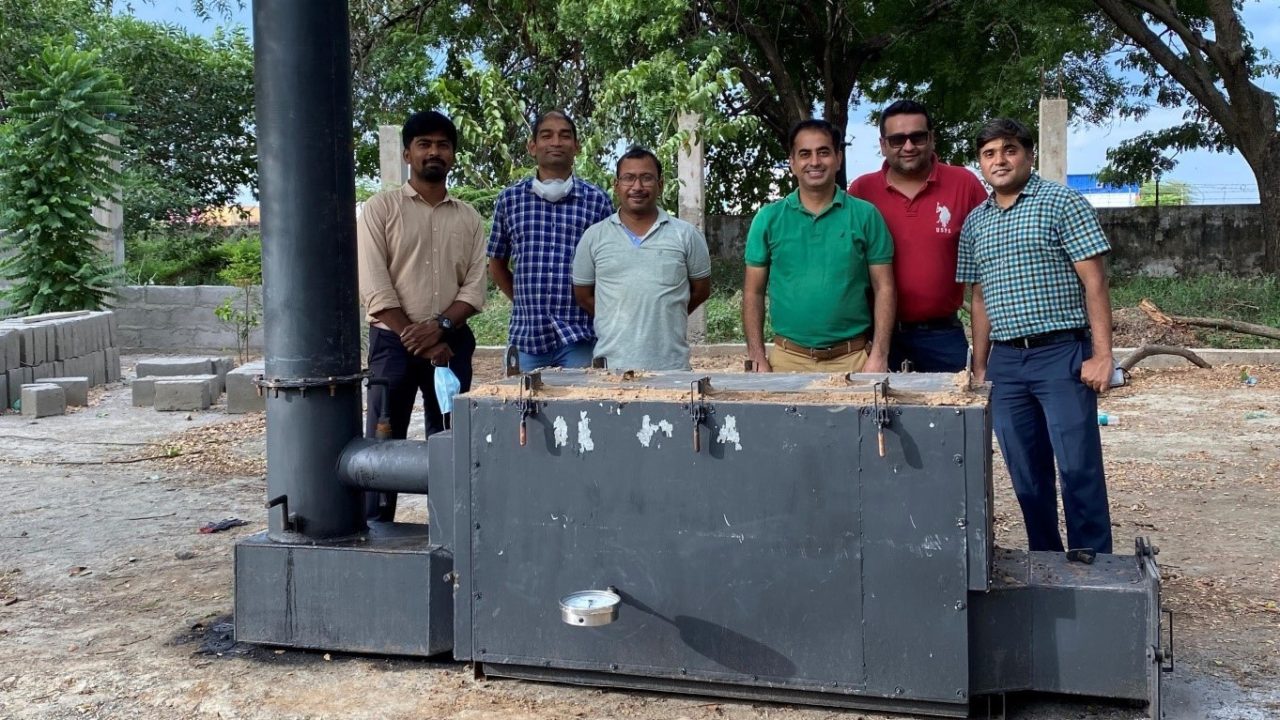
The developed charcoal retort reactor was installed and tested at Paramakudi, Ramanathapuram District, Tamil Nadu, with the fabrication help of M/s. Optima Heat Technologies, Tamil Nadu. The pilot-scale mobile charcoal production unit is 125 kg of input loading capacity with the two-phase model of operation. The demonstration of the whole research consumed two years with more than 60 field trials having been carried out to ensure consistent yield and quality of charcoal.

Speaking about the technology transfer agreement between IIT Guwahati and Sanron Fuel Pvt Ltd, New Delhi, and Samkitec Resources, Hyderabad, Dr. Subbiah said, “This technology transfer will enable further research and development to design a higher capacity reactor for producing an industrial-grade charcoal irrespective of any input loading feedstock with a higher mass & energy yield and lower emissions.” (ISW)

If you liked this article, then please subscribe to our YouTube Channel for the latest Science & Tech news. You can also find us on Twitter & Facebook
Rate

Dr. Arun Kumar Chandrasekaran and Dr. Senthilmurugan Subbiah, Professors in the Department of Chemical Engineering, IIT Guwahati, who were the lead innovators of the INDCR system, have filed an Indian patent for the design of this innovative reactor. The reactor’s technical detail and its performance have been published in the Energy & Fuels Journal.

Researchers from IIT Guwahati have chosen various biomasses such as Prosopis juliflora, Casuarina equisetifolia, Bambusoideae, Biomass briquettes, Wood pellets, and Refuse-Derived Fuel (RDF) briquettes from Municipal Solid Waste as the input feedstock for charcoal making process.

Good quality charcoal depends on its end-user. Hence, the retort reactor has been developed to be capable of producing charcoal in higher mass yield (34%-42%), versatile quality of fixed carbon (76%-88%), higher energy content (6400-7200 kcal/kg), minimal noxious emission (2.65 kg of CO2/kg of charcoal), and lesser carbonization time (4 hours), say researchers.

Further, the reactor can control the process at any point in time during operation. It is user-friendly in terms of loading biomass/feedstock and unloading charcoal. Upon attainment of 270°C and upward, the volatile gases produced in the wood chamber, which are mainly low molecular weight organic volatile compounds are redirected back into the combustion chamber for complete burnout and liberated as complete combustion products.

The retort system operates in an environmentally friendly way with very low emissions of Carbon Monoxide, Carbon Dioxide, Hydrocarbons, and particulate matter. Further, the charcoal produced from the retort reactor was used as a fuel in barbeque & blast furnace heating applications and as a sorbent in pharmaceutical wastewater treatment.

The developed charcoal retort reactor was installed and tested at Paramakudi, Ramanathapuram District, Tamil Nadu, with the fabrication help of M/s. Optima Heat Technologies, Tamil Nadu. The pilot-scale mobile charcoal production unit is 125 kg of input loading capacity with the two-phase model of operation. The demonstration of the whole research consumed two years with more than 60 field trials having been carried out to ensure consistent yield and quality of charcoal.

Speaking about the technology transfer agreement between IIT Guwahati and Sanron Fuel Pvt Ltd, New Delhi, and Samkitec Resources, Hyderabad, Dr. Subbiah said, “This technology transfer will enable further research and development to design a higher capacity reactor for producing an industrial-grade charcoal irrespective of any input loading feedstock with a higher mass & energy yield and lower emissions.” (ISW)

If you liked this article, then please subscribe to our YouTube Channel for the latest Science & Tech news. You can also find us on Twitter & Facebook

" }
Ozone Pollution Can Damage Wheat Crop

Ozone Pollution Can Damage Wheat Crop

Air pollution is not only injurious to human health but also to plant life. Scientists from Banaras Hindu University (BHU) have found that most wheat cultivars developed after the year 2000 are more sensitive to damage due to ozone, a byproduct of air pollution.

  • News
  • 3.3K
Read more
Scientists Develop Database of Everyday Harmful Chemicals

Scientists Develop Database of Everyday Harmful Chemicals

Scientists have developed a comprehensive database of such chemicals belonging to a particular category known as endocrine-disrupting chemicals or EDCs

  • News
  • 1.7K
Read more
Abhishek Bhagat explaining about his innovation

Children Display Innovative and Eco-Friendly Ideas

An app-driven automated food maker, an automatic dust lifting machine, a dustbin with sound alert, hand-driven waste picking and dumping cart, currency note sterilizing machine for ATMs, wrapper picker, cycle-powered road cleaner, a tiffin box that reminds children to wash hands before eating.

  • News
  • 2.8K
Read more

Internet is huge! Help us find great content

Newsletter

Never miss a thing! Sign up for our newsletter to stay updated.

About

Research Stash is a curated collection of tools and News for S.T.E.M researchers

Have any questions or want to partner with us? Reach us at hello@researchstash.com

Navigation

Submit