
Microplastics Threaten Marine Environment Along Kanyakumari Coast

Microplastics Threaten Marine Environment Along Kanyakumari Coast

  • Research Stash
  • News
  • 1.7K

Microplastics are usually plastic particles of less than 5mm. It may be primary or secondary microplastics which can be found in coastal environments all over the world. Also, the microplastics are much more hazardous than macroplastics because of their availability in all levels of marine food webs.

In a study conducted by the Department of Remote Sensing, Bharathidasan University covering eight different sampling stations along a 71 km long coastline with both urbanized beaches and undisturbed coastal areas along the Indian Ocean, the researchers assessed the magnitude of the microplastic pollution problem. The study revealed that microplastic is one of the carriers of major pollution to the marine environment found along the entire Kanyakumari coastal stretch of southernmost India.

The study came out with baseline data that helped in understanding the occurrence and distribution of microplastics (MPs) in the near-shore sediments. The researchers said that further studies would help in understanding the transport of microplastics as well as evaluate their interaction with the marine ecosystem of the region.

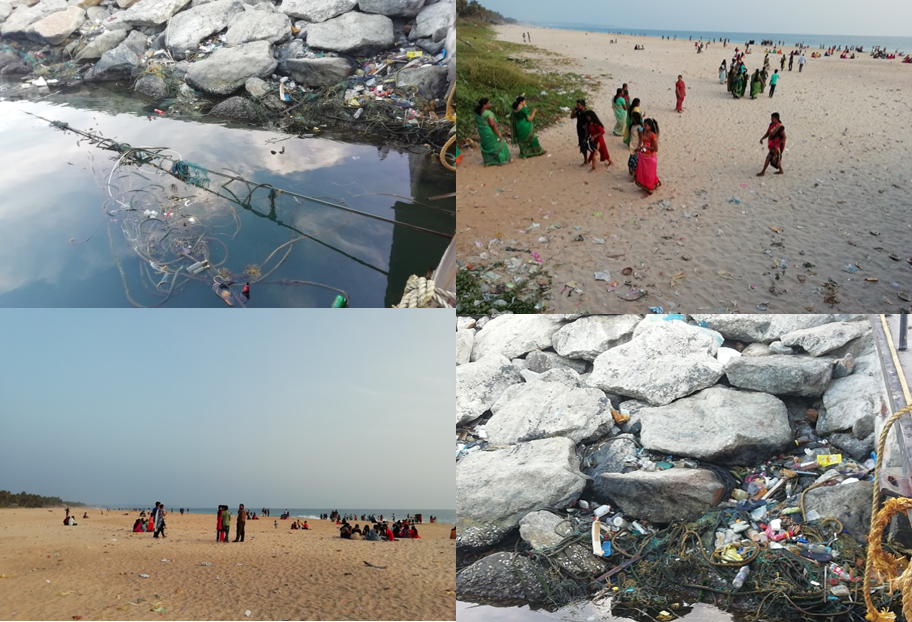
Researchers found an overall higher abundance of microplastics at the urbanized beaches as compared to undisturbed beaches due to significant human influence such as tourism activities as well as fishing. While tourist beaches had high levels of microplastics, more remote beaches and fishing ports also exhibited large amounts of microplastic pollution with plastic debris accumulation to the highest degree affecting the marine food web.

When sediments were analyzed, it was found that the tourist beaches have microplastics pollution with 150 particles (44%), harbor beaches with 99 particles (28.5%), and the coastal stretches along with the undisturbed areas with 15 particles (4.3%). These items are also likely to contain fibers from clothing and other synthetic textiles almost two fold more as compared with the tiny fragments from larger objects that had broken down over time.

In the present study, scientists tracked microplastics samples from different beach sediments, the average of which is found to be up to 43 particles per 50 g dry sediments. New research would help to identify mechanisms that influence their transport and deposition in the coastal sediments as well as evaluate the possible interaction between microplastic particles and marine ecosystems.  The authors urged policymakers and consumers to take proactive actions focusing on measures that can stop the plastics from intruding and polluting the ocean.

This research was done by Sajimol Sundar of the Department of Remote Sensing, Bharathidasan University, Tiruchirappalli, the research team comprised of Lakshumanan Chokkalingam of the Department of Remote Sensing, Bharathidasan University, Tiruchirappalli, Priyadarsi D. Roy Instituto de Geología, Universidad Nacional Autónoma de México (UNAM), Ciudad Universitaria, Mexico, and Tune Usha of National Centre for Coastal Research, Ministry of Earth Sciences, Chennai, India.

The study has been published in the journal Environmental Science and Pollution Research and was funded by the Department of Science and Technology under the PURSE II scheme. (ISW)

If you liked this article, then please subscribe to our YouTube Channel for the latest Science & Tech news. You can also find us on Twitter & Facebook
Researchers found an overall higher abundance of microplastics at the urbanized beaches as compared to undisturbed beaches due to significant human influence such as tourism activities as well as fishing. While tourist beaches had high levels of microplastics, more remote beaches and fishing ports also exhibited large amounts of microplastic pollution with plastic debris accumulation to the highest degree affecting the marine food web.

When sediments were analyzed, it was found that the tourist beaches have microplastics pollution with 150 particles (44%), harbor beaches with 99 particles (28.5%), and the coastal stretches along with the undisturbed areas with 15 particles (4.3%). These items are also likely to contain fibers from clothing and other synthetic textiles almost two fold more as compared with the tiny fragments from larger objects that had broken down over time.

In the present study, scientists tracked microplastics samples from different beach sediments, the average of which is found to be up to 43 particles per 50 g dry sediments. New research would help to identify mechanisms that influence their transport and deposition in the coastal sediments as well as evaluate the possible interaction between microplastic particles and marine ecosystems.  The authors urged policymakers and consumers to take proactive actions focusing on measures that can stop the plastics from intruding and polluting the ocean.

This research was done by Sajimol Sundar of the Department of Remote Sensing, Bharathidasan University, Tiruchirappalli, the research team comprised of Lakshumanan Chokkalingam of the Department of Remote Sensing, Bharathidasan University, Tiruchirappalli, Priyadarsi D. Roy Instituto de Geología, Universidad Nacional Autónoma de México (UNAM), Ciudad Universitaria, Mexico, and Tune Usha of National Centre for Coastal Research, Ministry of Earth Sciences, Chennai, India.

The study has been published in the journal Environmental Science and Pollution Research and was funded by the Department of Science and Technology under the PURSE II scheme. (ISW)

If you liked this article, then please subscribe to our YouTube Channel for the latest Science & Tech news. You can also find us on Twitter & Facebook

" }
Study to Help Develop Better Treatment for Blood-Related Disorders

A Better Treatment for Blood-Related Disorders

Newer and better treatments could soon be on the anvil for leukemia and other blood-related disorders with researchers developing a new model that could give a better insight into the molecular mechanism behind their development.

  • News
  • 1.5K
Read more

Understanding Positioning System of Cells May Help Unravel Key Diseases

A team of researchers led by Dr. Padinjat Raghu at National Centre for Biological Sciences, Bengaluru have shown that signals present within RDGB protein determine if it will remain in a specific compartment of the cell for it to function normally

  • News
  • 2.4K
Read more
Breeding Dual Purpose Rubber Trees

Breeding Dual Purpose Rubber Trees

Fiber length was negatively correlated to rubber tree growth. Hence, it may not be possible to simultaneously attain vigorous growth and longer fibers, researchers have reported in the study published in journal Tree Genetics & Genomes

  • News
  • 4.2K
Read more

Internet is huge! Help us find great content

Newsletter

Never miss a thing! Sign up for our newsletter to stay updated.

About

Research Stash is a curated collection of tools and News for S.T.E.M researchers

Have any questions or want to partner with us? Reach us at [email protected]

Navigation

Submit