
Hand-Held Device Developed to Detect Bacteria

Hand-Held Device Developed to Detect Bacteria

  • Research Stash
  • News
  • 1.8K

Researchers at the Indian Institute of Technology-Guwahati have developed a hand-held device that promises to detect bacteria without requiring a routine process of cell culture and microbiological assay. It could be useful for anti-bioterrorism measures and environmental monitoring applications, besides healthcare.

The new device is based on the concept of Organic Field-Effect Transistors (OFET). These transistors work on the principle that charges in the vicinity of channels of certain semiconductors can induce a current in them. In the new device, the charges on the surface of the bacterium induce a current, which is registered and read.

A press release from IIT-Guwahati said that the device consists of a hybrid tri-layer dielectric system built on glass and Polyethylene terephthalate plastic substrates, and can operate at ultra-low operating voltages. The researchers have shown that it can detect bacteria at even a concentration of 1000 colony-forming units (CFU) per milliliter. In addition, it can differentiate between Gram-positive and Gram-negative bacteria.

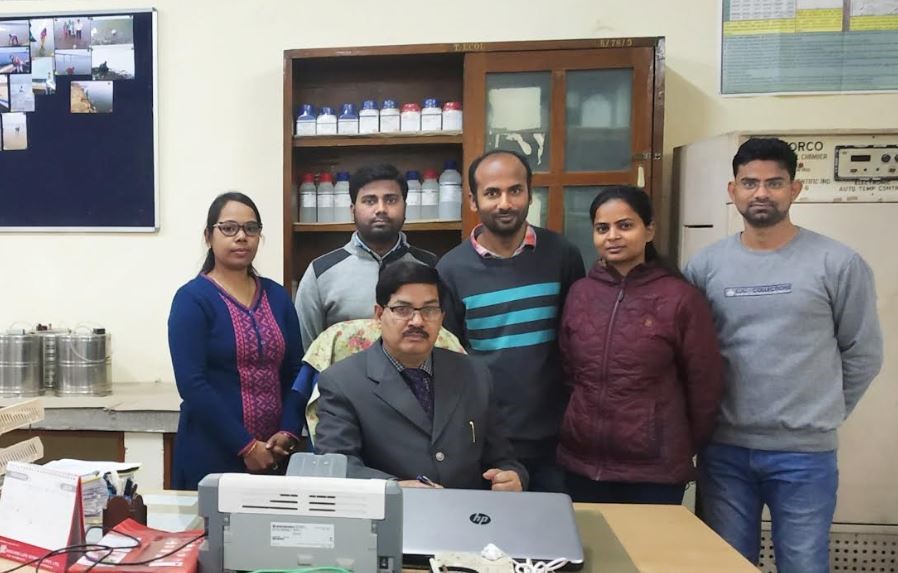
Prof. Parameswar K. Iyer

Prof. Parameswar Krishnan Iyer of Department of Chemistry and Prof. Siddhartha Sankar Ghosh of Department of Biosciences and Bioengineering at the Institute led the study team. They have patented their work and have published a report in the Journal of Materials Chemistry A.

“Not only have we shown the sensing capabilities of this portable OFET device, but have also shown the mechanism by which sensing occurs and elucidated the role of a bacterial wall in distinguishing various bacterial types,” Iyer said.

“It is known that Gram-positive bacteria such as S. pneumonia have different cell wall compositions than Gram-negative bacteria like E. coli. Such asymmetric cell wall organizations could alter the flow of electrons at the channel of OFETs during their detection,” added Ghosh. (India Science Wire)

Sunderarajan Padmanabhan

If you liked this article, then please subscribe to our YouTube Channel for the latest Science & Tech news. You can also find us on Twitter & Facebook.

Rate

Prof. Parameswar K. Iyer

Prof. Parameswar Krishnan Iyer of Department of Chemistry and Prof. Siddhartha Sankar Ghosh of Department of Biosciences and Bioengineering at the Institute led the study team. They have patented their work and have published a report in the Journal of Materials Chemistry A.

“Not only have we shown the sensing capabilities of this portable OFET device, but have also shown the mechanism by which sensing occurs and elucidated the role of a bacterial wall in distinguishing various bacterial types,” Iyer said.

“It is known that Gram-positive bacteria such as S. pneumonia have different cell wall compositions than Gram-negative bacteria like E. coli. Such asymmetric cell wall organizations could alter the flow of electrons at the channel of OFETs during their detection,” added Ghosh. (India Science Wire)

Sunderarajan Padmanabhan

If you liked this article, then please subscribe to our YouTube Channel for the latest Science & Tech news. You can also find us on Twitter & Facebook.

" }

Astrosat Discovers Ultraviolet Wings of Butterfly Nebula

Indian astrophysicists have discovered large ultraviolet lobes and jets that were hurled out from a dying star, using data from AstroSat – space observatory launched by the Indian Space Research Organisation (ISRO) in 2015

  • News
  • 3.7K
Read more
Food Processing Training Program for Budding Entrepreneurs

Food Processing Training Program for Budding Entrepreneurs

CSIR_CFTRI has planned to conduct a series of capacity building and training programs on food processing for the benefit of aspiring and budding entrepreneurs from SC/ST community of local areas and nearby aspirational districts entrepreneurs

  • News
  • 4.3K
Read more
Study Paves the Way for New Approach to Boost Rice Yield

Study Paves the Way for New Approach to Boost Rice Yield

Rice yield in India is low compared to other countries like China and Japan though it has the largest area under rice cultivation. Now scientists at the National Institute of Plant Genome Research here have identified a gene that is involved in regulating the size of rice grain

  • News
  • 1.9K
Read more

Internet is huge! Help us find great content

Newsletter

Never miss a thing! Sign up for our newsletter to stay updated.

About

Research Stash is a curated collection of tools and News for S.T.E.M researchers

Have any questions or want to partner with us? Reach us at hello@researchstash.com

Navigation

Submit