Ethical Framework and Standards Needed for AI Systems

Ethical Framework and Standards Needed for AI Systems

  • Research Stash
  • News
  • 2.4K

If India wants to catch up with China and other countries in the emerging field of Artificial Intelligence it will have to make huge investments in developing all enabling technologies and necessary eco-system, and also develop a framework for ethics and standards in AI.

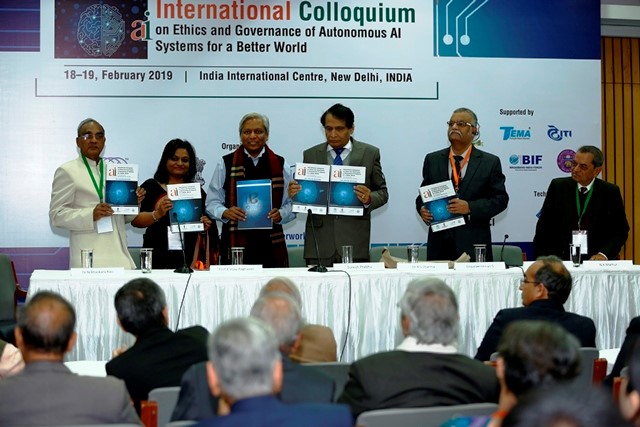
This was stated by experts participating in a two-day international colloquium on ‘Ethics and Governance of Autonomous Al Systems for a Better World’ which was inaugurated by commerce minister Suresh Prabhu and Prof K Vijaya Raghavan, Principal Scientific Adviser to the government on Monday.

The use of AI in various sectors like agriculture, health, infrastructure, education, and security is all set to grow as more and more data is generated and technologies like machine learning develop. “The use of AI in governance is also bound to grow. In such a situation, we need to start thinking about the people who will be displaced, and also of ethical issues such as privacy that arise with every new technology,” observed Prabhu.

“Ethical dilemma like whom should a driverless car hit in case of an accident are mainly ethical concerns of the West. In India, a major ethical concern would be access to fruits of AI and tools of wealth creation. If technology is based on the processing of data collected from people, why should they pay for products based on that data? It is questions like these that need to be addressed when it comes to the proliferation of new technological tools,” said Prof Vijaya Raghavan.

Dr. R. S. Sharma, Chairman, Telecom Regulatory Authority of India, said India was producing more data than China and America put together. “India is a data-rich country. But are we doing anything to monetize it? We talk about Aadhar data, but what about Facebook, Google, and Amazon who are mining data from Indians. We are providing the raw material for these companies but we have no share in the value-added products they are producing,” he said.

India needs to develop frameworks for data ownership, privacy, and security in order to take advantage of data­ being generated in the country, he added.

Prof. U B Desai (IIT, Hyderabad) said while India stood sixth in terms of research papers being published on AI (after China, US, Europe, Japan, and Korea), it was lagging greatly when it came to investments in AI ecosystem. India, he said, was digitally mature and had a talent pool developing, but it lacked investment by industry and startups. “In Silicon Valley, half the startups are AI-based, but in India, even big IT companies are only scratching the surface.”

Prof. Lalit Mohan Patnaik (National Institute of Advanced Studies, Bengaluru), Dr. N Bhaskar Rao (Chairman, Centre for Media Studies), Dr. Murali Mohan (head, ICPS division, Department of Science and Technology) and N K Mathur (Chairman, Infocom Think Tank) also spoke.

Over 40 leading experts from academic, R & D institutions, industry, civil society, public sector telecom bodies are participating in the meeting, organized by CMS, Infocom Think Tank, and DST. The colloquium is expected to come up with a set of recommendations on the ethical framework and regulatory mechanism required for harnessing AI for social good. (India Science Wire)

By Dinesh C Sharma

If you liked this article, then please subscribe to our YouTube Channel for the latest Science & Tech news. You can also find us on Twitter & Facebook.

Rate

“Ethical dilemma like whom should a driverless car hit in case of an accident are mainly ethical concerns of the West. In India, a major ethical concern would be access to fruits of AI and tools of wealth creation. If technology is based on the processing of data collected from people, why should they pay for products based on that data? It is questions like these that need to be addressed when it comes to the proliferation of new technological tools,” said Prof Vijaya Raghavan.

Dr. R. S. Sharma, Chairman, Telecom Regulatory Authority of India, said India was producing more data than China and America put together. “India is a data-rich country. But are we doing anything to monetize it? We talk about Aadhar data, but what about Facebook, Google, and Amazon who are mining data from Indians. We are providing the raw material for these companies but we have no share in the value-added products they are producing,” he said.

India needs to develop frameworks for data ownership, privacy, and security in order to take advantage of data­ being generated in the country, he added.

Prof. U B Desai (IIT, Hyderabad) said while India stood sixth in terms of research papers being published on AI (after China, US, Europe, Japan, and Korea), it was lagging greatly when it came to investments in AI ecosystem. India, he said, was digitally mature and had a talent pool developing, but it lacked investment by industry and startups. “In Silicon Valley, half the startups are AI-based, but in India, even big IT companies are only scratching the surface.”

Prof. Lalit Mohan Patnaik (National Institute of Advanced Studies, Bengaluru), Dr. N Bhaskar Rao (Chairman, Centre for Media Studies), Dr. Murali Mohan (head, ICPS division, Department of Science and Technology) and N K Mathur (Chairman, Infocom Think Tank) also spoke.

Over 40 leading experts from academic, R & D institutions, industry, civil society, public sector telecom bodies are participating in the meeting, organized by CMS, Infocom Think Tank, and DST. The colloquium is expected to come up with a set of recommendations on the ethical framework and regulatory mechanism required for harnessing AI for social good. (India Science Wire)

By Dinesh C Sharma

If you liked this article, then please subscribe to our YouTube Channel for the latest Science & Tech news. You can also find us on Twitter & Facebook.
" }
Agromet Advisories to Reach More Farmers from July

Agromet Advisories to Reach More Farmers from July

The Ministry of Earth Sciences (MoES) is all set to increase the number of farmers getting agro-meteorological advisory to 40 million from the current level of 24 million by next month.

  • News
  • 1.6K
Read more
Researchers Develop Transgenic Rice with Reduced Arsenic Accumulation

Researchers Develop Transgenic Rice with Reduced Arsenic Accumulation

Arsenic accumulation in rice grains is one of the serious agricultural issues in India. To address this, researchers at Lucknow- based CSIR-National Botanical Research Institute have developed transgenic rice by inserting a novel fungal gene, which results in reduced arsenic accumulation in rice grain

  • News
  • 3.8K
Read more
Lignin from Agro Waste Helps Make Useful Nano-composites

Lignin from Agro Waste Helps Make Useful Nano-composites

Researchers at the Mohali-based Centre of Innovative and Applied Bioprocessing have developed a lignin based nanocomposite which could potentially have commercial value

  • News
  • 2.3K
Read more

Internet is huge! Help us find great content

Newsletter

Never miss a thing! Sign up for our newsletter to stay updated.

About

Research Stash is a curated collection of tools and News for S.T.E.M researchers

Have any questions or want to partner with us? Reach us at hello@researchstash.com

Navigation

Submit