New Method Can Produce Designer Hydrogels

New Method Can Produce Designer Hydrogels

  • Research Stash
  • News
  • 2.8K

A team of scientists at the Bengaluru-based Jawaharlal Nehru Centre for Advanced Scientific Research (JNCASR) have developed a new technique that promises to produce hydrogels that could be used for a variety of applications like cleaning of industrial wastewater.
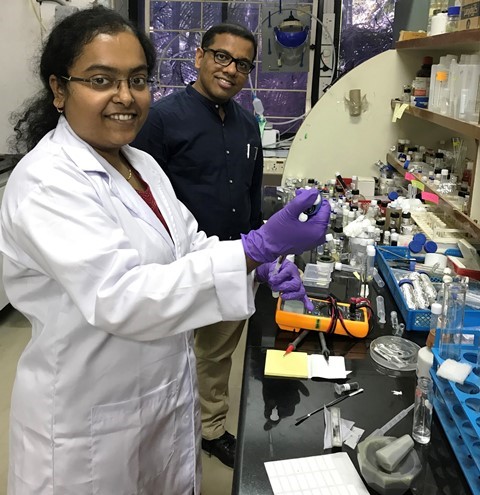
Prof. Tapas Maji at his lab in JNCASR.

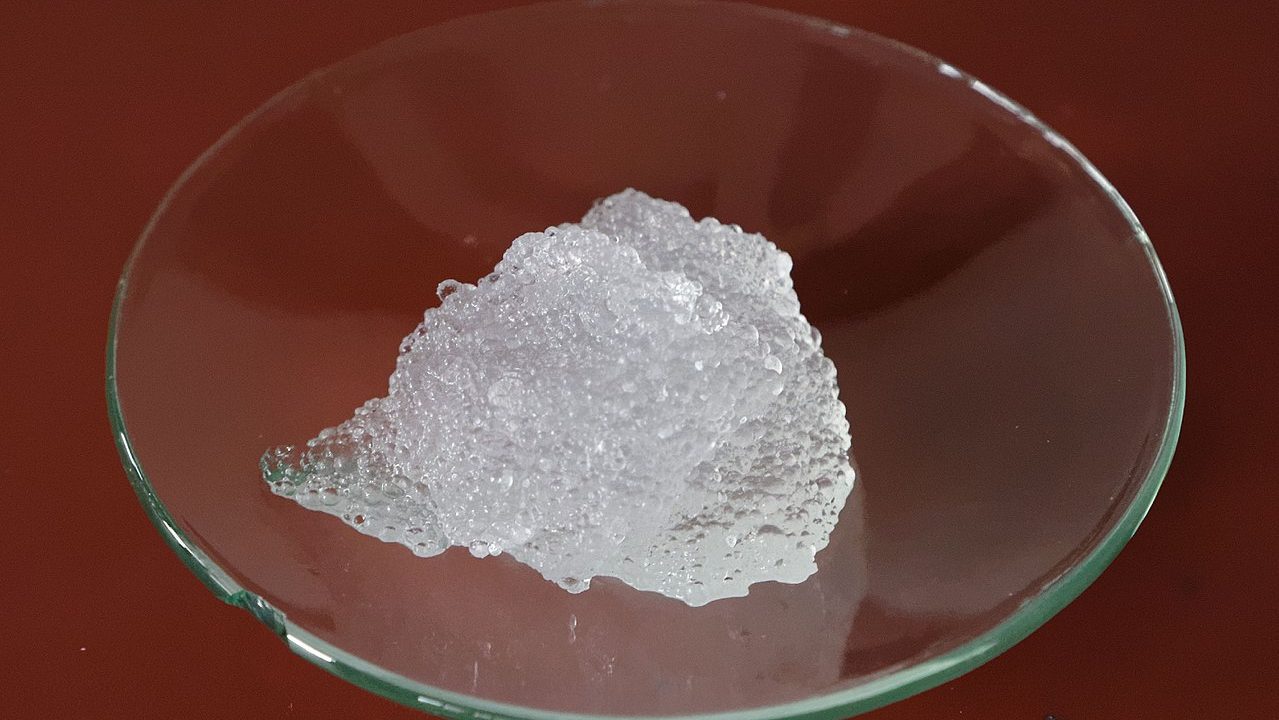
The method involves self-assembly of tiny cubes of metal-organic compounds into hydrogels with the help of molecular binders. The makeup of the resulting hydrogel depends on the size, shape and geometry of the molecular binder.

For instance, when researchers used a cationic ammonia-based molecular binder, the resulting hydrogel had a nano-tubular shape with a negative charge on its surface. It can be used as a gel-chromatography separator to separate cationic species from their anionic counterparts from any material.

This hydrogel can bind different types of metal ions including toxic heavy metal ions. The researchers have tried it out with wastewater samples containing dyes. When they passed the samples through a column of the hydrogel, the dye with positive charged got attached to the surface and cleaner water flowed out.

“The hydrogel is responsive to changes with the acid and base content of the water. Addition of acid breaks the gel. It again reconstructs upon addition of alkaline solutions. This means the hydrogel can be reused multiple times by just changing the acid level. This could bring down the cost of wastewater treatment substantially. Further, the separation was found to be much faster than the conventional methods,” explained Prof. Tapas Maji, leader of the research team, while speaking to India Science Wire.

The second hydrogel was developed with a binder based on an organic chromophore, tetraphenylethene. It turned out to be highly photo-responsive. “The cyan colour emitting hydrogel can be used in writing. It will be visible only in ultraviolet light. It could have immense application for agencies dealing with highly sensitive documents,” Dr. Maji added.

Further, the group has developed a tri-component white light emitting hydrogel based on two different molecular binders. It can find potential application as a white light-emitting substance.

Apart from Dr. Maji, his colleagues Papri Sutar, Venkata M. Suresh, Kolleboyina Jayaramulu and Arpan Hazra were involved in the work. The research results have been published in journal Nature Communication. The project was partly funded by the Science and Engineering Research Board. (India Science Wire)

By Sunderarajan Padmanabhan and Ratnesh Thakur

Journal Article

Binder driven self-assembly of metal-organic cubes towards functional hydrogels

If you liked this article, then please subscribe to our YouTube Channel for the latest Science & Tech news. You can also find us on Twitter & Facebook.

This hydrogel can bind different types of metal ions including toxic heavy metal ions. The researchers have tried it out with wastewater samples containing dyes. When they passed the samples through a column of the hydrogel, the dye with positive charged got attached to the surface and cleaner water flowed out.

“The hydrogel is responsive to changes with the acid and base content of the water. Addition of acid breaks the gel. It again reconstructs upon addition of alkaline solutions. This means the hydrogel can be reused multiple times by just changing the acid level. This could bring down the cost of wastewater treatment substantially. Further, the separation was found to be much faster than the conventional methods,” explained Prof. Tapas Maji, leader of the research team, while speaking to India Science Wire.

The second hydrogel was developed with a binder based on an organic chromophore, tetraphenylethene. It turned out to be highly photo-responsive. “The cyan colour emitting hydrogel can be used in writing. It will be visible only in ultraviolet light. It could have immense application for agencies dealing with highly sensitive documents,” Dr. Maji added.

Further, the group has developed a tri-component white light emitting hydrogel based on two different molecular binders. It can find potential application as a white light-emitting substance.

Apart from Dr. Maji, his colleagues Papri Sutar, Venkata M. Suresh, Kolleboyina Jayaramulu and Arpan Hazra were involved in the work. The research results have been published in journal Nature Communication. The project was partly funded by the Science and Engineering Research Board. (India Science Wire)

By Sunderarajan Padmanabhan and Ratnesh Thakur

Journal Article

Binder driven self-assembly of metal-organic cubes towards functional hydrogels

If you liked this article, then please subscribe to our YouTube Channel for the latest Science & Tech news. You can also find us on Twitter & Facebook.
" }
Evergreen Shrub May Be a Source of New Cancer Diagnostic Agent

Evergreen Shrub May Be a Source of New Cancer Diagnostic Agent

A team of researchers at the Indian Institute of Technology-Roorkee, have developed a set of fluorescent carbon nano-dots that promises to serve as a diagnostic-cum- therapeutic agent for cancer

  • News
  • 3.1K
Read more
Researchers Develop New Method of Supporting Ultra Small Metal Nanoparticles on Silica

Researchers Develop New Method of Supporting Ultra Small Metal Nanoparticles on Silica

A research team at CSIR-National Chemical Laboratory, Pune - has developed a new method that could overcome the difficulties of supporting ultra-small metal nanoparticles on silica with desirable loading.

  • News
  • 1.8K
Read more
Testing of sewage samples in lab

Sewage Holds the Key to Measure the Actual Extent Of COVID-19 Spread

Centre for Cellular and Molecular Biology and Indian Institute of Chemical Technology in a joint study have harvested the sewage samples to estimate the number of potentially infected individuals in the city of Hyderabad.

  • News
  • 1.4K
Read more

Internet is huge! Help us find great content

Newsletter

Never miss a thing! Sign up for our newsletter to stay updated.

About

Research Stash is a curated collection of tools and News for S.T.E.M researchers

Have any questions or want to partner with us? Reach us at [email protected]

Navigation

Submit