
New Bioactive Dental Filling Material Promises to Be Teeth-Friendly

  • Research Stash
  • News
  • 2.7K

A team of Indian scientists has developed a new technique that promises to help produce bioactive dental filling materials which will take much lesser time for the formation of new bone tissues.
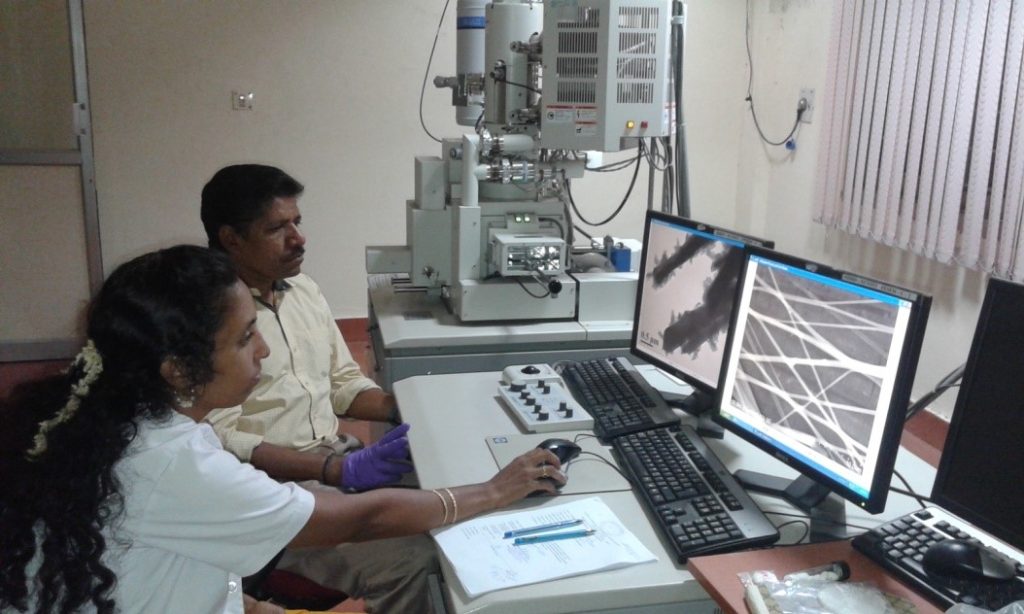
Prof. S. Balakumar and D. Durgalakshmi at the National Centre for Nanoscience and Nanotechnology, University of Madras

Bioactive dental filling materials are gaining popularity as they last longer, restore minerals in teeth and slow down secondary tooth decay more effectively. Previously, a technique called melt-derived method was used. The materials were produced without crystallization and were of micron size.

Now scientists have synthesized a crystallization induced, strontium-based nano-sized material using a simpler sol-gel assisted microwave method. The effect of crystallization on the product and its reactivity is the main focus of the findings.

Researchers claim that compared with commercially available micron-level materials the newly synthesized nano-structured materials have a higher rate of mineralisation of bone apatite, and thus cutting down on the time taken for the formation of new bone tissues.

Normally calcium is used for the production of biomaterials. In the present work, scientists synthesized nano-bioactive materials with the same base composition as that for commercially available biomaterial called Bioglass 45S5 but by substituting calcium with strontium and controlling the particle size at the nano-scale.

The sol-gel assisted microwave method, which was employed for the process, involves the conversion of monomers into a colloidal suspension ‘sol’, which is polymerised to form the ‘gel’ which is then heated at high temperature to give the final solid product.

Researchers said the new material acted as a better agent for occluding or blocking exposed dentin tubules and for decreasing hypersensitivity more effectively. It can kill microorganisms causing tooth decay faster and can also be used for bone regeneration applications, they added.

Speaking to India Science Wire, lead scientist Prof. S. Balakumar of the National Centre for Nanoscience and Nanotechnology, University of Madras, said “it takes only two days to prepare the bioactive glass by the new technique in the laboratory. The process is highly scalable for commercial purposes”.

The scientists conducted crystal structure analysis, dentin remineralisation, antibacterial efficacy test against dentin bacterial strains, and computer simulation interaction of the material with salivary metabolites. Multinuclear solid-state NMR studies of the product provided detailed atomistic insight into the presence of crystalline mineral phases in the bioactive material.

The surface morphological evaluation showed that strontium plays a major role in the morphological determination of the material. The biomaterial produced has been tested as per the global standards for biomaterials for mechanical, biocompatible applications. The researchers said that they are working on developing a nano-bioglass from natural calcium and phosphate source to further decrease the cost.

The National Centre for Nanoscience and Nanotechnology, University of Madras, conducted the study in collaboration with, Centre for Advanced Studies in Crystallography & Biophysics, University of Madras, National Chemical Laboratory, Pune, and Department of Medical Physics, Anna University.

The team included D. Durgalakshmi, R. Ajay Rakkesh, M. Kesavan, S. Ganapathy, T. G. Ajithkumar, S. Karthikeya and S. Balakumar. The study was funded by Department of Biotechnology (DBT). The research findings have been published in the journal Biomaterial Science. (India Science Wire)

By Dr Sanghamitra Deobhanj

Journal Article

Highly reactive crystalline-phase-embedded strontium-bioactive nanorods for multimodal bioactive applications

If you liked this article, then please subscribe to our YouTube Channel for the latest Science & Tech news. You can also find us on Twitter & Facebook.

Rate

Researchers claim that compared with commercially available micron-level materials the newly synthesized nano-structured materials have a higher rate of mineralisation of bone apatite, and thus cutting down on the time taken for the formation of new bone tissues.

Normally calcium is used for the production of biomaterials. In the present work, scientists synthesized nano-bioactive materials with the same base composition as that for commercially available biomaterial called Bioglass 45S5 but by substituting calcium with strontium and controlling the particle size at the nano-scale.

The sol-gel assisted microwave method, which was employed for the process, involves the conversion of monomers into a colloidal suspension ‘sol’, which is polymerised to form the ‘gel’ which is then heated at high temperature to give the final solid product.

Researchers said the new material acted as a better agent for occluding or blocking exposed dentin tubules and for decreasing hypersensitivity more effectively. It can kill microorganisms causing tooth decay faster and can also be used for bone regeneration applications, they added.

Speaking to India Science Wire, lead scientist Prof. S. Balakumar of the National Centre for Nanoscience and Nanotechnology, University of Madras, said “it takes only two days to prepare the bioactive glass by the new technique in the laboratory. The process is highly scalable for commercial purposes”.

The scientists conducted crystal structure analysis, dentin remineralisation, antibacterial efficacy test against dentin bacterial strains, and computer simulation interaction of the material with salivary metabolites. Multinuclear solid-state NMR studies of the product provided detailed atomistic insight into the presence of crystalline mineral phases in the bioactive material.

The surface morphological evaluation showed that strontium plays a major role in the morphological determination of the material. The biomaterial produced has been tested as per the global standards for biomaterials for mechanical, biocompatible applications. The researchers said that they are working on developing a nano-bioglass from natural calcium and phosphate source to further decrease the cost.

The National Centre for Nanoscience and Nanotechnology, University of Madras, conducted the study in collaboration with, Centre for Advanced Studies in Crystallography & Biophysics, University of Madras, National Chemical Laboratory, Pune, and Department of Medical Physics, Anna University.

The team included D. Durgalakshmi, R. Ajay Rakkesh, M. Kesavan, S. Ganapathy, T. G. Ajithkumar, S. Karthikeya and S. Balakumar. The study was funded by Department of Biotechnology (DBT). The research findings have been published in the journal Biomaterial Science. (India Science Wire)

By Dr Sanghamitra Deobhanj

Journal Article

Highly reactive crystalline-phase-embedded strontium-bioactive nanorods for multimodal bioactive applications

If you liked this article, then please subscribe to our YouTube Channel for the latest Science & Tech news. You can also find us on Twitter & Facebook.
" }
Astronomers Detect for First Time Light from Very First Stars of Universe

Astronomers Detect for First Time Light from Very First Stars of Universe

A team of astronomers including an Indian graduate student Nivedita Mahesh from Arizona State University have discovered for the first time signals from “cosmic dawn” - the moment when the universe's earliest stars emerged, making a significant breakthrough in our understanding of the evolution of cosmos.

  • News
  • 3.3K
Read more
Leaves from Nitrogen-Rich Trees Can Be Potential Fertilizers

Leaves from Nitrogen-Rich Trees Can Be Potential Fertilizers

Persistent overuse of fertilizers to increase the crop yield has led to serious consequences on the environment and human health.

  • News
  • 2.7K
Read more
Scientists Solve Genetic Puzzle Surrounding Mundas

Scientists Solve Genetic Puzzle Surrounding Mundas

Genetic studies, in recent years, have traced the origins of the majority of population groups in the Indian sub-continent to two ancestral populations– Ancestral North Indian and Ancestral South Indian. At the same time, it is seen that the sizeable population group of Mundas in central and northeast India shares genetic ancestry with Southeast Asian populations as well

  • News
  • 3.1K
Read more

Internet is huge! Help us find great content

Newsletter

Never miss a thing! Sign up for our newsletter to stay updated.

About

Research Stash is a curated collection of tools and News for S.T.E.M researchers

Have any questions or want to partner with us? Reach us at hello@researchstash.com

Navigation

Submit