Pune Scientists Tweak Anti-Cancer Drug To Make It More Effective

Scientists Tweak Anti-Cancer Drug To Make It More Effective

  • Research Stash
  • News
  • 3.1K

Cancer drugs are generally toxic and result in serious side effects in patients. A group of Indian researchers has now redesigned one such drug to get new chemicals which themselves may be potential anti-cancer and anti-bacterial drugs.
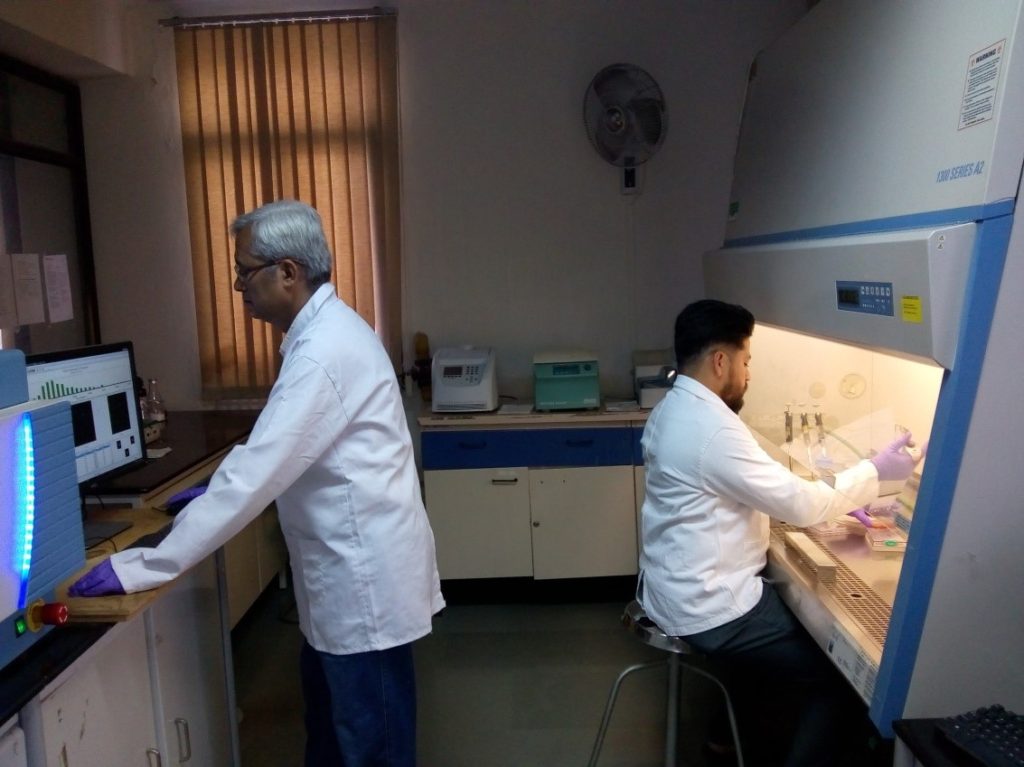
Dr. Dheeman Sarkar and Dr. S. Chakrabarty working in the lab

IMAGE: Dr. Dheeman Sarkar and Dr. S. Chakrabarty working in the lab

The group has synthesized several new compounds from Sunitinib, a drug used for treating kidney cancers. At least one of them promises to be more effective than Sunitinib itself.

Although potent like other anti-cancer drugs Sunitinib causes serious side effects. Globally chemists are working to tweak its structure to improve its potency while trying to reduce toxic effects.

The chemical structure of Sunitinib has three parts – an indole-2 ring, a pyrrole structure, and an N-diethylaminoethyl-substituted-carboxamide group. “The first two form the main body while the third forms the active limb of the compound.  While other groups have been trying to modify the drug at the diethylaminoehtyl substituted carboxamide end, we looked at the indole-2 ring,” explained Sangeeta V. Jagtap, a member of the research team, while speaking to India Science Wire.

Dr. Sangeeta Jagtap, Rahul Sonawane and Nishant Rasal (left to right)

IMAGE: Dr. Sangeeta Jagtap, Rahul Sonawane and Nishant Rasal (left to right)

“We replaced the indole-2-ring with different chemical structures such as acids, amides and esters and carboxamide group with esters and carboxylic groups,” Dr. Jagtap added. “The compounds where the carboxamide group was replaced with esters showed significant anti-cancer activity”. In all, 21 compounds, seven each containing one of the three chemical groups, have been synthesized.  “We then determined their structure and verified them using nuclear magnetic resonance techniques,” she added.

The team then tested the compounds on different types of human cancer cells – prostate, breast, cervical and monocyte. In addition, the new compounds have been tested on four types of bacteria – Staphylococcus aureus, Bacillus subtilis, Escherichia coli, and Pseudomonas aeruginosa. The tests revealed that seven of the newly synthesized compounds were active against both cancer cells and bacteria. They were further tweaked to see if the effect can be improved.

One of the compounds, code-named 9g, seemed to be the most effective against both cancer cells and bacterial agents “Other compounds too showed potential anti-proliferation and antibacterial activity. Further structural optimization of these compounds may offer new anticancer drug“, researchers said.

Asked about future plans, Sangeeta said:  “The compounds are effective on cultured cells. However, they need to be further tested on animal models and humans before they are used as drugs. It might take another three to five years to all the tests.”

Dr. Dheeman Sarkar, CSIR-National Chemical Laboratory, who evaluated the biological activity of the new chemical agrees. “We need to improve 9g against the intracellular target. This is doable. As Sunitinib data is available, it will be faster to develop the molecule as a drug.” He said.

The research team included Dr. Sangeeta Jagtap, Nishant Rasul and Rahul Sonawane (Baburaoji Gholap College, Pune); Amit S. Choudhari (Biocon Limited, Bengaluru) and Shakti S. Chakraborty and Dhiman D. Sarkar (CSIR-National Chemical Laboratory, Pune). The findings have been published in journal Chemistry Select. (India Science Wire).

The research was partly funded by the Scientific and Engineering Research Board as a Post-doctoral fellowship

By Kollegala Sharma

Journal Article

Novel 2,4‐Dimethyl‐5‐((E)‐3‐phenyl‐3‐oxoprop‐1‐enyl)‐1H‐pyrrole‐3‐carboxylic Acid Derivatives: New Leads in Cancer and Bacterial Chemotherapy

If you liked this article, then please subscribe to our YouTube Channel for the latest Science & Tech news. You can also find us on Twitter & Facebook.
Rate

The group has synthesized several new compounds from Sunitinib, a drug used for treating kidney cancers. At least one of them promises to be more effective than Sunitinib itself.

Although potent like other anti-cancer drugs Sunitinib causes serious side effects. Globally chemists are working to tweak its structure to improve its potency while trying to reduce toxic effects.

The chemical structure of Sunitinib has three parts – an indole-2 ring, a pyrrole structure, and an N-diethylaminoethyl-substituted-carboxamide group. “The first two form the main body while the third forms the active limb of the compound.  While other groups have been trying to modify the drug at the diethylaminoehtyl substituted carboxamide end, we looked at the indole-2 ring,” explained Sangeeta V. Jagtap, a member of the research team, while speaking to India Science Wire.

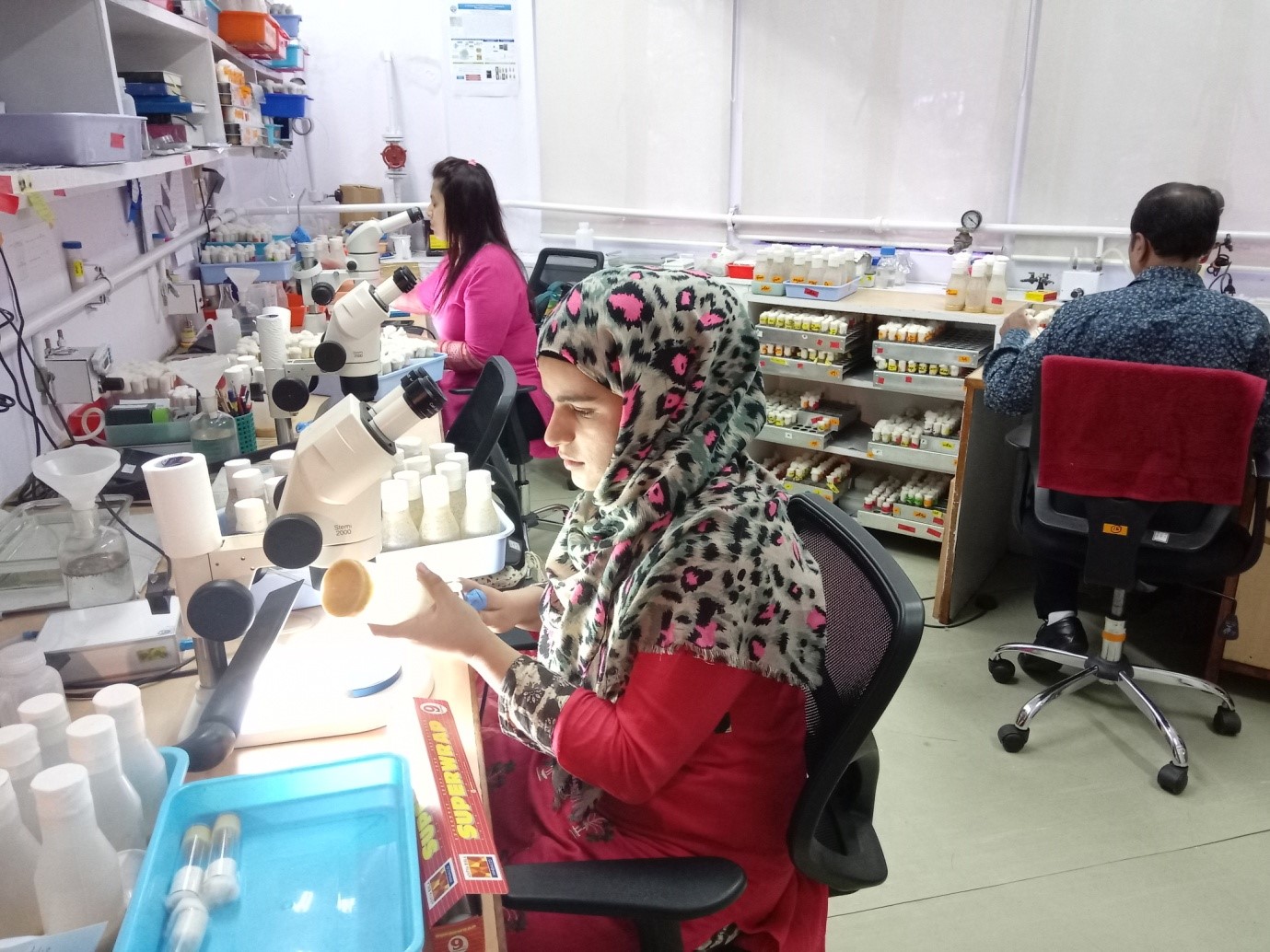
Dr. Sangeeta Jagtap, Rahul Sonawane and Nishant Rasal (left to right)

IMAGE: Dr. Sangeeta Jagtap, Rahul Sonawane and Nishant Rasal (left to right)

“We replaced the indole-2-ring with different chemical structures such as acids, amides and esters and carboxamide group with esters and carboxylic groups,” Dr. Jagtap added. “The compounds where the carboxamide group was replaced with esters showed significant anti-cancer activity”. In all, 21 compounds, seven each containing one of the three chemical groups, have been synthesized.  “We then determined their structure and verified them using nuclear magnetic resonance techniques,” she added.

The team then tested the compounds on different types of human cancer cells – prostate, breast, cervical and monocyte. In addition, the new compounds have been tested on four types of bacteria – Staphylococcus aureus, Bacillus subtilis, Escherichia coli, and Pseudomonas aeruginosa. The tests revealed that seven of the newly synthesized compounds were active against both cancer cells and bacteria. They were further tweaked to see if the effect can be improved.

One of the compounds, code-named 9g, seemed to be the most effective against both cancer cells and bacterial agents “Other compounds too showed potential anti-proliferation and antibacterial activity. Further structural optimization of these compounds may offer new anticancer drug“, researchers said.

Asked about future plans, Sangeeta said:  “The compounds are effective on cultured cells. However, they need to be further tested on animal models and humans before they are used as drugs. It might take another three to five years to all the tests.”

Dr. Dheeman Sarkar, CSIR-National Chemical Laboratory, who evaluated the biological activity of the new chemical agrees. “We need to improve 9g against the intracellular target. This is doable. As Sunitinib data is available, it will be faster to develop the molecule as a drug.” He said.

The research team included Dr. Sangeeta Jagtap, Nishant Rasul and Rahul Sonawane (Baburaoji Gholap College, Pune); Amit S. Choudhari (Biocon Limited, Bengaluru) and Shakti S. Chakraborty and Dhiman D. Sarkar (CSIR-National Chemical Laboratory, Pune). The findings have been published in journal Chemistry Select. (India Science Wire).

The research was partly funded by the Scientific and Engineering Research Board as a Post-doctoral fellowship

By Kollegala Sharma

Journal Article

Novel 2,4‐Dimethyl‐5‐((E)‐3‐phenyl‐3‐oxoprop‐1‐enyl)‐1H‐pyrrole‐3‐carboxylic Acid Derivatives: New Leads in Cancer and Bacterial Chemotherapy

If you liked this article, then please subscribe to our YouTube Channel for the latest Science & Tech news. You can also find us on Twitter & Facebook.

" }
Scientists at Centre for Cellular and Molecular Biology working to find solutions to different health problems

CCMB Working to Make Personalized Medicine a Reality

One size does not fit all. This applies to medicine, as much as for garments. Some medicines might work on some but not on others. The key to unraveling this secret lies in the uniqueness of cells of each one of us.

  • News
  • 1.7K
Read more
NASA’s X-59 Quiet Supersonic Research Aircraft Cleared for Final Assembly

NASA’s X-59 Quiet Supersonic Research Aircraft Cleared for Final Assembly

NASA’s first large scale piloted X-plane in more than three decades is cleared for final assembly and integration of its systems following a major project review by senior managers held Thursday at NASA Headquarters in Washington

  • News
  • 1.5K
Read more

ITRI’s Cytotwister Increases Stem Cell Harvest up to 10,000 Percent and Decreases Cost up to 90 Percent over Current Monolayer and 3D Structures

Ingenious Carrier Design Provides 3D-to-2D Conversion for Maximum Harvest of Clinical-grade Stem Cells for Autoimmune Diseases, Cancer Research, and Tissue Regeneration

  • News
  • 1.8K
Read more

Internet is huge! Help us find great content

Newsletter

Never miss a thing! Sign up for our newsletter to stay updated.

About

Research Stash is a curated collection of tools and News for S.T.E.M researchers

Have any questions or want to partner with us? Reach us at hello@researchstash.com

Navigation

Submit