
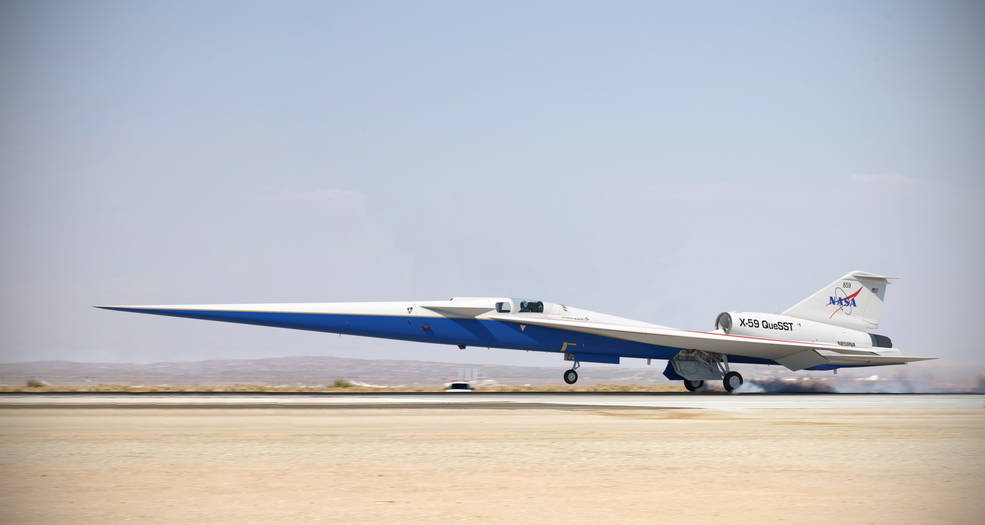
NASA’s X-59 Quiet Supersonic Research Aircraft Cleared for Final Assembly

NASA’s X-59 Quiet Supersonic Research Aircraft Cleared for Final Assembly

  • Research Stash
  • News
  • 1.6K

NASA’s first large scale piloted X-plane in more than three decades is cleared for final assembly and integration of its systems following a major project review by senior managers held Thursday at NASA Headquarters in Washington.

Image of the X-59 main assembly coming together.
Credits: Lockheed Martin

The management review, known as Key Decision Point-D (KDP-D), was the last programmatic hurdle for the X-59 Quiet SuperSonic Technology (QueSST) aircraft to clear before officials meet again in late 2020 to approve the airplane’s first flight in 2021.

“With the completion of KDP-D we’ve shown the project is on schedule, it’s well planned and on track. We have everything in place to continue this historic research mission for the nation’s air-traveling public,” said Bob Pearce, NASA’s associate administrator for Aeronautics.

The X-59 is shaped to reduce the loudness of a sonic boom reaching the ground to that of a gentle thump if it is heard at all. It will be flown above select U.S. communities to generate data from sensors and people on the ground in order to gauge public perception. That data will help regulators establish new rules to enable commercial supersonic air travel overland.

Construction of the X-59, under a $247.5 million cost-plus-incentive-fee contract, is continuing at Lockheed Martin Aeronautics Company’s Skunk Works factory in Palmdale, California.

Three major work areas are actively set up for building the airplane’s main fuselage, wing, and empennage. Final assembly and integration of the airplane’s systems – including an innovative cockpit eXternal Visibility System – is targeted for late 2020.

Management of the X-59 QueSST development and construction falls under the Low Boom Flight Demonstrator project, which is part of NASA’s Integrated Aviation Systems Program. NASA

If you liked this article, then please subscribe to our YouTube Channel for the latest Science & Tech news. You can also find us on Twitter & Facebook.
Rate

The X-59 is shaped to reduce the loudness of a sonic boom reaching the ground to that of a gentle thump if it is heard at all. It will be flown above select U.S. communities to generate data from sensors and people on the ground in order to gauge public perception. That data will help regulators establish new rules to enable commercial supersonic air travel overland.

Construction of the X-59, under a $247.5 million cost-plus-incentive-fee contract, is continuing at Lockheed Martin Aeronautics Company’s Skunk Works factory in Palmdale, California.

Three major work areas are actively set up for building the airplane’s main fuselage, wing, and empennage. Final assembly and integration of the airplane’s systems – including an innovative cockpit eXternal Visibility System – is targeted for late 2020.

Management of the X-59 QueSST development and construction falls under the Low Boom Flight Demonstrator project, which is part of NASA’s Integrated Aviation Systems Program. NASA

If you liked this article, then please subscribe to our YouTube Channel for the latest Science & Tech news. You can also find us on Twitter & Facebook.

" }
New Method Developed to Measure Soil Erosion

New Method Developed to Measure Soil Erosion

Scientists have developed a method to measure the rate of soil erosion and associated decrease in organic content in soil by assessing levels of radioactive cesium in soil. This method can help in monitoring the effects of soil erosion and the effectiveness of soil conservation strategies.

  • News
  • 1.8K
Read more
Indian Scientists Find Out How Neem Cells Produce Useful Chemicals

Indian Scientists Find Out How Neem Cells Produce Useful Chemicals

Neem is known for its medicinal and insecticidal properties for centuries. It is chemicals referred to as limonoids that give neem these properties. Indian scientists have now figured out the process of limonoid production in neem.

  • News
  • 3K
Read more

How Malaria Tricks the Immune System

The new study suggests a possible defense in the battle against this deadly disease Global efforts to eradicate malaria are crucially dependent on scientists’ ability to outsmart the malaria parasite.

  • News
  • 2.2K
Read more

Internet is huge! Help us find great content

Newsletter

Never miss a thing! Sign up for our newsletter to stay updated.

About

Research Stash is a curated collection of tools and News for S.T.E.M researchers

Have any questions or want to partner with us? Reach us at [email protected]

Navigation

Submit