Scientists Open New Avenue to Study Head Muscle Dystrophy

Scientists Open New Avenue to Study Head Muscle Dystrophy

  • Research Stash
  • News
  • 2.9K

Indian researchers have identified the mechanism by which muscles above the neck, known as head muscles, are formed during development of an embryo in the womb.
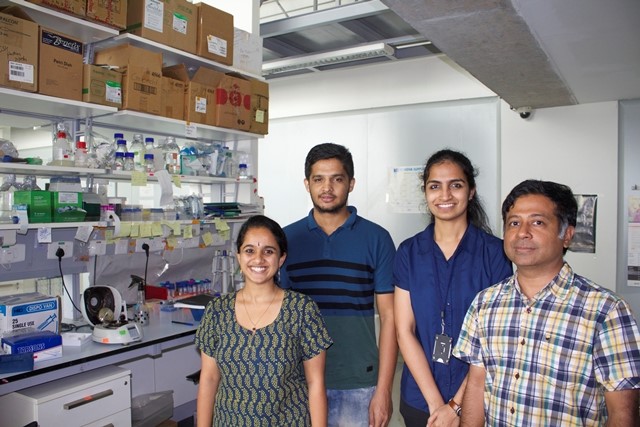
Dr. Ramkumar Sambasivan with research team at inSTEM

Dr. Ramkumar Sambasivan with research team at inSTEM

The study, done in mice and human stem cells, may help in future to test drugs developed for treating muscular dystrophies involving head muscles.

Till now scientists had only known about the way muscles below the neck develop in the embryo. The new study has found that the process is different for the development of head muscles. It was observed that formation of head muscles was triggered by inhibition of two pathways called Wnt/beta-catenin and Nodal pathways, while muscles below neck require switching on of two different pathways (Wnt and Fgf).

“We found that muscles in the head, such as jaw and facial muscles, have a fundamentally different developmental program when compared to that of muscles below the neck. We have shown this by mutating two genes in mice embryos,” explained Dr. Ramkumar Sambasivan, a member of the research team at the Institute for Stem Cell Biology and Regenerative Medicine (InStem), Bengaluru.

“We observed that in the mutant mice embryos, muscle development below neck fails completely. The head muscle development, however, surprisingly, appeared completely normal. These findings provided evidence that the two muscle groups have distinct paths of development,” he added.

“The study has traced the evolutionary process that allows the emergence of the head in vertebrates and identifies mechanistic cues that might be involved in the process. This information can be used to streamline therapy for muscular disorders affecting distinct parts of the body, rather than a ‘one therapy fits all muscles’ approach,” commented Dr. Suchitra Gopinath of Translational Health Science and Technology Institute (THSTI), Faridabad, who was not part of this study.

Sam J. Mathew, Assistant Professor at Regional Centre for Biotechnology (RCB), Faridabad, said: “This work raises interesting possibilities to find new treatment strategies for patients who have weakness and dysfunction of the head muscles.”

The research team included Nitya Nandkishore (InStem and SASTRA University, Thanjavur), Bhakti Vyas (InStem and Manipal Academy of Higher Education, Manipal), Alok Javali (InStem and NCBS), Subho Ghosh and Dr. Sambasivan (InStem). The results have been published in journal Development. The study was supported by Department of Biotechnology. (India Science Wire)

By Ratneshwar Thakur

Journal Article

Divergent early mesoderm specification underlies distinct head and trunk muscle programmes in vertebrates

If you liked this article, then please subscribe to our YouTube Channel for the latest Science & Tech news. You can also find us on Twitter & Facebook.
Rate

The study, done in mice and human stem cells, may help in future to test drugs developed for treating muscular dystrophies involving head muscles.

Till now scientists had only known about the way muscles below the neck develop in the embryo. The new study has found that the process is different for the development of head muscles. It was observed that formation of head muscles was triggered by inhibition of two pathways called Wnt/beta-catenin and Nodal pathways, while muscles below neck require switching on of two different pathways (Wnt and Fgf).

“We found that muscles in the head, such as jaw and facial muscles, have a fundamentally different developmental program when compared to that of muscles below the neck. We have shown this by mutating two genes in mice embryos,” explained Dr. Ramkumar Sambasivan, a member of the research team at the Institute for Stem Cell Biology and Regenerative Medicine (InStem), Bengaluru.

“We observed that in the mutant mice embryos, muscle development below neck fails completely. The head muscle development, however, surprisingly, appeared completely normal. These findings provided evidence that the two muscle groups have distinct paths of development,” he added.

“The study has traced the evolutionary process that allows the emergence of the head in vertebrates and identifies mechanistic cues that might be involved in the process. This information can be used to streamline therapy for muscular disorders affecting distinct parts of the body, rather than a ‘one therapy fits all muscles’ approach,” commented Dr. Suchitra Gopinath of Translational Health Science and Technology Institute (THSTI), Faridabad, who was not part of this study.

Sam J. Mathew, Assistant Professor at Regional Centre for Biotechnology (RCB), Faridabad, said: “This work raises interesting possibilities to find new treatment strategies for patients who have weakness and dysfunction of the head muscles.”

The research team included Nitya Nandkishore (InStem and SASTRA University, Thanjavur), Bhakti Vyas (InStem and Manipal Academy of Higher Education, Manipal), Alok Javali (InStem and NCBS), Subho Ghosh and Dr. Sambasivan (InStem). The results have been published in journal Development. The study was supported by Department of Biotechnology. (India Science Wire)

By Ratneshwar Thakur

Journal Article

Divergent early mesoderm specification underlies distinct head and trunk muscle programmes in vertebrates

If you liked this article, then please subscribe to our YouTube Channel for the latest Science & Tech news. You can also find us on Twitter & Facebook.

" }

Astrosat Discovers Ultraviolet Wings of Butterfly Nebula

Indian astrophysicists have discovered large ultraviolet lobes and jets that were hurled out from a dying star, using data from AstroSat – space observatory launched by the Indian Space Research Organisation (ISRO) in 2015

  • News
  • 3.7K
Read more
Scientists Pave the Way for a Vaccine against Tuberculosis

Scientists Pave the Way for a Vaccine against TB

The scope for developing a new vaccine against the dreaded disease of Tuberculosis through the biological route has become brighter, with researchers at Kolkata-based Indian Institute of Chemical Biology (IICB) and Bose Institute identifying a potential trouble spot and figuring out ways to deal with it.

  • News
  • 2.8K
Read more
Local Communities Key in Conservation of Snow Leopards

Local Communities Key in Conservation of Snow Leopards

Involving local communities and protecting their livelihoods may be a better strategy for conservation of snow leopards, a new study has found. Snow leopards are apex predators in the alpine ecosystem. Its conservation is critical for saving other species like Asiatic Ibex, Tibetan Argali, Ladakh Urial, Chiru, Takin, Serow and Musk Deer. However, snow leopard […]

  • News
  • 2.5K
Read more

Internet is huge! Help us find great content

Newsletter

Never miss a thing! Sign up for our newsletter to stay updated.

About

Research Stash is a curated collection of tools and News for S.T.E.M researchers

Have any questions or want to partner with us? Reach us at hello@researchstash.com

Navigation

Submit