Kargil Fossil Unravels Climatic Conditions of Early Himalayas

  • Research Stash
  • News
  • 2.4K

What might have been the climate along the trans- Himalayan region, when the Himalayas was beginning to form in the late Miocene era (5.3 million to 11.6 million years ago)?

A new study by researchers from Birbal Sahni Institute of Palaeosciences and the Geological Survey of India, Lucknow, has indicated that the climate may have been warm and humid when the Indian and Eurasian tectonic plates began to collide leading to the formation of the Himalayas.

The researchers have come to this conclusion following an analysis of some petrified wood fossil remains unearthed from a site in the northeastern part of Kargil district of Jammu and Kashmir. Based on microscopic features listed by the International Association of Wood Anatomists (IAWA), they found that its anatomical features were close to Genus Lagerstroemia of Lythraceae, a family of flowering plants.

On further comparison with other anatomical slides of this genus, the team concluded that the fossil had resemblance with Lagerstroemia parviflora, which is commonly called small flowered crape Myrtle.
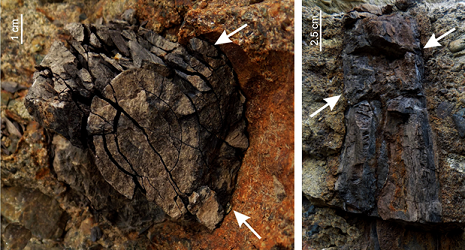
Fossilized wood embedded in the sandstone

Fossilized wood embedded in the sandstone

The study also confirmed that the fossil corresponds to the Miocene epoch of the Cenozoic era (5.3 to 11.6 million years ago) around the same time as Indian and Eurasian tectonic plates were beginning to collide to form the Himalayas.

The fossils of Lythraceae family found throughout the world further indicate its predominant distribution during this timescale. Genus Lagerstroemia consists of 53 species distributed in tropical and subtropical areas

“The presence of Lagerstroemia indicates a warm and humid climate which is in contrast to the present day climate of the fossil locality. Our future plan is to collect more plant fossils from the Himalayan region which will help in deciphering the upliftment of the Himalaya and related climate change” Dr. Gaurav Srivastava, Scientist at the Birbal Sahni Institute of Palaeosciences, Lucknow told India Science Wire.

Besides Dr. Srivastava, the study team included R. C. Mehrotra, S. R. Mishra, Prasenjit Barman and Satish C. Tripathi. They have published a report on their work in the Review of Palaeobotany and Palynology journal.  (India Science Wire)

By S Suresh Ramanan

Journal Reference

Lagerstroemia L. fossil wood from the Indus molasse sediments (possibly late Miocene) of Trans-Himalayan region and its phytogeographic and climatic significance

If you liked this article, then please subscribe to our YouTube Channel for the latest Science and Tech news. You can also find us on Twitter and Facebook

Rate

On further comparison with other anatomical slides of this genus, the team concluded that the fossil had resemblance with Lagerstroemia parviflora, which is commonly called small flowered crape Myrtle.

Fossilized wood embedded in the sandstone

Fossilized wood embedded in the sandstone

The study also confirmed that the fossil corresponds to the Miocene epoch of the Cenozoic era (5.3 to 11.6 million years ago) around the same time as Indian and Eurasian tectonic plates were beginning to collide to form the Himalayas.

The fossils of Lythraceae family found throughout the world further indicate its predominant distribution during this timescale. Genus Lagerstroemia consists of 53 species distributed in tropical and subtropical areas

“The presence of Lagerstroemia indicates a warm and humid climate which is in contrast to the present day climate of the fossil locality. Our future plan is to collect more plant fossils from the Himalayan region which will help in deciphering the upliftment of the Himalaya and related climate change” Dr. Gaurav Srivastava, Scientist at the Birbal Sahni Institute of Palaeosciences, Lucknow told India Science Wire.

Besides Dr. Srivastava, the study team included R. C. Mehrotra, S. R. Mishra, Prasenjit Barman and Satish C. Tripathi. They have published a report on their work in the Review of Palaeobotany and Palynology journal.  (India Science Wire)

By S Suresh Ramanan

Journal Reference

Lagerstroemia L. fossil wood from the Indus molasse sediments (possibly late Miocene) of Trans-Himalayan region and its phytogeographic and climatic significance

If you liked this article, then please subscribe to our YouTube Channel for the latest Science and Tech news. You can also find us on Twitter and Facebook

" }
Computex 2019 - Get ready for Asia’s largest IoT show

Computex 2019 – Get ready for Asia’s largest IoT show

With a strong R&D and manufacturing capabilities and IPR protection, Taiwan is a strategic destination for foreign companies and investors looking for partners in global technology ecosystems. The 2019 Computex is scheduled to be held from 28th of March to 1st June in Taipei

Read more
Glacial Lake Keeps Disaster Managers on Toes in Sikkim

Glacial Lake Keeps Disaster Managers on Toes in Sikkim

Disasters managers and scientists in Sikkim are keeping a close watch on a lake formed due to the melting of glaciers to see how successful is an experiment they began two years back to siphon off excess water from the lake to prevent it from bursting

  • News
  • 3.1K
Read more
Scientists Open New Avenue to Study Head Muscle Dystrophy

Scientists Open New Avenue to Study Head Muscle Dystrophy

Indian researchers have identified the mechanism by which muscles above the neck, known as head muscles, are formed during development of an embryo in the womb

  • News
  • 2.9K
Read more

Internet is huge! Help us find great content

Newsletter

Never miss a thing! Sign up for our newsletter to stay updated.

About

Research Stash is a curated collection of tools and News for S.T.E.M researchers

Have any questions or want to partner with us? Reach us at hello@researchstash.com

Navigation

Submit