

Antibody targeting IL-17B/RB proved effective for pancreatic cancer

  • Research Stash
  • News
  • 2.4K

Of all battles against cancer, when it comes to the therapeutics for pancreatic cancer, more than ever, it is too little and too late. That is why, when Dr. Wen-Hwa Lee’s team developed an antibody and proved that it can extend the life of lab mice to twice longer than its compared group, the participating scientists are excited, for they have pushed the milestone one step further in finding the therapeutics for pancreatic cancer patients! The team has published an article in Journal of Experimental Medicine to detail their research lately.

IL17RB_ResearchTeam

Research team(from left to right): Dr. Heng-Hsiung Wu, Dr. Yung-Ming Jeng, Dr. Yu-Wen Tien, Dr. Wen-Hwa Lee, Dr. Eva Y.-H.P. Lee, Dr. Jin-Yuh Shew, Dr. Che Ma, Dr. Chun-Mei Hu, postdoc student Wen-Hsin Lee

The mortality rate of pancreatic cancer patients is extremely high due to its lack of early symptoms nature. However, even when diagnosed at an early stage, it is still considered largely incurable because it is very aggressive in spreading. In many efforts searching for the causes for its high mobility, the role of IL-17RB, a receptor which has been known to relate to poor breast cancer prognosis when overexpressed, was suspicious yet unknown and triggered the investigation interests in Lee’s team.

As a result, the team has confirmed that IL-17RB and its counterpart ligand IL-17B create an essential mechanism for pancreatic cancer malignancy.

A ligand is a molecular substance produced by a cancer cell or an immune cell. A ligand floats inside the body and plays as a messenger that is constantly looking for its targeting receptor pair, which is a uniquely designed opening on the cell membrane. When the two molecules unite, a series of actions inside the cell will be activated for tumor progression.
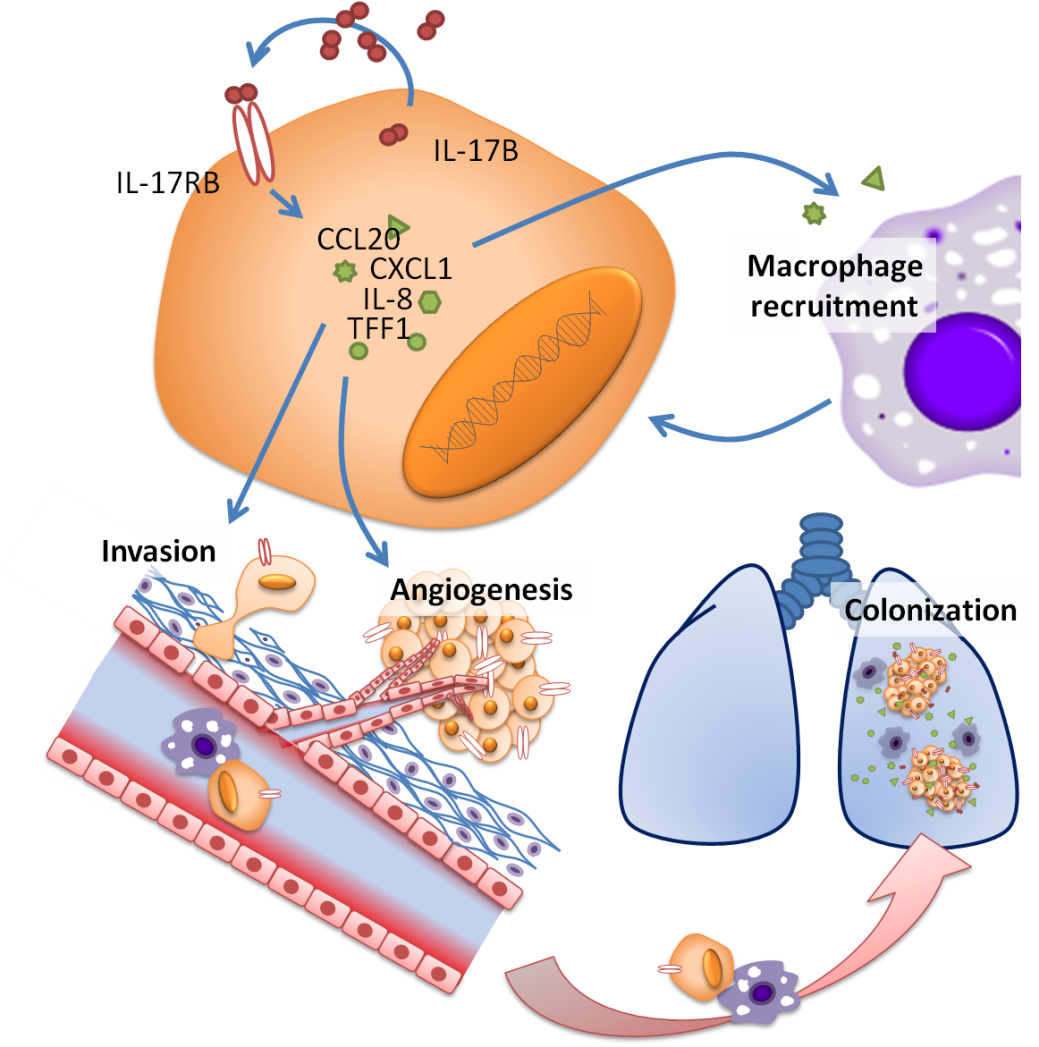
diagram-jpg.jpg

Image: Targeting of IL-17RB by specific antibody suppresses the metastasis of pancreatic cancer cells through attenuation of several cytokines secretion via abrogation of the interaction between IL-17RB and IL-17B.

The pancreatic cancer cell surface has a lot of IL-17RB receptors, which make the cell extremely sensitive toward IL-17B ligands. By collaboration with Dr. Tu-Wen Tien and Dr. Yung-Ming Jeng in NTUH, Lee’s team analyzed 111 pancreatic cancer specimens obtained from National Taiwan University Hospital. They observed that, in the pancreatic tumors, IL-17RB overexpression is associated with the enhanced tumor malignancy and the worse prognosis of patients.

The team has proved that once IL-17B binds to IL-17RB on the surface of cancer cells, it provokes the cell to become more active and start to multiply as well as making more proinflammatory cytokines which can promote tumor malignancy. It is also obvious that when IL-17B is removed, the tumor cells become quiet and tame.

So, what if there is a way to decrease the chances that IL-17B finds its way to meet IL-17RB? Will that be a strategy to reduce the possibilities of pancreatic cancer metastasis and even to prolong the life of pancreatic cancer patients?

They used human pancreatic cancer cell lines and transplanted it into xenograft mice to create the mouse model. Then, working with Dr. Alex Che Ma, who has a strong membrane proteins background, they singled out the IL-17RB antibodies developed inside the test mice.

As a result, the antibody treated xenografted mice had a significantly extended lifespan. Tumor growth and lung metastasis were significantly suppressed as well.

The team is operated under the guidance of Dr. Wen-Hwa Lee. Dr. Lee has a track record in cancer research. He has identified the first human tumor suppressor gene, Retinoblastoma gene (RB), in late 1980 that plays essential roles in maintaining genomic stability and preventing tumor formation. He also has developed breast cancer drugs which are in clinical trial phases currently. Although he has taken the administrative responsibility as the president of China Medical University since 2014, his involvement in research is going strong and non-stop in Genomics Research Center.

“The team will continue the study to further digging into the coming and going of IL-17RB in a microenvironment level to get a complete picture of the IL-17B/RB-centered regulatory network.”, Dr. Heng-Hsiung Wu, the first author of the publication, expressed high hopes regarding their findings, he also explained that, since IL-17RB presents much weaker roles in other parts of the human body, it is likely to have minimum side effects when treated with antibody targeting IL-17RB. Although there are much more to do, they have high hopes of finding more clues eventually since they are already on a promising track now.

The team has successfully applied patents for this antibody as a lead to develop pancreatic cancer drugs. They also have published their studies in the latest issue of Journal of Experimental Medicine (JEM).

The article titled “Targeting IL-17B/RB signaling with an anti-IL-17RB antibody block pancreatic cancer metastasis by silencing multiple chemokines” can be read online at  http://jem.rupress.org/content/early/2015/02/24/jem.20141702.full

Source: Academia Sinica

The mortality rate of pancreatic cancer patients is extremely high due to its lack of early symptoms nature. However, even when diagnosed at an early stage, it is still considered largely incurable because it is very aggressive in spreading. In many efforts searching for the causes for its high mobility, the role of IL-17RB, a receptor which has been known to relate to poor breast cancer prognosis when overexpressed, was suspicious yet unknown and triggered the investigation interests in Lee’s team.

As a result, the team has confirmed that IL-17RB and its counterpart ligand IL-17B create an essential mechanism for pancreatic cancer malignancy.

A ligand is a molecular substance produced by a cancer cell or an immune cell. A ligand floats inside the body and plays as a messenger that is constantly looking for its targeting receptor pair, which is a uniquely designed opening on the cell membrane. When the two molecules unite, a series of actions inside the cell will be activated for tumor progression.

diagram-jpg.jpg

Image: Targeting of IL-17RB by specific antibody suppresses the metastasis of pancreatic cancer cells through attenuation of several cytokines secretion via abrogation of the interaction between IL-17RB and IL-17B.

The pancreatic cancer cell surface has a lot of IL-17RB receptors, which make the cell extremely sensitive toward IL-17B ligands. By collaboration with Dr. Tu-Wen Tien and Dr. Yung-Ming Jeng in NTUH, Lee’s team analyzed 111 pancreatic cancer specimens obtained from National Taiwan University Hospital. They observed that, in the pancreatic tumors, IL-17RB overexpression is associated with the enhanced tumor malignancy and the worse prognosis of patients.

The team has proved that once IL-17B binds to IL-17RB on the surface of cancer cells, it provokes the cell to become more active and start to multiply as well as making more proinflammatory cytokines which can promote tumor malignancy. It is also obvious that when IL-17B is removed, the tumor cells become quiet and tame.

So, what if there is a way to decrease the chances that IL-17B finds its way to meet IL-17RB? Will that be a strategy to reduce the possibilities of pancreatic cancer metastasis and even to prolong the life of pancreatic cancer patients?

They used human pancreatic cancer cell lines and transplanted it into xenograft mice to create the mouse model. Then, working with Dr. Alex Che Ma, who has a strong membrane proteins background, they singled out the IL-17RB antibodies developed inside the test mice.

As a result, the antibody treated xenografted mice had a significantly extended lifespan. Tumor growth and lung metastasis were significantly suppressed as well.

The team is operated under the guidance of Dr. Wen-Hwa Lee. Dr. Lee has a track record in cancer research. He has identified the first human tumor suppressor gene, Retinoblastoma gene (RB), in late 1980 that plays essential roles in maintaining genomic stability and preventing tumor formation. He also has developed breast cancer drugs which are in clinical trial phases currently. Although he has taken the administrative responsibility as the president of China Medical University since 2014, his involvement in research is going strong and non-stop in Genomics Research Center.

“The team will continue the study to further digging into the coming and going of IL-17RB in a microenvironment level to get a complete picture of the IL-17B/RB-centered regulatory network.”, Dr. Heng-Hsiung Wu, the first author of the publication, expressed high hopes regarding their findings, he also explained that, since IL-17RB presents much weaker roles in other parts of the human body, it is likely to have minimum side effects when treated with antibody targeting IL-17RB. Although there are much more to do, they have high hopes of finding more clues eventually since they are already on a promising track now.

The team has successfully applied patents for this antibody as a lead to develop pancreatic cancer drugs. They also have published their studies in the latest issue of Journal of Experimental Medicine (JEM).

The article titled “Targeting IL-17B/RB signaling with an anti-IL-17RB antibody block pancreatic cancer metastasis by silencing multiple chemokines” can be read online at  http://jem.rupress.org/content/early/2015/02/24/jem.20141702.full

Source: Academia Sinica
" }

India Needs More Astronomers, Astronomy Education

New discoveries in astronomy in recent years have generated a lot of excitement globally, and Indian scientists have contributed to them in large measure. However, the country is lacking when it comes to promoting astronomy education at different levels and the number of professional astronomers it needs.

  • News
  • 1.9K
Read more
How Microscopic Marine Algae Impact Global Climate and Indian Monsoon

How Microscopic Marine Algae Impact Global Climate and Indian Monsoon

In a few weeks from now, a seasonal forecast for the Indian summer monsoon will be announced. Among various parameters that determine the fate of the monsoon is the sea surface temperature, more specifically, the contrast between land and sea temperatures.

  • News
  • 3.1K
Read more

Now glucose monitoring through saliva too

Researchers have developed a self-powered glucose biosensor technology base device that can measure the blood sugar level through saliva samples

  • News
  • 1.9K
Read more

Internet is huge! Help us find great content

Newsletter

Never miss a thing! Sign up for our newsletter to stay updated.

About

Research Stash is a curated collection of tools and News for S.T.E.M researchers

Have any questions or want to partner with us? Reach us at [email protected]

Navigation

Submit