
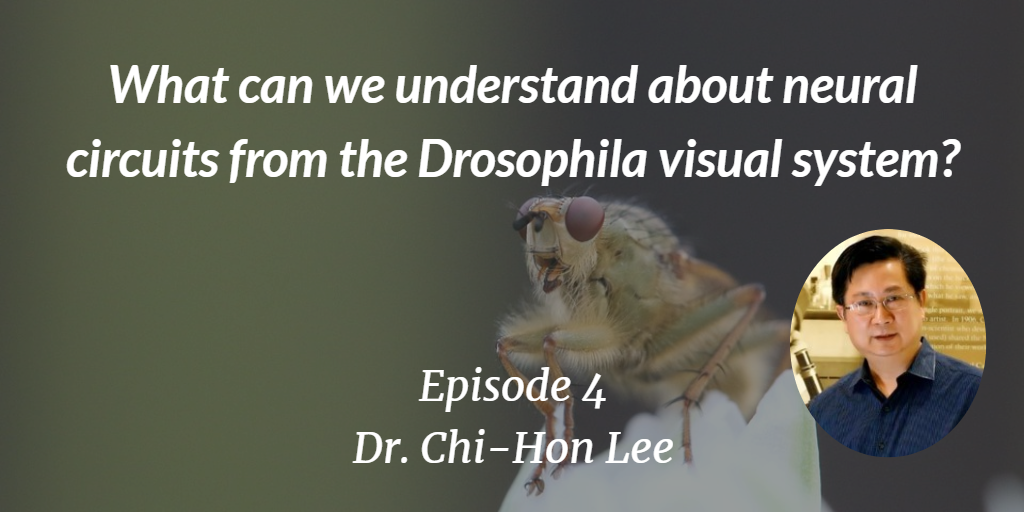
What can we understand about neural circuits from the Drosophila visual system

What can we understand about neural circuits from the Drosophila visual system?

  • Research Stash
  • Episodes
  • 1.9K

Dr. Chi-Hon Lee, the director of the Institute of Cellular and Organismic Biology at Academia Sinica, answers many questions like why Drosophila is a good animal model to study the nervous system, what is a neural circuit, how we can study the visual system in Drosophila to better understand neural circuits and how a circuit can control behavior and much more.

https://radiopublic.com/stemspeak-6rRR0R/ep/s1!a4f67

If you want to know more about his work in cognitive neuroscience, visit here

Using the Drosophila visual system as a model, we study how neurons form complex yet stereotyped synaptic connections during development and how the assembled neural circuits extract visual attributes, such as color and motion, to guide animal behaviors. To study visual circuit functions, we combine structural and functional approaches to map visual circuits.

With targeted manipulation of neuronal activity, we identified specific neurons that are functionally required for color-driven behaviors. Using both lights- and electron microscopy (EM) studies, we mapped the neurons’ synaptic circuits.

For circuit development, we focus on the formation of synaptic connections between the chromatic photoreceptors and their synaptic partners in the medulla neuropil. We used high-resolution imaging techniques and genetic manipulations to delineate the molecular mechanisms that control dendritic patterning and synaptic specificity of the medulla neurons.

Did you miss the previous episode? Listen to Episode 3

If you liked this article, then please subscribe to our YouTube Channel for the latest Science & Tech news. You can also find us on Twitter & Facebook.

Rate

Using the Drosophila visual system as a model, we study how neurons form complex yet stereotyped synaptic connections during development and how the assembled neural circuits extract visual attributes, such as color and motion, to guide animal behaviors. To study visual circuit functions, we combine structural and functional approaches to map visual circuits.

With targeted manipulation of neuronal activity, we identified specific neurons that are functionally required for color-driven behaviors. Using both lights- and electron microscopy (EM) studies, we mapped the neurons’ synaptic circuits.

For circuit development, we focus on the formation of synaptic connections between the chromatic photoreceptors and their synaptic partners in the medulla neuropil. We used high-resolution imaging techniques and genetic manipulations to delineate the molecular mechanisms that control dendritic patterning and synaptic specificity of the medulla neurons.

Did you miss the previous episode? Listen to Episode 3

If you liked this article, then please subscribe to our YouTube Channel for the latest Science & Tech news. You can also find us on Twitter & Facebook.

" }
Dr. Tien Hsien Chang On How He Became a Scientist – Part 2

Dr. Tien Hsien Chang On How He Became a Scientist – Part 2

Those who know Dr. Chang, know that he teaches an exciting course titled ‘To be a scientist’, where we trace the life and times of some of the greatest scientists of the 21st century. Here, he talks about his journey as a scientist.

Read more

Antibody targeting IL-17B/RB proved effective for pancreatic cancer

Of all battles against cancer, when it comes to the therapeutics for pancreatic cancer, more than ever, it is too little and too late. That is why, when Dr. Wen-Hwa Lee’s team developed an antibody and proved that it can extend the life of lab mice to twice longer than its compared group, the participating scientists are excited, for they have pushed the milestone one step further in finding the therapeutics for pancreatic cancer patients

  • News
  • 2.4K
Read more

Formosat-5 launches successfully, makes contact with ground station

Taiwan’s first indigenously produced ultra-high resolution Earth observation satellite Formosat-5 was launched at 2:51 a.m. Aug. 25 Pacific Daylight Time from Vandenberg Air Force Base in California, representing a milestone in the nation’s space technology industry.

  • News
  • 1.1K
Read more

Internet is huge! Help us find great content

Newsletter

Never miss a thing! Sign up for our newsletter to stay updated.

About

Research Stash is a curated collection of tools and News for S.T.E.M researchers

Have any questions or want to partner with us? Reach us at hello@researchstash.com

Navigation

Submit