
Low Academic Performers Prone to Higher Stress

Low Academic Performers Prone to Higher Stress

  • Research Stash
  • News
  • 1.8K

In recent years, there has been an alarming increase in social, parental and institutional emphasis on academic performance. A new study done among high school students has shown that students who do not do well in academics are prone to higher stress.
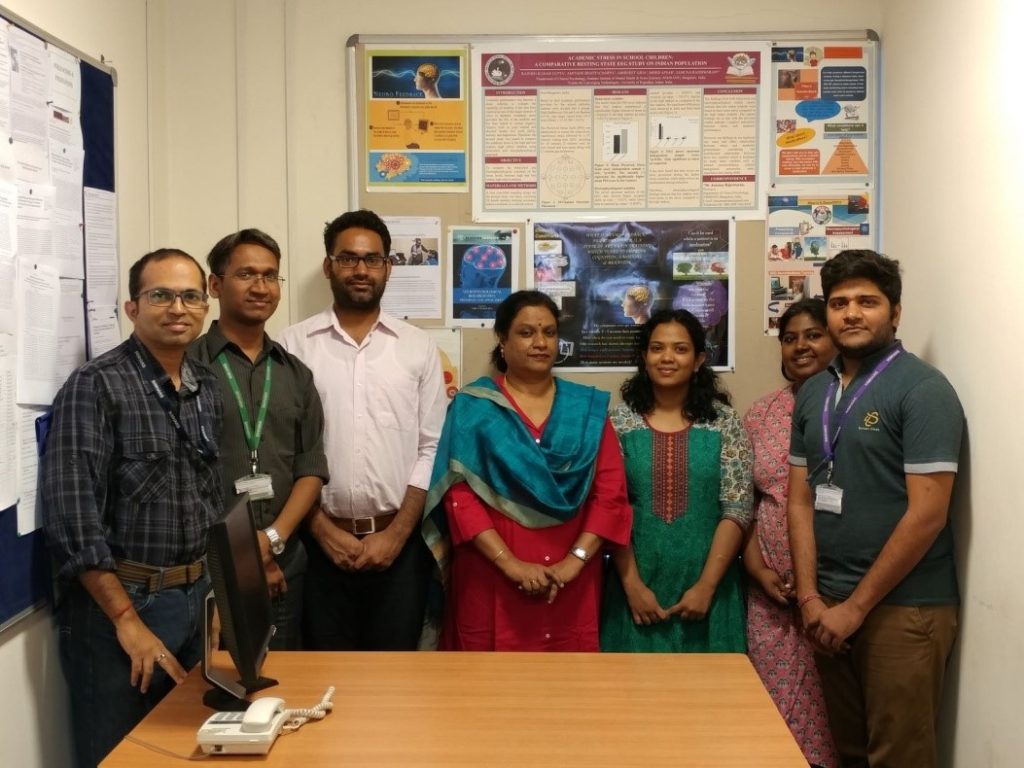
Deepak R. Ullal, Mohd Afsar, Dr. Rajnish Kumar Gupta, Dr. Jamuna Rajeswaran, Indu B. Priya, Chitra Narayanan, Rohit Kumar Yadav (L to R)

Textbook-focussed teaching is becoming the norm of the day and the rank of the performer holds a higher value rather than skill sets. Psychologists have observed that children and adolescents are facing enormous anxiety and stress in the course of their academic programmes, leading to poor mental and physical health.

A team of clinical psychologists from National Institute of Mental Health and Neurological Sciences (NIMHANS) here conducted the study to assess stress levels in twenty high school girl students: ten were high- rankers and ten low-rankers.

The researchers first built rapport with the children. They then gave them a psychological test called the Perceived Stress Scale (PSS), which involved answering a questionnaire. The electrical activity of the brains of the students was done using Electroencephalography (EEG). It was ensured they were calm before beginning the study. Data were collected using two methods – PSS and by the electrical response of the brain in specific areas using EEG readings.

PPS is a standard psychology tool or method where the individual is given a 10–item questionnaire based on life events for the past one month of their lives to which they provided detailed answers. The results showed that the students from the `low-rank’ group had higher Perceived Stress Scale values than those who did better academically.

The researchers then took EEG recording of the students for 10 minutes each: 5-minute eyes closed, and 5-minute eyes opened. EEG is a reliable, non-invasive method, which records the brain’s electrical activity with the help of probes placed at different points on the scalp.

“The brain’s electrical activity is divided into four bands. Each band represents a mental state of the individual. We found significant readings in two bands called Alpha and Beta. The Alpha band is prominent during relaxation, while the Beta band involves conscious thought and logical thinking with a stimulative effect, and takes prominence during high arousal, anxiety, and stress,” explained Dr. Jamuna Rajeswaran, Head of Clinical Neuropsychology and Cognitive Neuroscience Centre at NIMHANS, while speaking to India Science Wire.

The team observed that top ranking students had significantly higher Alpha (63.83%) and lower Beta (36.17%) activity and the low rankers, lower Alpha (37.5%) and higher Beta (62.5%) activity.

“This is an exploratory study. The results imply that there is a need for stress management programmes in schools. In the future, we intend to include socio-demographic factors like gender, region, the educational level also,” she added.

The research team included Rajnish Kumar Gupta, Cathlyn Niranjana Bennett, Amitabh Bhattacharya, and Abhineet Ojha, besides Dr.Rajeswaran. The study results have been published in the Indian Journal of Clinical Psychology. (India Science Wire)

By Susheela Srinivas

If you liked this article, then please subscribe to our YouTube Channel for the latest Science & Tech news. You can also find us on Twitter & Facebook.

Rate

The researchers first built rapport with the children. They then gave them a psychological test called the Perceived Stress Scale (PSS), which involved answering a questionnaire. The electrical activity of the brains of the students was done using Electroencephalography (EEG). It was ensured they were calm before beginning the study. Data were collected using two methods – PSS and by the electrical response of the brain in specific areas using EEG readings.

PPS is a standard psychology tool or method where the individual is given a 10–item questionnaire based on life events for the past one month of their lives to which they provided detailed answers. The results showed that the students from the `low-rank’ group had higher Perceived Stress Scale values than those who did better academically.

The researchers then took EEG recording of the students for 10 minutes each: 5-minute eyes closed, and 5-minute eyes opened. EEG is a reliable, non-invasive method, which records the brain’s electrical activity with the help of probes placed at different points on the scalp.

“The brain’s electrical activity is divided into four bands. Each band represents a mental state of the individual. We found significant readings in two bands called Alpha and Beta. The Alpha band is prominent during relaxation, while the Beta band involves conscious thought and logical thinking with a stimulative effect, and takes prominence during high arousal, anxiety, and stress,” explained Dr. Jamuna Rajeswaran, Head of Clinical Neuropsychology and Cognitive Neuroscience Centre at NIMHANS, while speaking to India Science Wire.

The team observed that top ranking students had significantly higher Alpha (63.83%) and lower Beta (36.17%) activity and the low rankers, lower Alpha (37.5%) and higher Beta (62.5%) activity.

“This is an exploratory study. The results imply that there is a need for stress management programmes in schools. In the future, we intend to include socio-demographic factors like gender, region, the educational level also,” she added.

The research team included Rajnish Kumar Gupta, Cathlyn Niranjana Bennett, Amitabh Bhattacharya, and Abhineet Ojha, besides Dr.Rajeswaran. The study results have been published in the Indian Journal of Clinical Psychology. (India Science Wire)

By Susheela Srinivas

If you liked this article, then please subscribe to our YouTube Channel for the latest Science & Tech news. You can also find us on Twitter & Facebook.
" }
Indo-U.S. Science and Technology Forum celebrates 18th Foundation Day

Indo-U.S. Science and Technology Forum celebrates 18th Foundation Day

The Indo-U.S. Science and Technology Forum (IUSSTF) celebrated its 18th Foundation Day here on Wednesday in the presence of Minister for Science & Technology, Earth Sciences, Environment, Forests and Climate Change, Dr. Harsh Vardhan, and the Ambassador of the United States to India, Mr. Kenneth Juster.

  • News
  • 3.1K
Read more
New Option Emerges For Treatment of Inflammatory Diseases

New Option Emerges For Treatment of Inflammatory Diseases

A team of Indian and American researchers has identified the immune-modulatory function of a protein that could potentially help in treating sepsis and other inflammatory diseases caused due to abnormal functioning of immune cells

  • News
  • 2.2K
Read more
How Fertilizer Use Alters Soil Bacteria Communities

How Fertilizer Use Alters Soil Bacteria Communities

Soil supports life on earth and is a dynamic living system. The microorganisms living in it are part of nutrient recycling especially carbon, nitrogen, sulfur, and phosphorus.

  • News
  • 2.8K
Read more

Internet is huge! Help us find great content

Newsletter

Never miss a thing! Sign up for our newsletter to stay updated.

About

Research Stash is a curated collection of tools and News for S.T.E.M researchers

Have any questions or want to partner with us? Reach us at hello@researchstash.com

Navigation

Submit