Selenium Nanoparticles May Act Like Antibacterial Agents

Selenium Nanoparticles May Act Like Antibacterial Agents

  • Research Stash
  • News
  • 3.1K

Scientists have found that nanoparticles of selenium, an essential micronutrient, can be used as an antibacterial agent.
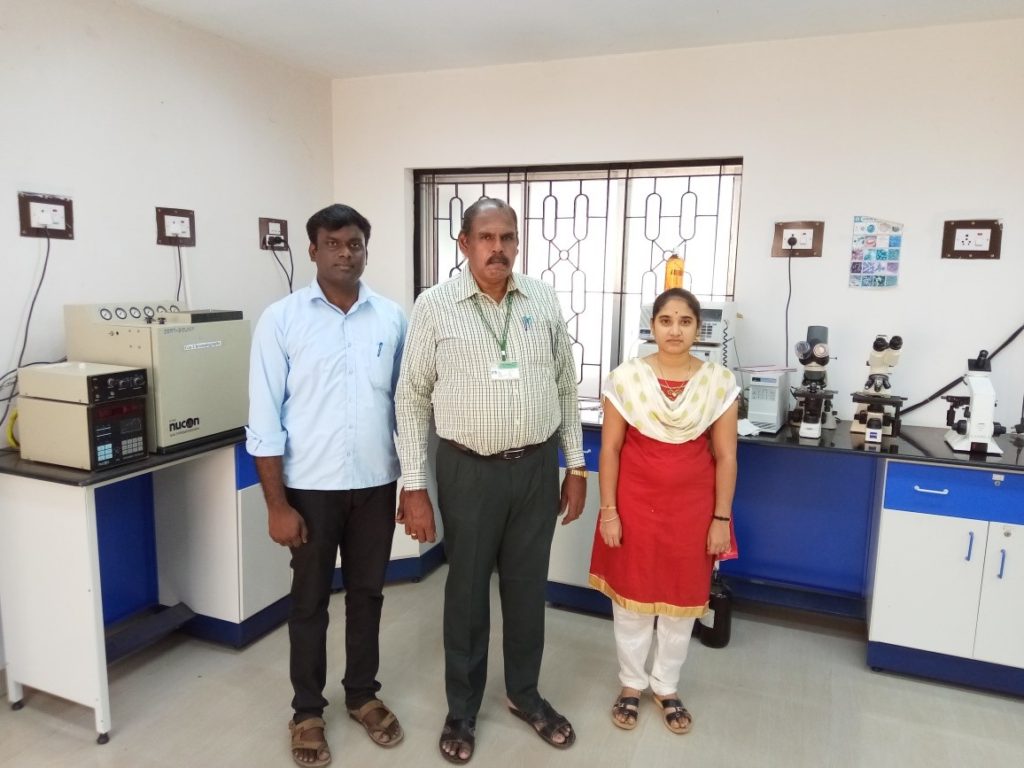
Venkidusamy Keerthika, Prof. Muthuswami Ruby Rajan and Angamuthu Ananth (Left to right)

Selenium is found naturally in wheat, eggs, cheese, nuts, and seafood. It is an antioxidant and immunity booster. Scientists found that selenium nanoparticles, owing to their unique structure and properties, may be more effective than antibiotics as they have a larger surface area and therefore can be more in contact with the external environment.

The antibacterial effect may be due to the fact that at a particular concentration nano-selenium interacts with the bacterial cell surface and penetrates into the cell, thus causing damage. Selenium in excess is toxic. Though silver nanoparticles are also being used for similar purposes, researchers chose selenium due to their stable nature.

Selenium nanoparticles were made by combining sodium selenite with vitamin C. As the most easily observed property of nanoparticles is their color change at different sizes, researchers allowed the process to continue till a color change was seen. Thereafter, a high-speed centrifuge was used to separate selenium nanoparticles in the form of pellets from the solution.

To confirm whether the newly-produced selenium was actually selenium, the sample was matched in structure, function, and properties associated with selenium, using various methods. These artificially-made particles are spherical in shape with an average diameter range between 15 and 18 nanometers.  The vitamin C used during the process helps in maintaining better uniformity of the particles

“Nano-selenium can be an alternative to antibiotics like ampicillin to prevent and treat a number of bacterial diseases or infections in humans,” claimed Muthuswami Ruby Rajan, who led the research team at the Gandhigram Rural Institute, while speaking to India Science Wire.

The study has also indicated that nano-selenium is 60 times more effective in fighting infections caused by S. aureus, E.coli and P. aeruginosa than conventional treatments. However, more research needs to be carried out to deduce the antimicrobial response of the disease-causing microorganisms.

The research team included Angamuthu Ananth, Venkidusamy Keerthika and Muthuswami Ruby Rajan. The study results have been published in the journal Current Science. (India Science Wire)

By Monika Kundu Srivastava

If you liked this article, then please subscribe to our YouTube Channel for the latest Science & Tech news. You can also find us on Twitter & Facebook.

Rate

Selenium nanoparticles were made by combining sodium selenite with vitamin C. As the most easily observed property of nanoparticles is their color change at different sizes, researchers allowed the process to continue till a color change was seen. Thereafter, a high-speed centrifuge was used to separate selenium nanoparticles in the form of pellets from the solution.

To confirm whether the newly-produced selenium was actually selenium, the sample was matched in structure, function, and properties associated with selenium, using various methods. These artificially-made particles are spherical in shape with an average diameter range between 15 and 18 nanometers.  The vitamin C used during the process helps in maintaining better uniformity of the particles

“Nano-selenium can be an alternative to antibiotics like ampicillin to prevent and treat a number of bacterial diseases or infections in humans,” claimed Muthuswami Ruby Rajan, who led the research team at the Gandhigram Rural Institute, while speaking to India Science Wire.

The study has also indicated that nano-selenium is 60 times more effective in fighting infections caused by S. aureus, E.coli and P. aeruginosa than conventional treatments. However, more research needs to be carried out to deduce the antimicrobial response of the disease-causing microorganisms.

The research team included Angamuthu Ananth, Venkidusamy Keerthika and Muthuswami Ruby Rajan. The study results have been published in the journal Current Science. (India Science Wire)

By Monika Kundu Srivastava

If you liked this article, then please subscribe to our YouTube Channel for the latest Science & Tech news. You can also find us on Twitter & Facebook.

" }
Asthma Medicine Mode of Action Revealed

Asthma Medicine Mode of Action Revealed

In a research article published in Nature, a team of researchers including Prof. Arun Shukla’s laboratory at IIT Kanpur, describe the structure of an asthma drug in complex with its target receptor and a regulatory protein in action.

  • News
  • 1.9K
Read more
Yak in Indian Himalayas Facing Threat of Climate Change

Yak in Indian Himalayas Facing Threat of Climate Change

Yak – the lifeline of pastoral nomads in high altitudes of the Indian Himalayan region – is facing the threat of gradually rising temperatures in the region.

  • News
  • 4K
Read more
New Method Can Predict Reservoir Levels in Advance

New Method Can Predict Reservoir Levels in Advance

As the mercury soars and countdown begins for the monsoon, storage levels in reservoirs keep the government and hydropower generators on tenterhooks.  Now Indian scientists have found a potential solution - a new framework that can predict reservoir storage anomalies one to three months ahead for the dry season

  • News
  • 2.2K
Read more

Internet is huge! Help us find great content

Newsletter

Never miss a thing! Sign up for our newsletter to stay updated.

About

Research Stash is a curated collection of tools and News for S.T.E.M researchers

Have any questions or want to partner with us? Reach us at hello@researchstash.com

Navigation

Submit