
New Technique May Help Accelerate Production of Blood Cancer Drug

New Technique May Accelerate Production of Blood Cancer Drug

  • Research Stash
  • News
  • 2K

Researchers at Madurai Kamaraj University have developed a technique that promises to quicken the process of production of L-asparaginase, an enzyme used in the treatment of acute lymphoblastic leukemia.
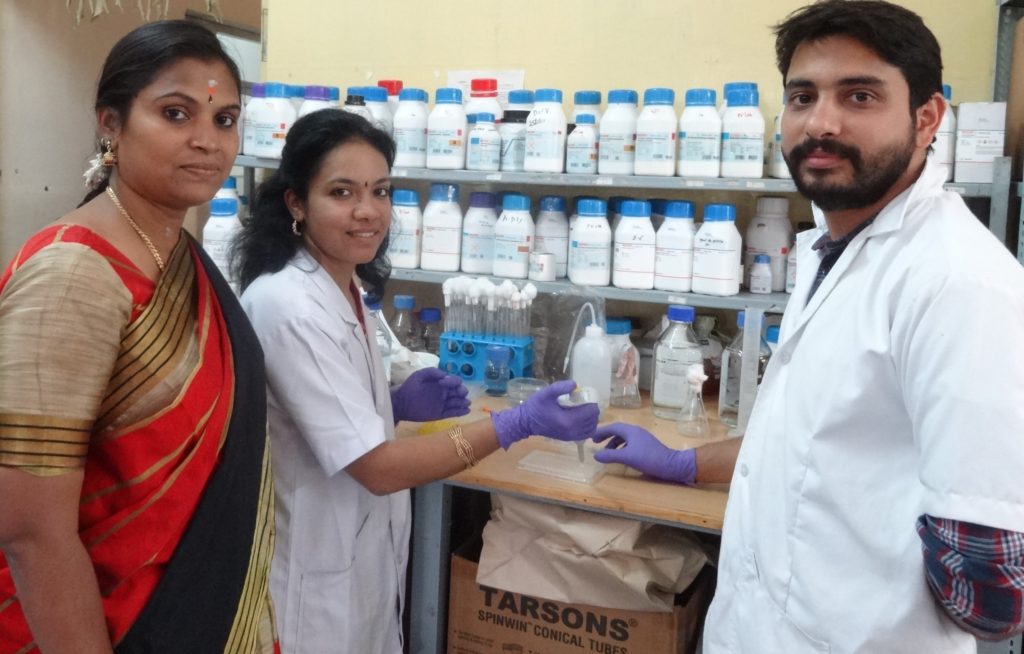
Researchers at their lab in Madurai Kamaraj University

Human cells need a steady supply of an amino acid, Asparagine, to build proteins and use an enzyme called asparagine synthetase to make it. Cancerous cells, however, rely on blood for their requirement of asparagine.

L-Asparaginase therapy takes advantage of this. L-Asparaginase enzyme performs the opposite reaction to asparagine synthetase. It catalyzes the conversion of L-asparagine to aspartic acid and ammonia. If a large dose of this enzyme is introduced into the blood, it will circulate and continually break down all asparagine that it finds, ultimately starving the cells that depend on blood for asparagine supply.

L-Asparaginase is an effective therapy for those cases where blood cells become cancerous, such as in acute lymphoblastic leukemia. L-Asparaginase cuts off the supply of asparagine in blood and cancer cells die as they are unable to build their proteins. It is produced from various microbes including a marine bacterium called Bacillus tequilensis PV9W.

Researchers cloned the gene coding for L-asparaginase from Bacillus tequilensis PV9W and expressed it in Escherichia coli BL21 bacterium. In just 12 hours they could produce as much quantity of recombinant enzyme as the native Bacillus tequilensis PV9W could do in 48 hours.

“We have been able to cut down the production time by 75 percent at the laboratory scale. It should be possible to extrapolate the process at commercial scale,” explained Dr. P. Varalakshmi, leader of the research team, while speaking to India Science Wire.

The team has also developed another technique that promises to improve the shelf life of the L-asparaginase enzyme and enhance its activity. Researchers encapsulated native L-asparaginase of Bacillus tequilensis PV9W using solid lipid particles and hot lipid emulsion. “Tests showed that the encapsulated enzyme was stable for 25 days even when stored at 25 degrees as compared to the native enzyme which needed refrigerated conditions,” researchers said.

The enzyme has been tested on the cervical cancer cell line. “The cytotoxicity ability of the particle was found to be highly enhanced compared to the native L-asparaginase from Bacillus tequilensis PV9W,” they said.

In addition, the team has found that lipid encapsulated enzyme could be used to detect L-asparagine in cell extracts using the electrochemistry method, Differential Pulse Voltammetry (DPV). This work was done in collaboration with researchers at the Central Electro Chemical Research Institute (CECRI) at Karaikudi.

Researchers coated a glassy carbon electrode with the lipid encapsulated enzyme and found that there was a difference in the generated current when the electrode was in contact with L- asparagine. This means lipid encapsulated enzyme could possibly be used as a biosensor to monitor the cancer progression and treatment by L-asparaginase.

Besides Dr. P. Varalakshmi, the research team included Senior Scientist Dr. V. Ganesh of CECRI, Prof. Dr.V.S.Vasantha of School of Chemistry at MKU, Dr. B. Ashok Kumar, School of Genetic Engineering, MKU and research scholars Dr.G. Shakambari, and Mr. Sameer Kumar Rai. The findings have been published in the journal Scientific Reports.

By Sunderarajan Padmanabhan

Journal Article

Cloning and expression of L-asparaginase from Bacillus tequilensis PV9W and therapeutic efficacy of Solid Lipid Particle formulations against cancer

If you liked this article, then please subscribe to our YouTube Channel for the latest Science & Tech news. You can also find us on Twitter & Facebook.

Rate

L-Asparaginase is an effective therapy for those cases where blood cells become cancerous, such as in acute lymphoblastic leukemia. L-Asparaginase cuts off the supply of asparagine in blood and cancer cells die as they are unable to build their proteins. It is produced from various microbes including a marine bacterium called Bacillus tequilensis PV9W.

Researchers cloned the gene coding for L-asparaginase from Bacillus tequilensis PV9W and expressed it in Escherichia coli BL21 bacterium. In just 12 hours they could produce as much quantity of recombinant enzyme as the native Bacillus tequilensis PV9W could do in 48 hours.

“We have been able to cut down the production time by 75 percent at the laboratory scale. It should be possible to extrapolate the process at commercial scale,” explained Dr. P. Varalakshmi, leader of the research team, while speaking to India Science Wire.

The team has also developed another technique that promises to improve the shelf life of the L-asparaginase enzyme and enhance its activity. Researchers encapsulated native L-asparaginase of Bacillus tequilensis PV9W using solid lipid particles and hot lipid emulsion. “Tests showed that the encapsulated enzyme was stable for 25 days even when stored at 25 degrees as compared to the native enzyme which needed refrigerated conditions,” researchers said.

The enzyme has been tested on the cervical cancer cell line. “The cytotoxicity ability of the particle was found to be highly enhanced compared to the native L-asparaginase from Bacillus tequilensis PV9W,” they said.

In addition, the team has found that lipid encapsulated enzyme could be used to detect L-asparagine in cell extracts using the electrochemistry method, Differential Pulse Voltammetry (DPV). This work was done in collaboration with researchers at the Central Electro Chemical Research Institute (CECRI) at Karaikudi.

Researchers coated a glassy carbon electrode with the lipid encapsulated enzyme and found that there was a difference in the generated current when the electrode was in contact with L- asparagine. This means lipid encapsulated enzyme could possibly be used as a biosensor to monitor the cancer progression and treatment by L-asparaginase.

Besides Dr. P. Varalakshmi, the research team included Senior Scientist Dr. V. Ganesh of CECRI, Prof. Dr.V.S.Vasantha of School of Chemistry at MKU, Dr. B. Ashok Kumar, School of Genetic Engineering, MKU and research scholars Dr.G. Shakambari, and Mr. Sameer Kumar Rai. The findings have been published in the journal Scientific Reports.

By Sunderarajan Padmanabhan

Journal Article

Cloning and expression of L-asparaginase from Bacillus tequilensis PV9W and therapeutic efficacy of Solid Lipid Particle formulations against cancer

If you liked this article, then please subscribe to our YouTube Channel for the latest Science & Tech news. You can also find us on Twitter & Facebook.
" }
Records of Historical Supernova Found in Karnataka

Records of Historical Supernova Found in Karnataka

Imagine walking at dusk under a blue sky that is gradually turning black. Twinkling stars are beginning to appear here and there. And suddenly you discover new star dazzling that was not there the previous night. Could it be Venus or perhaps a comet?

  • News
  • 3.1K
Read more
New Nanocomposite for Flexible Electronic Devices in The Offing

New Nanocomposite for Flexible Devices in The Offing

Researchers from Chennai based SRM Institute of Science and Technology have demonstrated the electronic properties of a nanocomposite made from graphene and Polyvinylidene Fluoride

  • News
  • 1.8K
Read more

USC Stem Cell scientists obtain “how to” guide for producing hair follicles

How does the skin develop follicles and eventually sprout hair? A USC-led study, published in the Proceedings of the National Academy of Sciences (PNAS), addresses this question using insights gleaned from organoids, 3D assemblies of cells possessing rudimentary skin structure and function--including the ability to grow hair.

  • News
  • 1.9K
Read more

Internet is huge! Help us find great content

Newsletter

Never miss a thing! Sign up for our newsletter to stay updated.

About

Research Stash is a curated collection of tools and News for S.T.E.M researchers

Have any questions or want to partner with us? Reach us at hello@researchstash.com

Navigation

Submit