Indo-Pak Study Reveals Extensive Arsenic Problem in Punjab Groundwater

Indo-Pak Study Reveals Extensive Arsenic Problem in Punjab Groundwater

  • Research Stash
  • News
  • 2.4K

A new survey has shown that there is a major problem of arsenic contamination of groundwater in flood plains of Ravi river on both sides of the India-Pakistan border.

The study covered 30,567 wells in 383 villages dotting along both sides of the border and it found that as much as 23 per cent of them had arsenic content higher than the limit set by the World Health Organization. The problem appeared to be more severe on the Indian side.
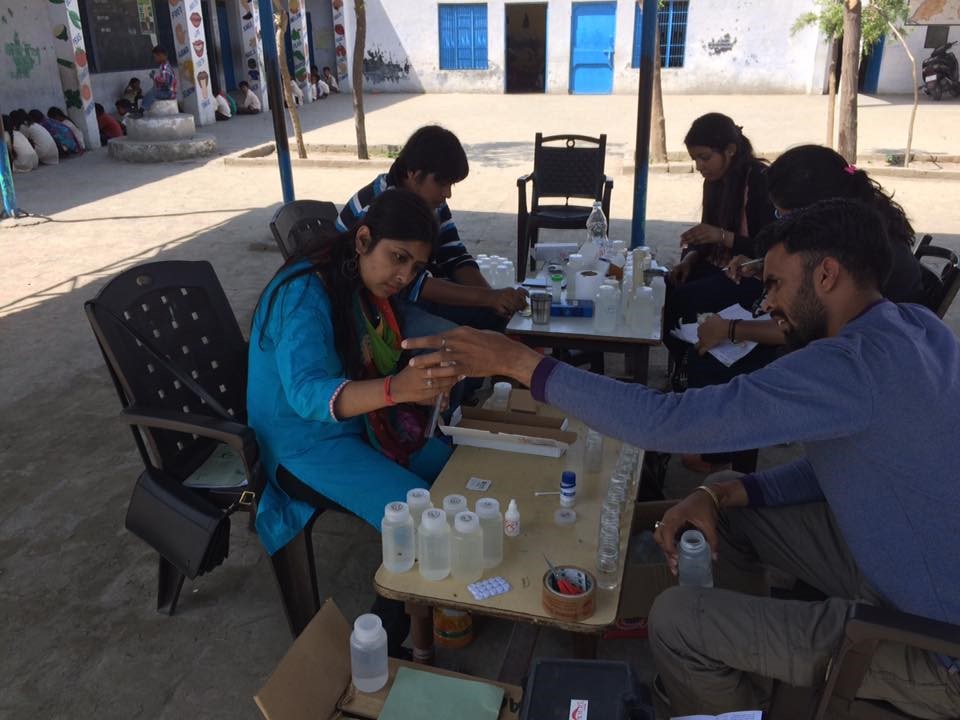
Onsite testing of samples during the study

The researchers tested water samples from 13,000 wells from 199 villages on the Indian side and 17,567 wells from 184 villages on the Pakistan side. But the proportion of wells with higher level of arsenic was more in the Indian villages at 25 per cent. Water samples were tested using a portable field kit. Later a set of sub-samples was also tested in laboratory to validate the results.

So far, arsenic was considered to be a major problem mainly in the Ganges-Brahmaputra basin comprising of West Bengal, Bihar, Jharkhand, Uttar Pradesh, Assam, Manipur and Chhattisgarh. “It was known also that there is arsenic contamination in groundwater in Punjab. But full extent of the problem was not known as studies conducted so far were limited in scope. Now it is clear that Punjab’s floodplains are also severely affected by arsenic contamination,” Dr. Chander Kumar Singh, lead researcher, explained while speaking to India Science Wire.

The study was conducted jointly by New Delhi-based TERI School of Advanced Studies, Islamabad-based Quaid-i-Azam University and Columbia University of New York. In India, water samples were tested onsite in the Amritsar, Gurdaspur and Tarn Taran along with Pathankot, Faridkot, Bhatinda, Jalandhar, Firozpur and Fazilka districts in Punjab.

In some wells, arsenic levels were found to be 20 to 50 times higher than WHO prescribed limits of 10 microgram per liter. However, it was found, 87% of households that had wells high in arsenic also had access to wells with cleaner water within a distance of 100 metres.

After conducting the tests, the surveyors informed households about the status of their wells. Hand pumps with higher levels of arsenic were marked with red metal placards and those safe with blue placards. The location of households and survey data was recorded on GPS to help future studies.

“We conducted a follow-up study one year later in five villages in Pakistan and found that the arsenic level was elevated in 59% of the wells. However, two-thirds of households indicated that they had switched to a neighboring well in response to the testing”, Dr. Singh said.

Apart from Dr. Singh, the research team included Anand Kumar (TERI School of Advanced Studies); Alexander Van Geen and Taylor Ellis (Columbia University); and Junaid Ali Khattak, Abida Faruqi, Nisbah Mustaq and Ishtiaque Hussain (Qaide-Azam University). The research results have been published in journal Science of the Total Environment.  (India Science Wire)

By Umashankar Mishra

Journal Article

Field testing of over 30,000 wells for arsenic across 400 villages of the Punjab plains of Pakistan and India: Implications for prioritizing mitigation

If you liked this article, then please subscribe to our YouTube Channel for the latest Science & Tech news. You can also find us on Twitter & Facebook.

Rate

The researchers tested water samples from 13,000 wells from 199 villages on the Indian side and 17,567 wells from 184 villages on the Pakistan side. But the proportion of wells with higher level of arsenic was more in the Indian villages at 25 per cent. Water samples were tested using a portable field kit. Later a set of sub-samples was also tested in laboratory to validate the results.

So far, arsenic was considered to be a major problem mainly in the Ganges-Brahmaputra basin comprising of West Bengal, Bihar, Jharkhand, Uttar Pradesh, Assam, Manipur and Chhattisgarh. “It was known also that there is arsenic contamination in groundwater in Punjab. But full extent of the problem was not known as studies conducted so far were limited in scope. Now it is clear that Punjab’s floodplains are also severely affected by arsenic contamination,” Dr. Chander Kumar Singh, lead researcher, explained while speaking to India Science Wire.

The study was conducted jointly by New Delhi-based TERI School of Advanced Studies, Islamabad-based Quaid-i-Azam University and Columbia University of New York. In India, water samples were tested onsite in the Amritsar, Gurdaspur and Tarn Taran along with Pathankot, Faridkot, Bhatinda, Jalandhar, Firozpur and Fazilka districts in Punjab.

In some wells, arsenic levels were found to be 20 to 50 times higher than WHO prescribed limits of 10 microgram per liter. However, it was found, 87% of households that had wells high in arsenic also had access to wells with cleaner water within a distance of 100 metres.

After conducting the tests, the surveyors informed households about the status of their wells. Hand pumps with higher levels of arsenic were marked with red metal placards and those safe with blue placards. The location of households and survey data was recorded on GPS to help future studies.

“We conducted a follow-up study one year later in five villages in Pakistan and found that the arsenic level was elevated in 59% of the wells. However, two-thirds of households indicated that they had switched to a neighboring well in response to the testing”, Dr. Singh said.

Apart from Dr. Singh, the research team included Anand Kumar (TERI School of Advanced Studies); Alexander Van Geen and Taylor Ellis (Columbia University); and Junaid Ali Khattak, Abida Faruqi, Nisbah Mustaq and Ishtiaque Hussain (Qaide-Azam University). The research results have been published in journal Science of the Total Environment.  (India Science Wire)

By Umashankar Mishra

Journal Article

Field testing of over 30,000 wells for arsenic across 400 villages of the Punjab plains of Pakistan and India: Implications for prioritizing mitigation

If you liked this article, then please subscribe to our YouTube Channel for the latest Science & Tech news. You can also find us on Twitter & Facebook.

" }
Harnessing Science, Technology and Innovation for Societal Benefits

Harnessing Science, Technology and Innovation for Societal Benefits

Director-General of Council of Scientific and Industrial Research, Dr. Shekhar C. Mande, has urged for greater collaboration between society, on one hand, and the scientific community on the other to ensure that there was proper promotion of scientific endeavors and effective utilization of the fruits of science, technology, and innovation for the welfare of the people

  • News
  • 1.7K
Read more

How Indian Telescope Data Helped Solve Mystery of Jets from Colliding Neutron Stars

The enigma of why the merger of two neutron stars resulting in a kilonova explosion was not as bright as it should have been, has been solved by an international team of astronomers using crucial data from the Indian radio telescope, the Giant Meterwave Radio Telescope (GMRT) near Pune.

  • News
  • 2.6K
Read more
A quantum gate between atoms and photons may help in scaling up quantum computers

A quantum gate between atoms and photons may help in scaling up quantum computers

Research in the quantum optics lab of Prof. Barak Dayan in the Weizmann Institute of Science may be bringing the development of supercomputers one step closer by providing the “quantum gates” that are required for communication within and between such quantum computers.

  • News
  • 2.3K
Read more

Internet is huge! Help us find great content

Newsletter

Never miss a thing! Sign up for our newsletter to stay updated.

About

Research Stash is a curated collection of tools and News for S.T.E.M researchers

Have any questions or want to partner with us? Reach us at hello@researchstash.com

Navigation

Submit