
For the latest Science, Tech news and conversations, follow Research Stash on Twitter, Facebook, and subscribe to our YouTube channel

Scientists Develop Early Flowering Transgenic Mustard

  • Research Stash
  • News
  • 2.7K

Researchers at Delhi-based TERI School of Advanced Studies have developed an early flowering transgenic variety of mustard.

The work is important as Indian mustard is a major oilseed crop in the country and due to changing climate the number of cold days required for full plant cycle has shrunken. Scientists have been working on improving crop varieties by modifying plant genes to make them more adaptable changing climate. Early flowering and maturing varieties can help cope with climate change, without compromising on yields.

Dr Anandita Singh

Dr Anandita Singh

Researchers led by Dr Anandita Singh figured out the role of a regulatory gene, called MIR172 belonging to the micro RNA family, that is present in functionally varied forms in Indian mustard (Brassica juncea) and is responsible for a number of traits including the timing of flowering. In plants, this microRNA enacts by negatively regulating the expression of some protein-coding genes involved in flowering time.
Scientists Develop Early Flowering Transgenic Mustard

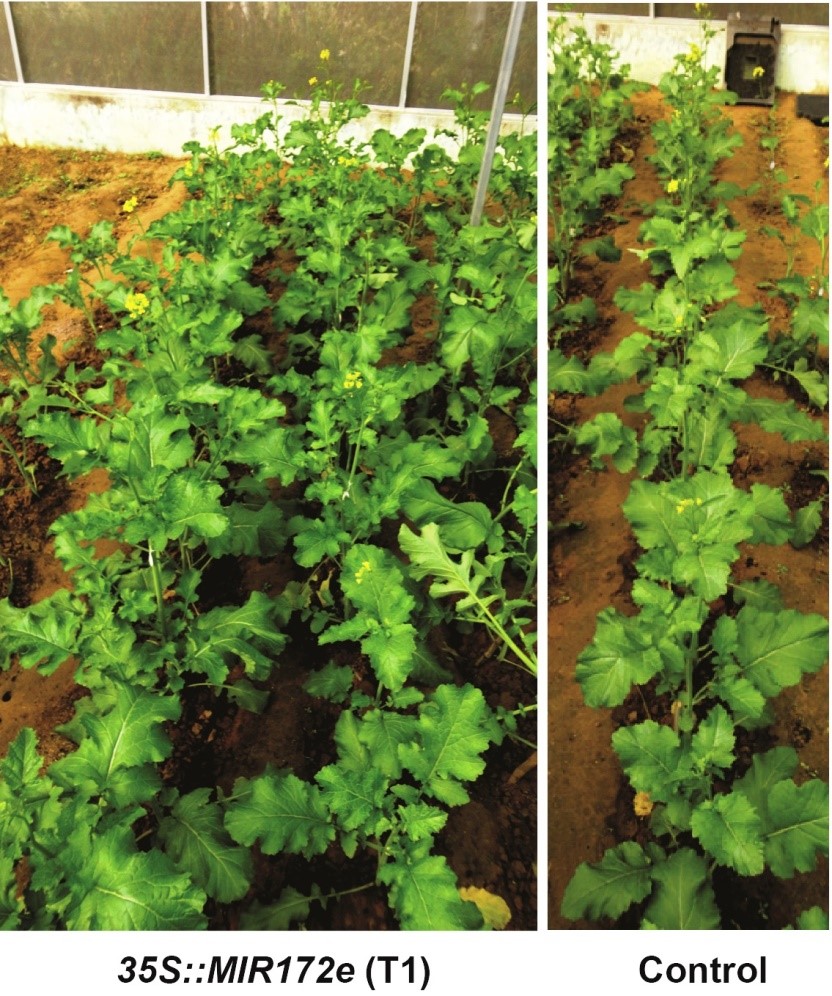
By increasing the expression of this microRNA, the researchers have developed an early flowering transgenic plant of Indian mustard cultivar Brassica juncea cv. Varuna and shown that by manipulating flowering time, one can develop a plant variety with shorter life cycle and thus help have better yields through reduced exposure to the harsh climatic conditions in the fields.

“Given the diversity in evolutionary lineages of Brassica MIR172 candidates that were discovered in our study, it will be interesting to characterize the entire range of natural variants of Brassica MIR172 by altering, modulating or tinkering the expression levels and pattern of these genes and studying the impact/outcome in the plants,” Dr Singh explained while speaking to India Science Wire. She said, “we have good reasons to believe that novel natural alleles of Brassica MIR172 are both a blueprint and a valuable resource of favourable agronomic traits to be transferred into elite crop varieties.”

Apart from MIR172, the research group is studying several genes that affect other traits that might be useful in generating better varieties. “Analysis of transgenics in natural field conditions showed that most Brassica genes govern several dependents and independent agronomic traits. Changing one trait to achieve a favourable outcome may offset another trait. Thus, future studies will involve careful optimization of gene levels for minimizing trait trade-offs,” Dr Singh added.

Dr Sunil Mukherjee, NASI Senior Scientist at the Department of Genetics, University of Delhi South Campus, who was not connected with the study, feels the study is important. “Most crop plants are polyploids or having multiple copies of a gene in nature and a longstanding question in biology is how polyploidy influences gene expression.

This research is a welcome move in this direction as MIR172 has been used as a probe in Brassica polyploidy and structural variants of a MIR172 family have been nicely portrayed. It has also been shown that family members are functionally different and polyploidy affects gene outcomes.”

The research team included S M Shivaraj and Aditi Jain, besides Anandita Singh from TERI School of Advanced Studies. The research results have been published in journal Molecular Genetics and Genomics. This work was supported by the Department of Biotechnology. (India Science Wire)

By Shikha T Malik

Journal Article

Highly preserved roles of Brassica MIR172 in polyploid Brassicas: ectopic expression of variants of Brassica MIR172 accelerates floral transition.

For the latest Science, Tech news and conversations, follow Research Stash on TwitterFacebook, and subscribe to our YouTube channel 
Rate

Dr Anandita Singh

Researchers led by Dr Anandita Singh figured out the role of a regulatory gene, called MIR172 belonging to the micro RNA family, that is present in functionally varied forms in Indian mustard (Brassica juncea) and is responsible for a number of traits including the timing of flowering. In plants, this microRNA enacts by negatively regulating the expression of some protein-coding genes involved in flowering time.

Scientists Develop Early Flowering Transgenic Mustard

By increasing the expression of this microRNA, the researchers have developed an early flowering transgenic plant of Indian mustard cultivar Brassica juncea cv. Varuna and shown that by manipulating flowering time, one can develop a plant variety with shorter life cycle and thus help have better yields through reduced exposure to the harsh climatic conditions in the fields.

“Given the diversity in evolutionary lineages of Brassica MIR172 candidates that were discovered in our study, it will be interesting to characterize the entire range of natural variants of Brassica MIR172 by altering, modulating or tinkering the expression levels and pattern of these genes and studying the impact/outcome in the plants,” Dr Singh explained while speaking to India Science Wire. She said, “we have good reasons to believe that novel natural alleles of Brassica MIR172 are both a blueprint and a valuable resource of favourable agronomic traits to be transferred into elite crop varieties.”

Apart from MIR172, the research group is studying several genes that affect other traits that might be useful in generating better varieties. “Analysis of transgenics in natural field conditions showed that most Brassica genes govern several dependents and independent agronomic traits. Changing one trait to achieve a favourable outcome may offset another trait. Thus, future studies will involve careful optimization of gene levels for minimizing trait trade-offs,” Dr Singh added.

Dr Sunil Mukherjee, NASI Senior Scientist at the Department of Genetics, University of Delhi South Campus, who was not connected with the study, feels the study is important. “Most crop plants are polyploids or having multiple copies of a gene in nature and a longstanding question in biology is how polyploidy influences gene expression.

This research is a welcome move in this direction as MIR172 has been used as a probe in Brassica polyploidy and structural variants of a MIR172 family have been nicely portrayed. It has also been shown that family members are functionally different and polyploidy affects gene outcomes.”

The research team included S M Shivaraj and Aditi Jain, besides Anandita Singh from TERI School of Advanced Studies. The research results have been published in journal Molecular Genetics and Genomics. This work was supported by the Department of Biotechnology. (India Science Wire)

By Shikha T Malik

Journal Article

Highly preserved roles of Brassica MIR172 in polyploid Brassicas: ectopic expression of variants of Brassica MIR172 accelerates floral transition.

For the latest Science, Tech news and conversations, follow Research Stash on TwitterFacebook, and subscribe to our YouTube channel 

" }

Scientists Meet to Understand Solar Cycle Better

Influence of the Sun on the Earth is modulated by solar activity cycle. The 11-year cycle is one of the most striking phenomena in solar physics and has fascinated both specialists and laymen for centuries.

  • News
  • 3.2K
Read more
New Polymeric Material Developed for Controlled Release of Two Different Drugs

New Polymeric Material Developed for Controlled Release of Two Different Drugs

A team of researchers at Indian Institute of Technology, Guwahati has developed a biocompatible polymeric material that promises to help in the simultaneous and extended release of two different drugs from a single platform

  • News
  • 2.6K
Read more
Albumin Better Indicator of Diabetes: Study

Albumin Better Indicator of Diabetes: Study

Based on findings of their new research, scientists at the National Chemical Laboratory, Pune have suggested that measuring levels of free albumin and albumin attached to glucose molecules in the blood can be a better diagnostic test for diabetes and help in its management.

  • News
  • 2.2K
Read more

Internet is huge! Help us find great content

Newsletter

Never miss a thing! Sign up for our newsletter to stay updated.

About

Research Stash is a curated collection of tools and News for S.T.E.M researchers

Have any questions or want to partner with us? Reach us at hello@researchstash.com

Navigation

Submit