
Science Is Not for Children Alone but Is a Way of Life

Science Is Not for Children Alone but Is a Way of Life

  • Research Stash
  • News
  • 2.1K

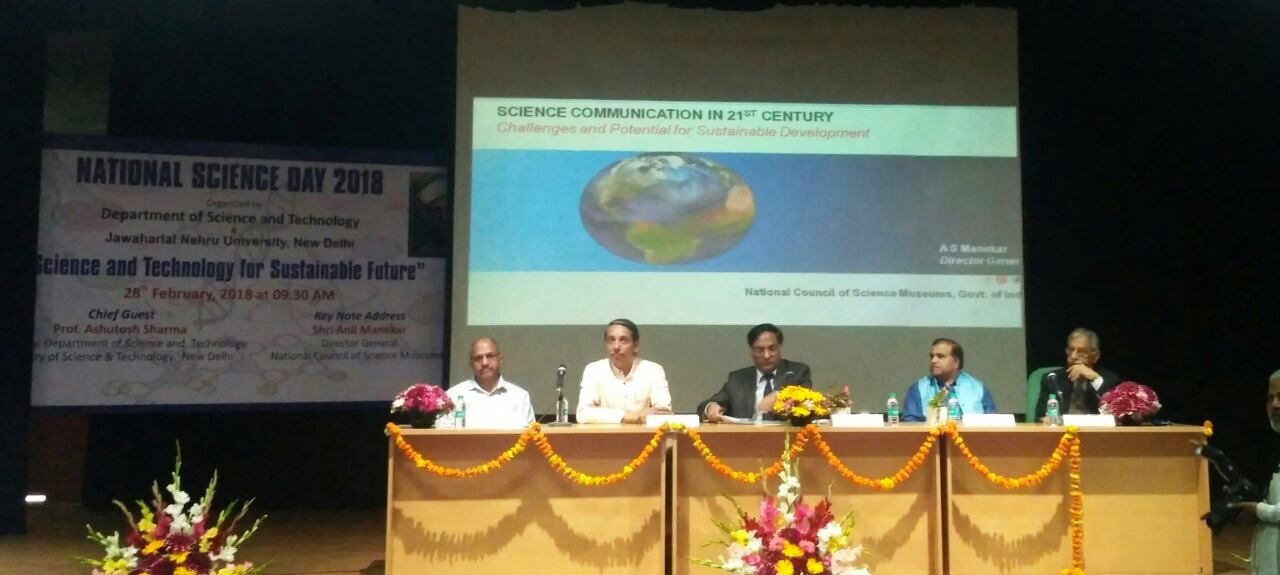
Eminent physicist, Sir C.V.Raman was the toast of the day as Department of Science and Technology (DST) and Jawaharlal Nehru University (JNU) jointly celebrated the National Science Day to mark the discovery of Raman Effect which won him Nobel Prize and helped place India in the global map of science.

Director General of the National Council of Science Museum (NCSM), Anil Manekar, who delivered the keynote address, set the tone for the deliberations by recalling how apart from pursuing cutting-edge science with limited resources, Raman made special efforts to popularize science among the people.

Noting that there was a myth that science was meant for children alone, he said there was a need for efforts to make science a way of life. “There is science in everything we do from morning to night. There is a need to appreciate this and promote the scientific attitude among the common man.”

Emphasising that the scientific community had a great role to play in ensuring a sustainable future for the coming generations, he said there was a need for scientists and technologists to work in unison with policymakers and other sections of the society.

He detailed how NCSM was working to create awareness as to how science could help in solving various problems facing the country such as poverty, health, education and other such social issues through its science centers established across the country.

DST Secretary Dr. Ashutosh Sharma said even while celebrating contributions made by eminent scientists such as Sir C.V. Raman, S.N.Bose, and Meghanad Saha, scientists need to try to excel them. There was a need to combine the eastern philosophy of `learning at the feet of the master’ with the Western thought that focused on `standing on the shoulders of the giants and look far ahead’.

He urged scientists to make use of the government’s latest Programme to encourage young scientists to write popular articles about their research work. “We expect about 5,000 entries every year. Hundred top articles will be shortlisted and rewarded amply. We will also arrange for them to be published in newspapers, magazines, and other popular outlets”.

JNU Vice-Chancellor, Prof. M.Jagdeesh Kumar, emphasized the need for promoting renewable energy to ensure a sustainable future and urged for efforts to develop high capacity battery systems to store power generated by them. “Presently, lithium is the material of choice but it is not available in the country. We have to identify materials that are locally available in abundance”.  (India Science Wire)

By Sundararajan Padmanabhan

For the latest Science, Tech news and conversations, follow Research Stash on TwitterFacebook, and subscribe to our YouTube channel 
Rate

Emphasising that the scientific community had a great role to play in ensuring a sustainable future for the coming generations, he said there was a need for scientists and technologists to work in unison with policymakers and other sections of the society.

He detailed how NCSM was working to create awareness as to how science could help in solving various problems facing the country such as poverty, health, education and other such social issues through its science centers established across the country.

DST Secretary Dr. Ashutosh Sharma said even while celebrating contributions made by eminent scientists such as Sir C.V. Raman, S.N.Bose, and Meghanad Saha, scientists need to try to excel them. There was a need to combine the eastern philosophy of `learning at the feet of the master’ with the Western thought that focused on `standing on the shoulders of the giants and look far ahead’.

He urged scientists to make use of the government’s latest Programme to encourage young scientists to write popular articles about their research work. “We expect about 5,000 entries every year. Hundred top articles will be shortlisted and rewarded amply. We will also arrange for them to be published in newspapers, magazines, and other popular outlets”.

JNU Vice-Chancellor, Prof. M.Jagdeesh Kumar, emphasized the need for promoting renewable energy to ensure a sustainable future and urged for efforts to develop high capacity battery systems to store power generated by them. “Presently, lithium is the material of choice but it is not available in the country. We have to identify materials that are locally available in abundance”.  (India Science Wire)

By Sundararajan Padmanabhan

For the latest Science, Tech news and conversations, follow Research Stash on TwitterFacebook, and subscribe to our YouTube channel 

" }
Researchers Study Egg-Laying Behavior Of Wasps for Designing Specific Pest Control Measures

Researchers Study Egg-Laying Behavior Of Wasps for Designing Specific Pest Control Measures

A new study conducted by researchers will help understand the egg-laying behaviour of certain pests and therefore help in designing specific control measures

  • News
  • 1.7K
Read more

India May Not Achieve SDG Targets on Reducing Child Mortality

A new study has warned that over two-thirds of the districts in the country are unlikely to achieve the UN Sustainable Development Goal (SDG) target of reducing deaths to 25 or less per 1000 live births in under 5-year old children and 12 or less per 1000 live births for newborns by 2030

  • News
  • 2.1K
Read more
Scientists Provide New Insight into Bipolar Disorder

Scientists Provide New Insight into Bipolar Disorder

Researchers have found that bipolar disorder patients carry some residual impairment in terms of processing of information even in their ‘normal’ phases

  • News
  • 1.8K
Read more

Internet is huge! Help us find great content

Newsletter

Never miss a thing! Sign up for our newsletter to stay updated.

About

Research Stash is a curated collection of tools and News for S.T.E.M researchers

Have any questions or want to partner with us? Reach us at [email protected]

Navigation

Submit