
Country’s First Open Rock Museum Inaugurated In Hyderabad

Country’s First Open Rock Museum Inaugurated In Hyderabad

  • Research Stash
  • News
  • 1.9K

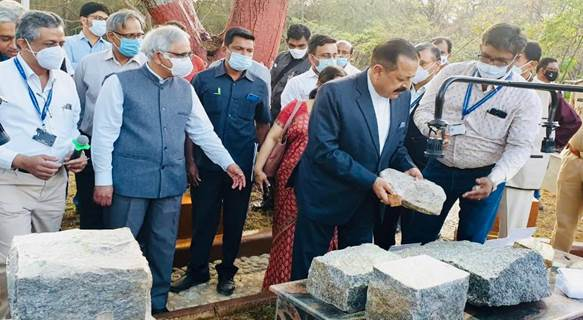
The Union Minister of State Science & Technology Dr. Jitendra Singh inaugurated the country’s first open rock museum in Hyderabad, on Thursday.

The new rock museum on the campus of the Council of Scientific and Industrial Research-National Geophysical Research Institute (CSIR-NGRI), houses around 35 different types of rocks from different parts of India with ages ranging from 3.3 billion years to around 55 million years. It aims to educate and enlighten the masses about the lesser-known physical properties of the earth and its surrounding environment.

One of the recent decisions we also took, because we are going through the 75 years of independence, was, that we would have 75 science museums across the nation. We entered an MoU with the Ministry of Culture for this project about two months ago”, Minister said.

He noted that Big Earth data occupied the strategic high ground in the era of knowledge economies and said that India is fully exploiting this new frontier contributing to the advancement of earth science. Geo science is contributing significantly towards self-reliance and national priorities in new India, he added.

On the occasion, Dr. Jitendra Singh also released earthquake risk maps of Lucknow and Dehradun cities and handed them to the representatives of Uttarakhand and Uttar Pradesh State Disaster Management Authorities. The maps have been prepared by NGRI considering the seismic vulnerability of the two cities. They are prepared by characterizing the hazard and its uncertainty, to serve as input for risk assessment and earthquake-resistant design for different applications – ranging from private homes to multi-storied buildings and critical infrastructures such as bridges or dams.

The Minister noted that science blended with creative innovation brings ease of living for the common man and urged scientists to adopt out of box thinking to address the problems of the people. He said the expectations of society from scientists are ever-growing and scientists should continuously be involved in providing the best S&T solutions.

Dr. Singh also recalled that while the country is celebrating its 75 years of Independence as “Azadi Ka Amrit Mahotsav”, CSIR is celebrating 80 years of its foundation and said it was appropriate that all ministries and departments who are pursuing science should explore S&T innovations for making India self-reliant in different sectors. He emphasized that India should be a global leader in matters ranging from defense to economics with strong scientific and technological inputs in another 25 years when India celebrates 100 years of Independence.

Referring to CSIR-NGRI’s aim to focus on deep-earth and near-surface explorations to have a better understanding of the processes responsible for shaping Earth’s structure and dynamics, and for the sustenance of life on Earth, Dr. Jitendra Singh expressed hope that with its charted vision and mission, CSIR-NGRI will play a vital and pivotal role in coming years to fulfill the aspirations of the nation.

If you liked this article, then please subscribe to our YouTube Channel for the latest Science & Tech news. You can also find us on Twitter & Facebook

Rate

He noted that Big Earth data occupied the strategic high ground in the era of knowledge economies and said that India is fully exploiting this new frontier contributing to the advancement of earth science. Geo science is contributing significantly towards self-reliance and national priorities in new India, he added.

On the occasion, Dr. Jitendra Singh also released earthquake risk maps of Lucknow and Dehradun cities and handed them to the representatives of Uttarakhand and Uttar Pradesh State Disaster Management Authorities. The maps have been prepared by NGRI considering the seismic vulnerability of the two cities. They are prepared by characterizing the hazard and its uncertainty, to serve as input for risk assessment and earthquake-resistant design for different applications – ranging from private homes to multi-storied buildings and critical infrastructures such as bridges or dams.

The Minister noted that science blended with creative innovation brings ease of living for the common man and urged scientists to adopt out of box thinking to address the problems of the people. He said the expectations of society from scientists are ever-growing and scientists should continuously be involved in providing the best S&T solutions.

Dr. Singh also recalled that while the country is celebrating its 75 years of Independence as “Azadi Ka Amrit Mahotsav”, CSIR is celebrating 80 years of its foundation and said it was appropriate that all ministries and departments who are pursuing science should explore S&T innovations for making India self-reliant in different sectors. He emphasized that India should be a global leader in matters ranging from defense to economics with strong scientific and technological inputs in another 25 years when India celebrates 100 years of Independence.

Referring to CSIR-NGRI’s aim to focus on deep-earth and near-surface explorations to have a better understanding of the processes responsible for shaping Earth’s structure and dynamics, and for the sustenance of life on Earth, Dr. Jitendra Singh expressed hope that with its charted vision and mission, CSIR-NGRI will play a vital and pivotal role in coming years to fulfill the aspirations of the nation.

If you liked this article, then please subscribe to our YouTube Channel for the latest Science & Tech news. You can also find us on Twitter & Facebook
" }
No More Slaughtering of Animals for Meat

No More Slaughtering of Animals for Meat

The traditional way of producing meat by slaughtering animals may be a matter of past in a few years as Indian scientists begin work on ‘cultured meat’ - meat made by cells extracted from animals

  • News
  • 2.1K
Read more
Fireflies Emit Light Similar to Lasers

Fireflies Emit Light Similar to Lasers

Fireflies are known for the light they emit during nights. A new study has analyzed the light emitted from fireflies and found a certain portion of it to be similar to laser beams.

  • News
  • 2.3K
Read more
Micro needle-Based System Can Take Pain Away from Vaccinations

Microneedle-Based System Can Take Pain Away from Vaccinations

For kids who hate needle pricks, there may be another option in the offing. Scientists at Hyderabad campus of Birla Institute of Technology and Science (BITS) Pilani have developed a microneedle patch for drug delivery using a biopolymer, zein.

  • News
  • 2.2K
Read more

Internet is huge! Help us find great content

Newsletter

Never miss a thing! Sign up for our newsletter to stay updated.

About

Research Stash is a curated collection of tools and News for S.T.E.M researchers

Have any questions or want to partner with us? Reach us at hello@researchstash.com

Navigation

Submit