
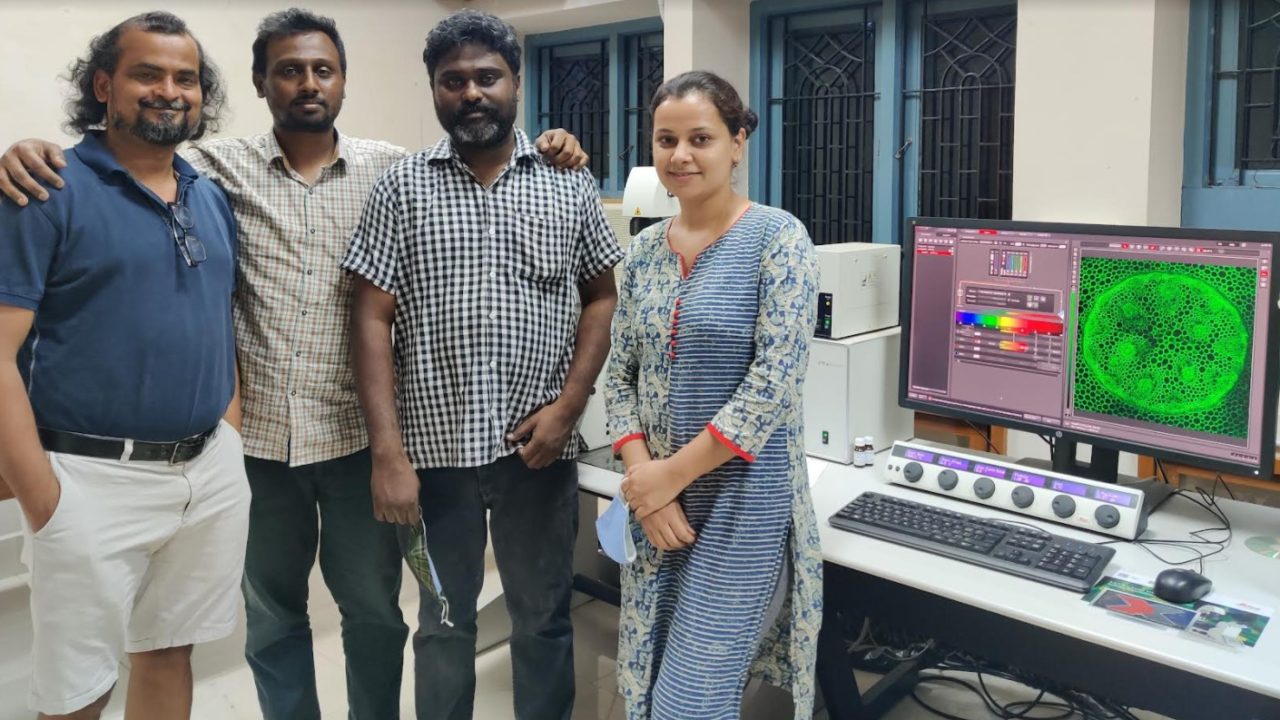
IIT Madras Research Team that won the ‘SERB-Technology Translation Award’ for their work on White Light Emitters for LED Applications

Researchers Design White Light Emitters for LED Applications

  • Research Stash
  • News
  • 1.7K

The conventional LED materials cannot emit white light and specialized techniques such as coating blue LED with yellow phosphor and combining blue, green, and red LEDs, have been used to produce white light. There has been a worldwide search for materials that can directly emit white light rather than through these indirect techniques that can cause loss of efficiency.
Transcriptome-wide Association Study and eQTL colocalization identify potentially causal genes responsible for bone mineral density GWAS associations
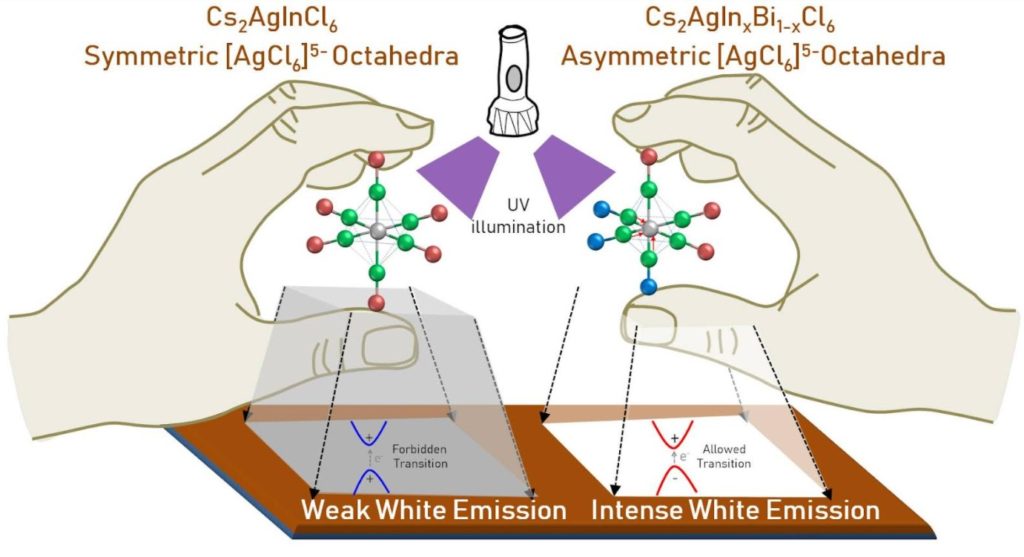
A visual representation of the IIT Madras Research on White Light Emitters for LED Applications

Researchers at the Indian Institute of Technology (IIT) Madras have successfully developed a white light emitter for use in LEDs. The development of energy-efficient Light Emitting Diodes or LEDs replaced the energy-inefficient incandescent lamps in lighting and display applications. While LEDs have been available in almost all colors, white LEDs are a more recent development.

The innovation has been patented by the researchers and was recently granted the Government of India’s ‘SERB-Technology Translation Award.’ The Science and Engineering Research Board (SERB) provides financial assistance to researchers, academic institutions, research and development laboratories, industrial concerns, and other agencies. The team proposes to use the grant money of Rs. 30 lakh to produce LEDs using their distorted perovskite materials.

This study was led by Dr. Aravind Kumar Chandiran, Assistant Professor, Department of Chemical Engineering, IIT Madras, and Prof. Ranjit Kumar Nanda B., Department of Physics, IIT Madras.

Explaining the practical applications of this Research, Dr. Aravind Kumar Chandiran, Assistant Professor, Department of Chemical Engineering, IIT Madras, said, “The indigenously-developed bright white light emitters can potentially replace the conventional high-cost materials and phenomenally save the energy cost per lumens.” “We believe that our work contributes to Government of India’s ‘Make in India’ program and we hope to become a technology leader in light emitters in the near future”, Dr. Chandiran added.

Researchers, in addition to reporting the details of the specific perovskite material, have also proposed a clear design strategy that scientists can employ to develop white light emitters.

Highlighting the impact this research could have in the field, Prof. Ranjit Kumar Nanda B., Department of Physics, IIT Madras, said, “Tuning the distortion at the atomic level to extract white light will motivate perovskite community to explore this topic much deeper.”

The IIT Madras team has been exploring crystalline materials called ‘Halide-Perovskites’ for various applications due to their extraordinary optoelectronic properties and excellent light-to-current conversion efficiencies.

The researchers developed expertise in tuning the material at an atomic level to obtain different properties. Through a recent project that included simulation and experimental work, the team distorted the crystal structure of this material to obtain a natural white light emitter.

Elaborating further, Dr. Aravind Kumar Chandiran said, “The strategic introduction of distortion in halide perovskite generated intense light covering the complete visible spectrum. These materials show at least eight times intense white light emission compared to the conventional Ce: YAG emitters.”

This distorted perovskite can be used independently as a white light emitter or as a phosphor in combination with blue LEDs to produce white light.

Unlike other recently developed white LED materials, this distorted perovskite showed phenomenal stability under ambient conditions. The emission of intense light and stability make them useful in long-lasting, energy-saving lighting applications.  Apart from general lighting, white LEDs can potentially be used in liquid crystal display backlights, display mobile lighting, and medical and communication equipment.

The study has been published in the research journal Communications Materials. Apart from Dr. Ranjit Kumar Nanda B. and Dr. Aravind Kumar Chandiran; Dr. Tamilselvan Appadurai, Mr. Ravi Kashikar, Ms. Poonam Sikarwar, and Dr. Sudhadevi Antharjanam were involved in the study.  (ISW)

If you liked this article, then please subscribe to our YouTube Channel for the latest Science & Tech news. You can also find us on Twitter & Facebook
Rate

This study was led by Dr. Aravind Kumar Chandiran, Assistant Professor, Department of Chemical Engineering, IIT Madras, and Prof. Ranjit Kumar Nanda B., Department of Physics, IIT Madras.

Explaining the practical applications of this Research, Dr. Aravind Kumar Chandiran, Assistant Professor, Department of Chemical Engineering, IIT Madras, said, “The indigenously-developed bright white light emitters can potentially replace the conventional high-cost materials and phenomenally save the energy cost per lumens.” “We believe that our work contributes to Government of India’s ‘Make in India’ program and we hope to become a technology leader in light emitters in the near future”, Dr. Chandiran added.

Researchers, in addition to reporting the details of the specific perovskite material, have also proposed a clear design strategy that scientists can employ to develop white light emitters.

Highlighting the impact this research could have in the field, Prof. Ranjit Kumar Nanda B., Department of Physics, IIT Madras, said, “Tuning the distortion at the atomic level to extract white light will motivate perovskite community to explore this topic much deeper.”

The IIT Madras team has been exploring crystalline materials called ‘Halide-Perovskites’ for various applications due to their extraordinary optoelectronic properties and excellent light-to-current conversion efficiencies.

The researchers developed expertise in tuning the material at an atomic level to obtain different properties. Through a recent project that included simulation and experimental work, the team distorted the crystal structure of this material to obtain a natural white light emitter.

Elaborating further, Dr. Aravind Kumar Chandiran said, “The strategic introduction of distortion in halide perovskite generated intense light covering the complete visible spectrum. These materials show at least eight times intense white light emission compared to the conventional Ce: YAG emitters.”

This distorted perovskite can be used independently as a white light emitter or as a phosphor in combination with blue LEDs to produce white light.

Unlike other recently developed white LED materials, this distorted perovskite showed phenomenal stability under ambient conditions. The emission of intense light and stability make them useful in long-lasting, energy-saving lighting applications.  Apart from general lighting, white LEDs can potentially be used in liquid crystal display backlights, display mobile lighting, and medical and communication equipment.

The study has been published in the research journal Communications Materials. Apart from Dr. Ranjit Kumar Nanda B. and Dr. Aravind Kumar Chandiran; Dr. Tamilselvan Appadurai, Mr. Ravi Kashikar, Ms. Poonam Sikarwar, and Dr. Sudhadevi Antharjanam were involved in the study.  (ISW)

If you liked this article, then please subscribe to our YouTube Channel for the latest Science & Tech news. You can also find us on Twitter & Facebook
" }
Gender Balance in Scientific Research Improving in India

Gender Balance in Scientific Research Improving in India

The participation of Indian women in scientific publishing is growing in certain fields like mathematics, economics, obstetrics, gynecology, and dentistry

  • News
  • 2.7K
Read more

Science Films Can Help Promote Scientific Temperament

Over 200 films makers along with a large contingent of scientists, students and film critics from across the country have gathered here for the eighth edition of the National Science Film Festival of India (NSFFI) which began today at the P.D Hall of Gauhati University.

  • News
  • 2.1K
Read more

WCIT 2017 ICT Award Winners Shared their Dreams of Future Digital Economy Revolution

The three-day event WCIT 2017 was successfully concluded yesterday and the main highlight of the event was the WCIT 2017 ITC award ceremony.  The 21st World Congress on Information Technology kick-started in Taipei on September 11th. The 3-day event was aimed at bringing in the latest trends of digital economy development to the island nation.

  • News
  • 2.3K
Read more

Internet is huge! Help us find great content

Newsletter

Never miss a thing! Sign up for our newsletter to stay updated.

About

Research Stash is a curated collection of tools and News for S.T.E.M researchers

Have any questions or want to partner with us? Reach us at hello@researchstash.com

Navigation

Submit