
Wood Substitute from Argo-Industrial Waste

Wood Substitute from Argo-Industrial Waste

  • Research Stash
  • News
  • 1.7K

India, the second-largest agro-based economy with year-round crop cultivation, generates a large volume of agricultural waste; including crop residues. Crop-residue has emerged as a threat to the environment. The burning of crop residue in Punjab and Haryana is responsible for severe air pollution during winter in Delhi and Northern India. Various ways have been thought of and used to tackle the agro-waste in an eco-friendly manner.

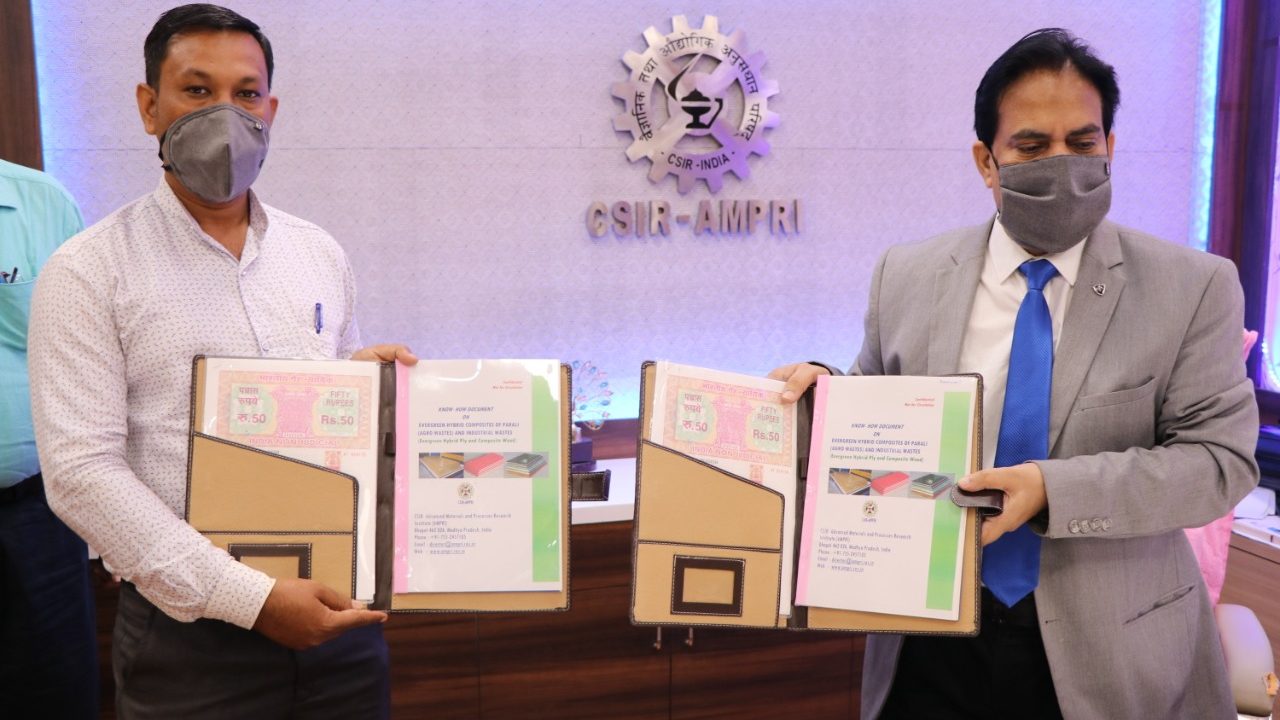
The Council of Scientific and Industrial Research-Advanced Materials and Processes Research Institute (CSIR-AMPRI), Bhopal researched to find a productive way to manage the agro-industrial waste. The findings of the research paved the way to introduce new materials for the development of a wood substitute for building applications so that the consumption of timber in building and house construction can be minimized. This technology also offers a potential solution for the effective utilization of different agro-industrial wastes such as paddy straw, wheat straw, marble wastes, red mud, fly ash, and other minerals, metallurgical wastes.

For making evergreen hybrid ply and composite wood, agro wastes primarily paddy straw/ stubble and wheat straw, and industrial wastes, mainly marble wastes, fly ash from Thermal power plants, red mud from Aluminium industries were used as a primary raw material with natural fibres in the polymeric system (Polyester / epoxy resin).

The performance of evergreen hybrid ply and composite wood would vary depending on the raw materials quantity, quality, particulate- fibre ratio, particulate/fibres – binder ratio, type of polymeric system, and processing and manufacturing conditions. It can be made in a single-stage fabrication process as solid material as well as a two-stage process as a sandwich composite of required performance. The demonstrated results revealed that high quality and glossy finish composites under single stage operating condition can be achieved using about 60% agro-industrial wastes.

The innovative composite materials have a variety of application potential for infrastructure in the construction sector, locomotive (train), and other transport systems (bus, ship, etc.) and infrastructure as doors, false ceilings, flooring, architectural wall panels, partition, and furniture, etc. The evergreen hybrid ply and composite wood are stronger and environmental-friendly.

“It is resistant to weather, corrosion, water, moisture, and is a termite and fungus free composite. The composite materials are fire retardant, self- extinguishing in nature, cost-effective, and maintenance-free materials. Evergreen Hybrid Ply and Composite Wood has the potential to be used as an alternate material for wood/timber, plastic, synthetic wood such as MDF board, particleboard and plywood, and all other conventional materials used in the furniture industry. Addition of agro-industrial wastes particulates and fibres enhance the surface finish, density, flexural modulus, and resistance to abrasion” says the statement issued by the institution. Recently the technology transfer has been done by AMPRI to M/s. Shubh Green Sheet Pvt Ltd, Bhilai. (ISW)

If you liked this article, then please subscribe to our YouTube Channel for the latest Science & Tech news. You can also find us on Twitter & Facebook

Rate

The performance of evergreen hybrid ply and composite wood would vary depending on the raw materials quantity, quality, particulate- fibre ratio, particulate/fibres – binder ratio, type of polymeric system, and processing and manufacturing conditions. It can be made in a single-stage fabrication process as solid material as well as a two-stage process as a sandwich composite of required performance. The demonstrated results revealed that high quality and glossy finish composites under single stage operating condition can be achieved using about 60% agro-industrial wastes.

The innovative composite materials have a variety of application potential for infrastructure in the construction sector, locomotive (train), and other transport systems (bus, ship, etc.) and infrastructure as doors, false ceilings, flooring, architectural wall panels, partition, and furniture, etc. The evergreen hybrid ply and composite wood are stronger and environmental-friendly.

“It is resistant to weather, corrosion, water, moisture, and is a termite and fungus free composite. The composite materials are fire retardant, self- extinguishing in nature, cost-effective, and maintenance-free materials. Evergreen Hybrid Ply and Composite Wood has the potential to be used as an alternate material for wood/timber, plastic, synthetic wood such as MDF board, particleboard and plywood, and all other conventional materials used in the furniture industry. Addition of agro-industrial wastes particulates and fibres enhance the surface finish, density, flexural modulus, and resistance to abrasion” says the statement issued by the institution. Recently the technology transfer has been done by AMPRI to M/s. Shubh Green Sheet Pvt Ltd, Bhilai. (ISW)

If you liked this article, then please subscribe to our YouTube Channel for the latest Science & Tech news. You can also find us on Twitter & Facebook

" }
Researchers Bring Out Human Microbiome-Prakriti Correlation

Researchers Bring Out Human Microbiome-Prakriti Correlation

Researchers at the Pune-based National Centre for Cellular Sciences have carried out studies to understand the association between the human microbiome and Ayurveda’s `Prakriti’. A comprehensive microbial analysis of samples from the gut, oral cavity and skin of healthy individuals was carried out.

  • News
  • 1.8K
Read more
EMBO Global Investigator Network Winners for 2019

EMBO Global Investigator Network Winners for 2019

Three Indian scientists have been selected to join the European Molecular Biology Organization’s recently launched Global Investigator Network Programme that is designed to support life scientists who are in the early stages of establishing independent laboratories, to have access to career-enhancing training and networking opportunities.

  • News
  • 3K
Read more
Super Tiny Particles Derived From Table Sugar Can Detect Lead in Water

Super Tiny Particles Derived From Table Sugar Can Detect Lead in Water

Nanotechnology deals with particles that are several thousand times smaller than a human hair, and it is being put to use in a variety of applications such as drug delivery and diagnostic tests.

  • News
  • 5.5K
Read more

Internet is huge! Help us find great content

Newsletter

Never miss a thing! Sign up for our newsletter to stay updated.

About

Research Stash is a curated collection of tools and News for S.T.E.M researchers

Have any questions or want to partner with us? Reach us at hello@researchstash.com

Navigation

Submit