
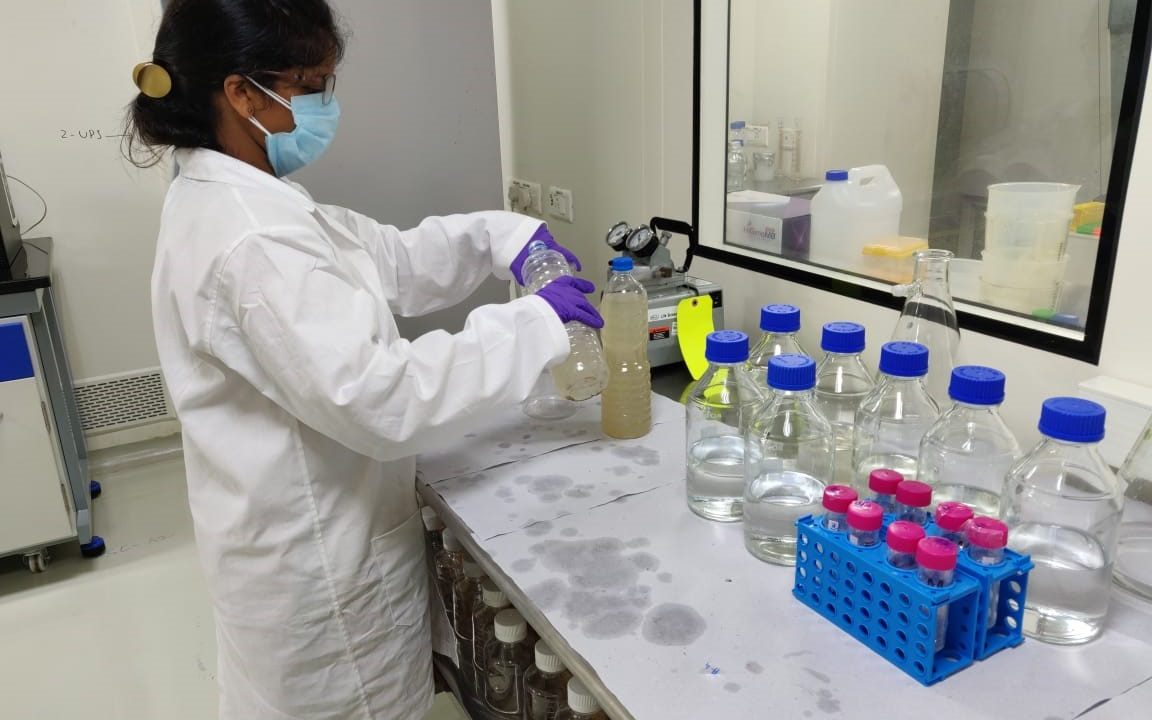
Testing of sewage samples in lab

Sewage Holds the Key to Measure the Actual Extent Of COVID-19 Spread

  • Research Stash
  • News
  • 1.4K

Various studies have demonstrated that faeces can harbour SARS-CoV-2. Centre of Scientific and Industrial Research (CSIR) institutions Centre for Cellular and Molecular Biology (CCMB) and Indian Institute of Chemical Technology (IICT) in a joint study have harvested the sewage samples to estimate the number of potentially infected individuals in the city of Hyderabad.

The novel coronavirus (SARS-CoV-2) in sewage samples is found to be non-infectious, thus it can be easily taken for epidemiological studies. Estimating the spread is very important in identifying the affected areas and controlling the pandemic. Since an infected person sheds viral material in faecal samples for up to ~35 days, these studies will provide an overall estimate of the situation in a window of one month.

To carry out the studies of sewage samples from major Sewage Treatment Plants (STPs) were processed for detecting the presence of SARS-CoV-2 viral RNA. While viral RNA is detectable in the inlet samples, the outlet (after treatment) samples of STP were largely clean (free from viral RNA) in this regard, indicating efficient treatment practices at STP.

Of the 1800 million litres water used daily in Hyderabad, 40% is processed at different STPs. This study covers about 80% of the STPs in Hyderabad revealed that there are around 2 lakh people who are shedding viral materials. Since only 40% of the Hyderabad sewage reaches STPs, this data can be used to extrapolate the overall number of potentially infected people, which turned out to be approximately 6lakhs, that is, around 6% of the city’s population. The number includes symptomatic, asymptomatic, and also recently recovered individuals in a time window of about 35 days. A conservative estimate of the number of active cases who are shedding the virus may be around 2lakhs.

“Our finding clearly indicates that a large proportion of the affected individuals are asymptomatic and did not need hospitalization. This is also in agreement with the observation that hospitalization rush or mortality is way lower than otherwise expected with such a large infection rate at a given time. It explains why our healthcare system has been able to handle reasonably well the situation during the pandemic. Such studies if carried out in coordination with civic bodies to identify the hotspots in the city and monitor the dynamics of the infection rate can assist the system in taking necessary measures”, explained, Dr Rakesh Mishra, Director, CCMB.

The findings are posted on the preprint server, MedRxiv, which is yet to be peer-reviewed. All the experiments were conducted at the CSIR-CCMB COVID-19 testing facility and the teams included Hemalatha Manupati, Kopperi Harishankar and S.Venkata Mohan from CSIR-IICT and Uday Kiran, C.G. Gokulan, Santosh Kumar Kuncha and Rakesh K Mishra from CSIR-CCMB. (ISW)

Rate

Of the 1800 million litres water used daily in Hyderabad, 40% is processed at different STPs. This study covers about 80% of the STPs in Hyderabad revealed that there are around 2 lakh people who are shedding viral materials. Since only 40% of the Hyderabad sewage reaches STPs, this data can be used to extrapolate the overall number of potentially infected people, which turned out to be approximately 6lakhs, that is, around 6% of the city’s population. The number includes symptomatic, asymptomatic, and also recently recovered individuals in a time window of about 35 days. A conservative estimate of the number of active cases who are shedding the virus may be around 2lakhs.

“Our finding clearly indicates that a large proportion of the affected individuals are asymptomatic and did not need hospitalization. This is also in agreement with the observation that hospitalization rush or mortality is way lower than otherwise expected with such a large infection rate at a given time. It explains why our healthcare system has been able to handle reasonably well the situation during the pandemic. Such studies if carried out in coordination with civic bodies to identify the hotspots in the city and monitor the dynamics of the infection rate can assist the system in taking necessary measures”, explained, Dr Rakesh Mishra, Director, CCMB.

The findings are posted on the preprint server, MedRxiv, which is yet to be peer-reviewed. All the experiments were conducted at the CSIR-CCMB COVID-19 testing facility and the teams included Hemalatha Manupati, Kopperi Harishankar and S.Venkata Mohan from CSIR-IICT and Uday Kiran, C.G. Gokulan, Santosh Kumar Kuncha and Rakesh K Mishra from CSIR-CCMB. (ISW)

" }
ASHAs Help Bring Dramatic Reduction in Malaria Cases in Odisha

ASHAs Help Bring Dramatic Reduction in Malaria Cases in Odisha

Involving Accredited Social Health Activists in the malaria eradication programme has proved to be fruitful in bringing down the number of malaria cases in Odisha.

  • News
  • 2.7K
Read more
STI Council Leveraging S&T Through Nine Societal Missions

STI Council Leveraging S&T Through Nine Societal Missions

As part of an exercise to leverage scientific research for societal benefits, the Prime Minister’s Science, Technology and Innovation Council have taken up nine mission mode projects in areas ranging from biodiversity to artificial intelligence

  • News
  • 1.8K
Read more

Scientists Find Synthetic Mimic For Critical Biomolecule

Biological assemblies are thousands of tiny pieces of machinery which play collectively important roles towards maintaining the cellular structure and functions, and many of them even play very critical roles.

  • News
  • 3K
Read more

Internet is huge! Help us find great content

Newsletter

Never miss a thing! Sign up for our newsletter to stay updated.

About

Research Stash is a curated collection of tools and News for S.T.E.M researchers

Have any questions or want to partner with us? Reach us at [email protected]

Navigation

Submit