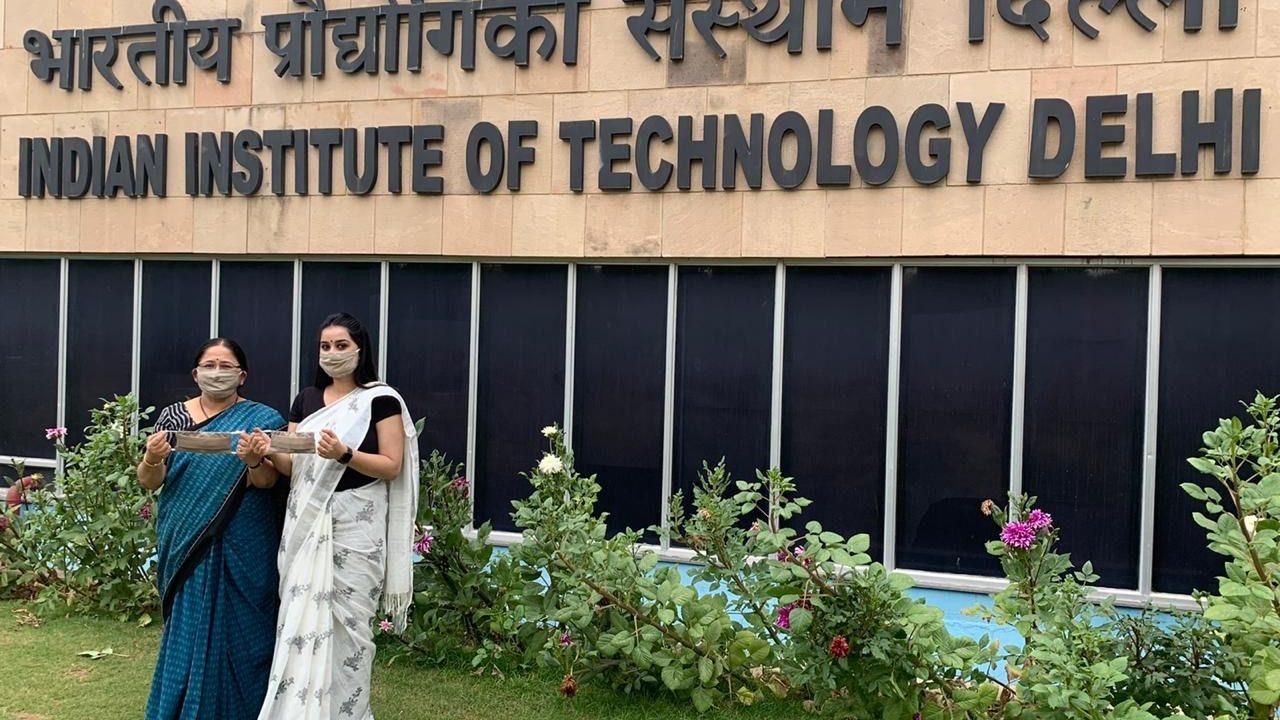
IIT Delhi start-up launches ‘Reusable Antimicrobial Mask’

  • Research Stash
  • News
  • 2.1K

The COVID-19 pandemic has triggered an acute shortage of face masks in the country. The face mask is considered as an important tool to contain transmission of coronavirus from one person to another. Now that every individual has been mandated to use a face mask regularly, the single-use mask is not a cost-effective solution for everyone.

An IIT Delhi start-up “Nanosafe Solutions” has launched an antimicrobial and washable face mask “NSafe”, which is reusable up to 50 launderings, thus greatly cutting down the cost of use.

The team consists of Dr. Anasuya Roy, an IIT Delhi Alumnus, Founder and CEO of Nanosafe Solutions Pvt. Ltd., and Prof. Mangala Joshi, Department of Textile and Fibre Engineering, IIT Delhi, and also Founder and Director of the start-up.

NSafe mask is a highly engineered triple-layered product consisting of an inner hydrophilic layer for comfort, a middle layer having antimicrobial activity and the outermost layer that repels water and oil

NSafe mask has 99.2% bacterial filtration efficiency (at 3 microns) and complies with ASTM standards of breathability and splash resistance. The mask is extremely comfortable and breathable. Elastic band in the chin region and wire in the nose region provide an adequate fit of the mask to the wearer.

Prof. Mangala Joshi, Department of Textile and Fibre Engineering, IIT Delhi, said, “We believe this is the first fabric-based antimicrobial face mask launched in India, which is washable and reusable. This mask has very high bacterial filtration efficiency and conforms to ASTM standards. It is engineered to have very good breathability and comfort.”

Dr. Anasuya Roy, Founder, and CEO of Nanosafe Solutions added, “The mask has been designed to maximize durability and dimensional stability so that the mask can be reused 50 times. Effective reusability is an important factor as single-use masks will cause huge disposal issues”.

NSafe mask enhances protection to the wearer through three different mechanisms: mechanical filtration, antimicrobial decontamination, and repulsion of aerosol droplets.

NSafe masks are dry-cleaned before packaging and packaged under hygienic conditions. After each usage (approximately 8-9 hours), the mask has to be hand-washed in cold water with mild detergent and dried thoroughly in the sunlight. After 50 usages, the mask has to be disposed of in a sealed polyethylene bag and put in the recyclable waste bin.

NSafe mask is a premium product that is likely to be available at MRP of Rs. 299 (Pack of 2) and Rs. 589 (Pack of 4). The start-up has started manufacturing the masks. (ISW)

If you liked this article, then please subscribe to our YouTube Channel for the latest Science & Tech news. You can also find us on Twitter & Facebook
Rate

NSafe mask is a highly engineered triple-layered product consisting of an inner hydrophilic layer for comfort, a middle layer having antimicrobial activity and the outermost layer that repels water and oil

NSafe mask has 99.2% bacterial filtration efficiency (at 3 microns) and complies with ASTM standards of breathability and splash resistance. The mask is extremely comfortable and breathable. Elastic band in the chin region and wire in the nose region provide an adequate fit of the mask to the wearer.

Prof. Mangala Joshi, Department of Textile and Fibre Engineering, IIT Delhi, said, “We believe this is the first fabric-based antimicrobial face mask launched in India, which is washable and reusable. This mask has very high bacterial filtration efficiency and conforms to ASTM standards. It is engineered to have very good breathability and comfort.”

Dr. Anasuya Roy, Founder, and CEO of Nanosafe Solutions added, “The mask has been designed to maximize durability and dimensional stability so that the mask can be reused 50 times. Effective reusability is an important factor as single-use masks will cause huge disposal issues”.

NSafe mask enhances protection to the wearer through three different mechanisms: mechanical filtration, antimicrobial decontamination, and repulsion of aerosol droplets.

NSafe masks are dry-cleaned before packaging and packaged under hygienic conditions. After each usage (approximately 8-9 hours), the mask has to be hand-washed in cold water with mild detergent and dried thoroughly in the sunlight. After 50 usages, the mask has to be disposed of in a sealed polyethylene bag and put in the recyclable waste bin.

NSafe mask is a premium product that is likely to be available at MRP of Rs. 299 (Pack of 2) and Rs. 589 (Pack of 4). The start-up has started manufacturing the masks. (ISW)

If you liked this article, then please subscribe to our YouTube Channel for the latest Science & Tech news. You can also find us on Twitter & Facebook

" }
Kerala Botanists Discover Two New Ginger Species in Arunachal

Kerala Botanists Discover Two New Ginger Species in Arunachal

Ginger not only adds some spice to Indian food but is also an important medicinal plant. Now a team of researchers from Kerala has discovered two new species of ginger in the biodiversity hotspot of the Northeast.

  • News
  • 3.5K
Read more
Testing of sewage samples in lab

Sewage Holds the Key to Measure the Actual Extent Of COVID-19 Spread

Centre for Cellular and Molecular Biology and Indian Institute of Chemical Technology in a joint study have harvested the sewage samples to estimate the number of potentially infected individuals in the city of Hyderabad.

  • News
  • 1.4K
Read more
New Algorithm Predicts Gestational Diabetes

New Algorithm Predicts Gestational Diabetes

A new computer algorithm can predict in the early stages of pregnancy, or even before pregnancy has occurred, in which women are at a high risk of gestational diabetes – according to a study by researchers at the Weizmann Institute of Science reported today in Nature Medicine.

  • News
  • 1.5K
Read more

Internet is huge! Help us find great content

Newsletter

Never miss a thing! Sign up for our newsletter to stay updated.

About

Research Stash is a curated collection of tools and News for S.T.E.M researchers

Have any questions or want to partner with us? Reach us at [email protected]

Navigation

Submit