
Training Program in Food Processing for Rural Enterprises

Training Program in Food Processing for Rural Enterprises

  • Research Stash
  • News
  • 2K

The Council of Scientific and Industrial Research (CSIR)’s Mysuru-based constituent laboratory, Central Food Technological Research Institute (CSIR–CFTRI) is known for in-depth research and development in the areas of food science and technology. CSIR-CFTRI has been a pioneer in steering automation in the traditional food processing sectors for over six decades.

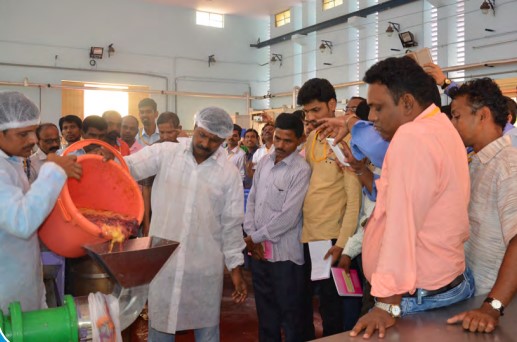
The institute has also made an indelible mark in employment generation in the food processing sector through its extensive training programs. In a new initiative of its kind, CSIR-CFTRI is organizing an online training program on “Sustainable Rural Food Processing Enterprises for Livelihood generation” on 18th Nov 2021. This training program is being organized under the CSIR Integrated Skill Initiative for the benefit of Self Help Groups (SHGs) and rural entrepreneurs who are interested in food processing.

The virtual training program consists of the processing of locally grown agro-commodities with 1-2 case studies; Jam, jelly, and ketchup processing; Ingredients and formulations for papad and chips making; processing and preparation of variety pickles: Packing, labeling, branding, and marketing requirements; hygiene, nutrition standards, and FSSAI requirements; requisite skills for creating linkages with livelihoods opportunities; Interfacing with DICs for state govt. support

This program is targeted at Self-Help Groups (SHGs) registered under State/National Rural Livelihoods Mission (SRLM /NRLM). Though the priority and the targeted group are SHGs, rural entrepreneurs can also apply for this program (individual registrations). One SHG can nominate a maximum of five members to attend this program.

This webinar online program will be organized on 18th November 2021 (09:30 AM to 1:00 PM & 2:00 PM to 4:30 PM). E-Certificates will be issued to those who complete the program, the CSIR-CFTRI statement said. Further information regarding this program can be found on the website of CSIR-CFTRI. (ISW)

If you liked this article, then please subscribe to our YouTube Channel for the latest Science & Tech news. You can also find us on Twitter & Facebook
This program is targeted at Self-Help Groups (SHGs) registered under State/National Rural Livelihoods Mission (SRLM /NRLM). Though the priority and the targeted group are SHGs, rural entrepreneurs can also apply for this program (individual registrations). One SHG can nominate a maximum of five members to attend this program.

This webinar online program will be organized on 18th November 2021 (09:30 AM to 1:00 PM & 2:00 PM to 4:30 PM). E-Certificates will be issued to those who complete the program, the CSIR-CFTRI statement said. Further information regarding this program can be found on the website of CSIR-CFTRI. (ISW)

If you liked this article, then please subscribe to our YouTube Channel for the latest Science & Tech news. You can also find us on Twitter & Facebook
" }
A Treatment For ‘Retinitis Pigmentosa’ Could Be in the Offing

A Treatment For ‘Retinitis Pigmentosa’ Could Be in the Offing

In a significant development in the area of ophthalmology, a team of researchers has come out with a finding that shows the possibility for a cure for the progressively irreversible retinal degenerative disease which causes partial or complete blindness

  • News
  • 3.1K
Read more
Dr. Jitendra Kumar Thakur with his colleagues

Researchers Find A New Possibility to Improve Rice Productivity

Researchers from the National Institute of Plant Genome Research, Indian Agricultural Research Institute, National Rice Research Institute, and University of Delhi South Campus have identified a region in the genome of a rice, which seems to have the potential for improving productivity.

  • News
  • 2.3K
Read more
Genomic Study May Help Solve ‘Indian Enigma’ Relating To Gastric Bacteria

Genomic Study May Help Solve ‘Indian Enigma’ Relating To Gastric Bacteria

Indian researchers, working in collaboration with their Australian counterparts, have sequenced 42 strains of a disease-causing bacterium, Helicobacter pylori, to better understand genetic factors that play a role in disease development in Indian populations.

  • News
  • 2.2K
Read more

Internet is huge! Help us find great content

Newsletter

Never miss a thing! Sign up for our newsletter to stay updated.

About

Research Stash is a curated collection of tools and News for S.T.E.M researchers

Have any questions or want to partner with us? Reach us at [email protected]

Navigation

Submit