Microbial Metabolite from Berries May Help Address Bowel Disease

Microbial Metabolite from Berries May Help Address Bowel Disease

  • Research Stash
  • News
  • 2.6K

A group of Indian researchers has found that a substance formed during the process of metabolism of berries and pomegranates in the human gut may help mitigate inflammatory bowel disease (IBD) that afflicts millions of people globally.
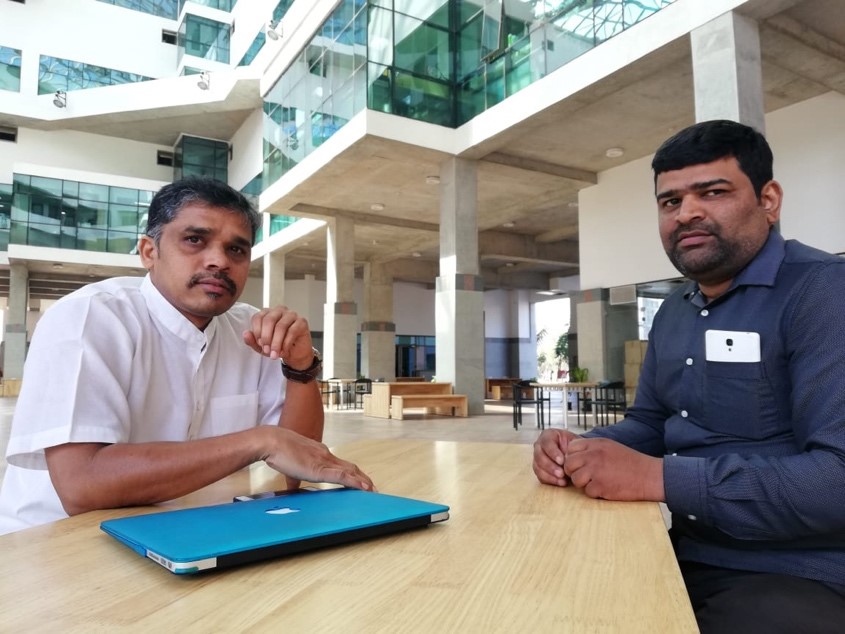
Picture of Praveen Vemula (left) and Sandeep Chandrashekharappa (right) at inStem, Bengaluru

IBD is usually marked by chronic intestinal inflammation and does not have any effective remedy at present. The metabolite formed during the breaking down of berries and pomegranates in the gut with the help of gut bacteria boosts certain proteins critical for keeping the gut lining strong. The metabolite helps the cells in the gut lining to remain glued to each and not allow toxins to penetrate. The researchers have also found a synthetic version of the metabolite to be effective in laboratory studies.
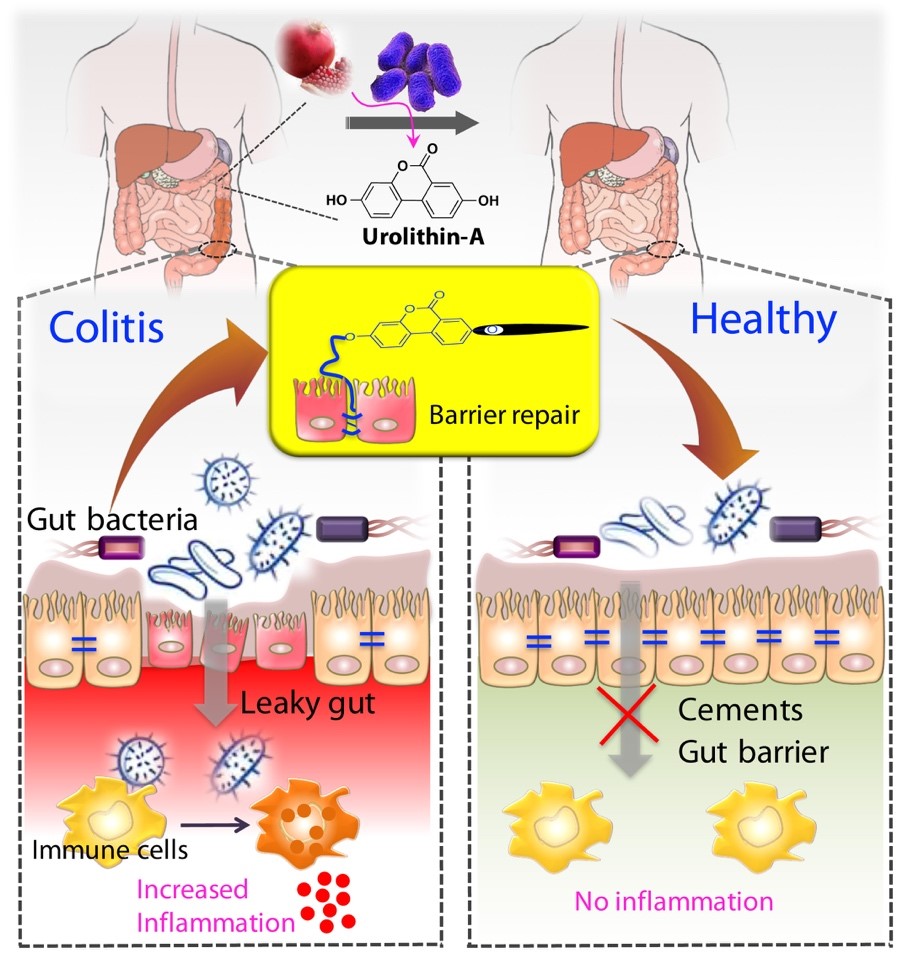
Illustration showing tightening of gut barrier cells and reduced inflammation due to gut metabolite, by Praveen Kumar Vemula, inStem, India.
Illustration showing tightening of gut barrier cells and reduced inflammation due to a gut metabolite, by Praveen Kumar Vemula, inStem, India.

The barrier in the gut lining is made up of a single-cell layer that provides protection against antigens and toxins present in the gut. The cells remain together with the help of certain proteins like claudins and zona occludin-1. Loss of these cell-cell junction proteins causes IBD and makes the protective layer permeable.

The microbial metabolite called Urolithin A (UroA)) derived from berries and pomegranates has been found to boost cell junction proteins. The metabolite is derived from polyphenolics of berries. Metabolites are intermediary products produced during the process of metabolism.

The researchers have also found the mechanism by which the microbial metabolite and its analog reduce inflammation and restore gut barrier integrity. The results of the study, done by researchers at the Bangalore-based Institute for Stem Cell Biology and Regenerative Medicine (InStem) and the University of Louisville, have been published in journal Nature Communications on Thursday. In this paper, Praveen Kumar Vemula and Venkatakrishna Rao Jala are senior authors, with Rajbir Singh.

“Restoring the gut barrier and reducing the inflammation using a small-molecule will provide a better therapeutic output in the treatment of IBD,” said Dr. Vemula of InStem.

“The general belief thus far in the field is that Urolithins have a beneficial effect only through their anti-inflammatory property. We have discovered that their major mode of function is repairing the gut barrier dysfunction,” added Rajbir Singh, a postdoctoral fellow at the University of Louisville.

The new agent has been found to be both therapeutic and preventive effect in initial studies in mice. Vemula and Jala said they plan to set up a start-up based on this technology and aim to develop the molecule as a drug.

The research was supported by the Department of Biotechnology, India and National Institute of Health, USA.  (India Science Wire)

By Dinesh C Sharma

Journal Article

Enhancement of the gut barrier integrity by a microbial metabolite through the Nrf2 pathway

If you liked this article, then please subscribe to our YouTube Channel for the latest Science & Tech news. You can also find us on Twitter & Facebook.
Rate

The microbial metabolite called Urolithin A (UroA)) derived from berries and pomegranates has been found to boost cell junction proteins. The metabolite is derived from polyphenolics of berries. Metabolites are intermediary products produced during the process of metabolism.

The researchers have also found the mechanism by which the microbial metabolite and its analog reduce inflammation and restore gut barrier integrity. The results of the study, done by researchers at the Bangalore-based Institute for Stem Cell Biology and Regenerative Medicine (InStem) and the University of Louisville, have been published in journal Nature Communications on Thursday. In this paper, Praveen Kumar Vemula and Venkatakrishna Rao Jala are senior authors, with Rajbir Singh.

“Restoring the gut barrier and reducing the inflammation using a small-molecule will provide a better therapeutic output in the treatment of IBD,” said Dr. Vemula of InStem.

“The general belief thus far in the field is that Urolithins have a beneficial effect only through their anti-inflammatory property. We have discovered that their major mode of function is repairing the gut barrier dysfunction,” added Rajbir Singh, a postdoctoral fellow at the University of Louisville.

The new agent has been found to be both therapeutic and preventive effect in initial studies in mice. Vemula and Jala said they plan to set up a start-up based on this technology and aim to develop the molecule as a drug.

The research was supported by the Department of Biotechnology, India and National Institute of Health, USA.  (India Science Wire)

By Dinesh C Sharma

Journal Article

Enhancement of the gut barrier integrity by a microbial metabolite through the Nrf2 pathway

If you liked this article, then please subscribe to our YouTube Channel for the latest Science & Tech news. You can also find us on Twitter & Facebook.

" }

Science Beam – using computer vision to extract PDF data

There’s a vast trove of science out there locked inside the PDF format. From preprints to peer-reviewed literature and historical research, millions of scientific manuscripts today can only be found in a print-era format that is effectively inaccessible to the web of interconnected online services and APIs that are increasingly becoming the digital scaffold of today’s research infrastructure.

  • News
  • 4.2K
Read more
New Super-Computer to Help Research and Start-Ups

New Super-Computer to Help Research and Start-Ups

Advanced 650 teraflops supercomputing facility was inaugurated at National Agri-Food Biotechnology Institute, which will act as a facilitator for start-ups working in areas like telemedicine, digital health, mHealth with big data, AI, Blockchain, and other technologies.

  • News
  • 1.6K
Read more
Here Is Why Improved Forecasts Are Not Helping Prevent Floods and Droughts

Here Is Why Improved Forecasts Are Not Helping Prevent Floods and Droughts

A systematic evaluation of the perception of forecast accuracy among engineers and managers who make decisions and uncertainty on dam operations as well as water resources is needed to bridge the gap from forecasts to lifesaving decisions

  • News
  • 2.2K
Read more

Internet is huge! Help us find great content

Newsletter

Never miss a thing! Sign up for our newsletter to stay updated.

About

Research Stash is a curated collection of tools and News for S.T.E.M researchers

Have any questions or want to partner with us? Reach us at hello@researchstash.com

Navigation

Submit