
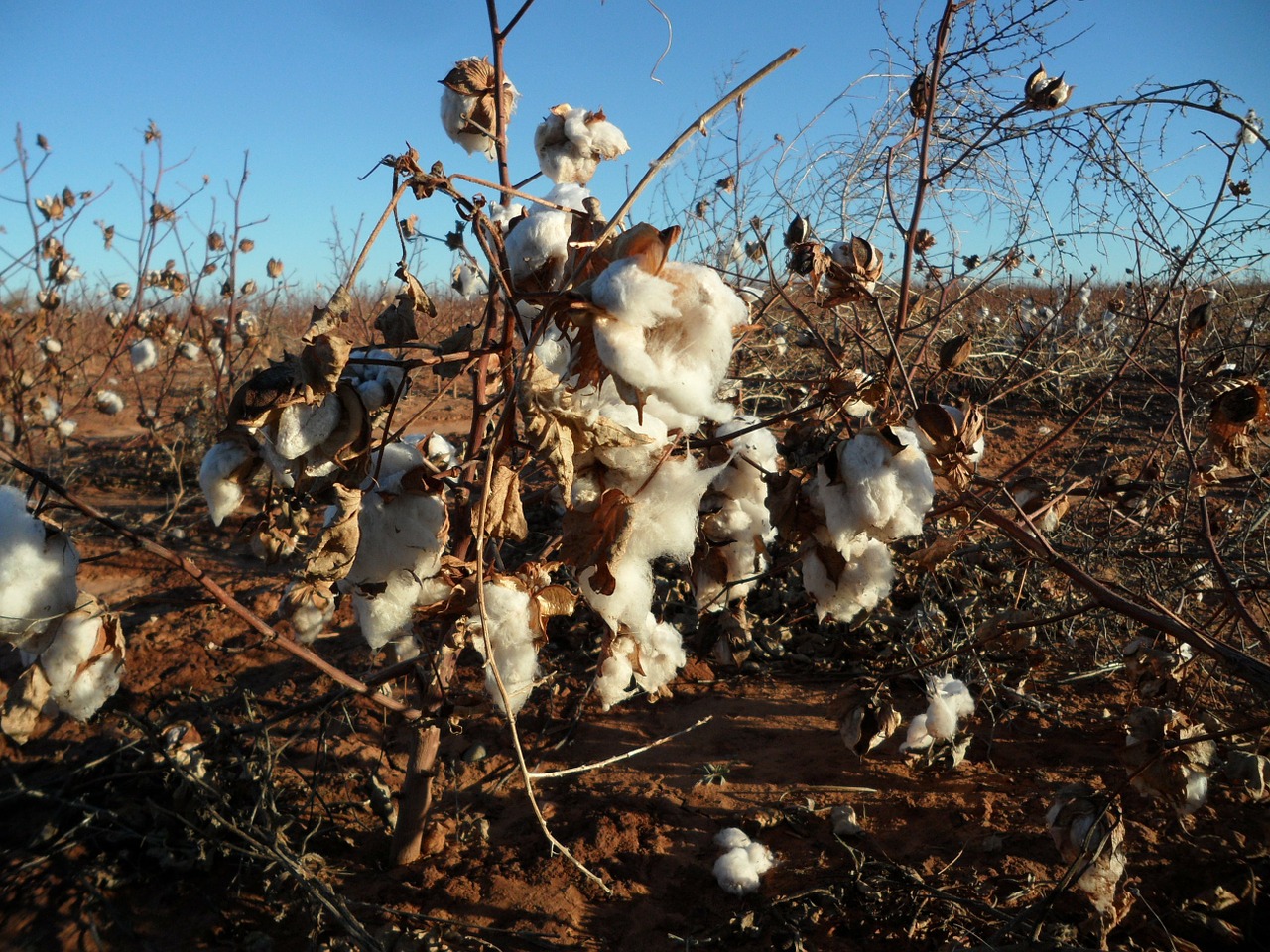
Buttermilk-Based Bioformulation Helps In Cotton Disease Control

Buttermilk-Based Bioformulation Helps In Cotton Disease Control

  • Research Stash
  • News
  • 3.6K

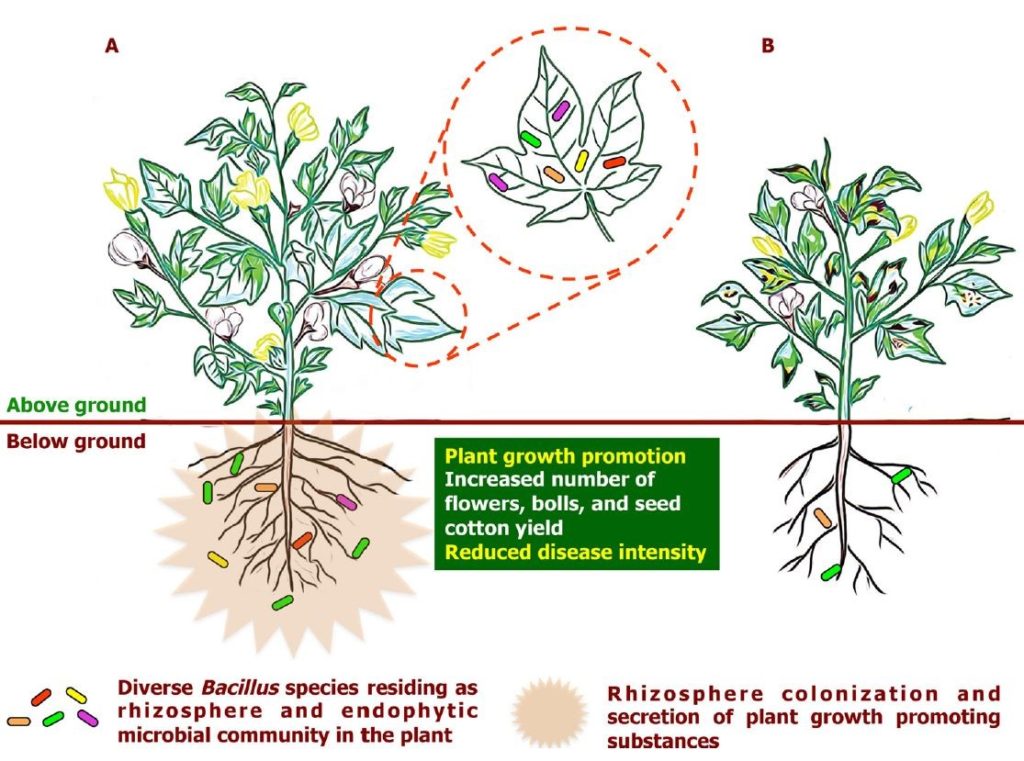
Scientists at Coimbatore-based Tamil Nadu Agricultural University (TNAU) have found that a plant growth promoting rhizobacteria called Bacillus amyloliquefaciens can be used to fight Tobacco Streak Virus (TSV) in the cotton crop.
Buttermilk-Based Bioformulation Helps In Cotton Disease Control

The formulation, prepared in buttermilk, was tested against the plant virus and found effective. The use of buttermilk for its antimicrobial activity in humans and plants has been a traditional practice. Many milk proteins are known to have shown antiviral activity, by inhibiting Reverse transcriptase enzyme of viruses. In the new study too, buttermilk base alone could reduce virus concentration but was more effective when used in combination with Bacillus formulations.

TSV causes cotton necrosis disease and is a major problem for cotton farmers. The virus gets transmitted to cotton plants through insect vector, thrips. TSV produces multifarious symptoms. Farmers are generally unaware of these symptoms and end up applying insecticides indiscriminately to control the vector. Scientists have, therefore, been looking for an eco-friendly management method.

Members of the research team TNAU

IMAGE: Members of the research team TNAU

A few studies have reported the possibility of antiviral activity of bacteria against cotton leaf curl, cucumber mosaic virus, and tobacco mosaic virus. Taking the cue, researchers collected rhizospheric and endophytic bacteria from both healthy as well as infected cotton plants. They cultured the bacteria and assessed their antiviral efficiency. They found that a rhizobacterium called Bacillus amyloliquefaciens was showing promising results.

Experiments were conducted during 2015 and 2016 in two different locations in Tamil Nadu to assess the efficacy of Bacillus species and phyto-antiviral principles against TSV infecting cotton. A High yielding hybrid, RCH659 was selected for the study.

Buttermilk was used as a carrier base for application of bacterial inoculation. It was found to effectively colonize rhizosphere and phylloplane of the cotton plant and produce anti-microbial peptides and fatty acids, which curbed the virus.

“The formulations of plant growth promoting rhizobacteria suspended in buttermilk not only reduced the disease incidence but also promoted plant growth and yield. More studies are needed to develop formulation into a user-friendly product. There is also a need to test it in other cotton growing areas in the country,” said Dr. S. Vinodkumar, a member of the research team, while speaking to India Science Wire.

Besides Dr. Vinodkumar, the team included Dr. S. Nakkeeran, Dr. P. Renukadevi, Dr. V. G. Malathi (Centre for Plant Protection Studies); and Dr. S. Mohankumar (Centre for Plant Molecular Biology and Biotechnology) at TNAU.  The study results have been published in journal Agriculture, Ecosystems and Environment Journal. (India Science Wire).

By S Suresh Ramanan

Journal Article

Diversity and antiviral potential of rhizospheric and endophytic Bacillus species and phyto-antiviral principles against tobacco streak virus in cotton

If you liked this article, then please subscribe to our YouTube Channel for the latest Science & Tech news. You can also find us on Twitter & Facebook.
Rate

TSV causes cotton necrosis disease and is a major problem for cotton farmers. The virus gets transmitted to cotton plants through insect vector, thrips. TSV produces multifarious symptoms. Farmers are generally unaware of these symptoms and end up applying insecticides indiscriminately to control the vector. Scientists have, therefore, been looking for an eco-friendly management method.

Members of the research team TNAU

IMAGE: Members of the research team TNAU

A few studies have reported the possibility of antiviral activity of bacteria against cotton leaf curl, cucumber mosaic virus, and tobacco mosaic virus. Taking the cue, researchers collected rhizospheric and endophytic bacteria from both healthy as well as infected cotton plants. They cultured the bacteria and assessed their antiviral efficiency. They found that a rhizobacterium called Bacillus amyloliquefaciens was showing promising results.

Experiments were conducted during 2015 and 2016 in two different locations in Tamil Nadu to assess the efficacy of Bacillus species and phyto-antiviral principles against TSV infecting cotton. A High yielding hybrid, RCH659 was selected for the study.

Buttermilk was used as a carrier base for application of bacterial inoculation. It was found to effectively colonize rhizosphere and phylloplane of the cotton plant and produce anti-microbial peptides and fatty acids, which curbed the virus.

“The formulations of plant growth promoting rhizobacteria suspended in buttermilk not only reduced the disease incidence but also promoted plant growth and yield. More studies are needed to develop formulation into a user-friendly product. There is also a need to test it in other cotton growing areas in the country,” said Dr. S. Vinodkumar, a member of the research team, while speaking to India Science Wire.

Besides Dr. Vinodkumar, the team included Dr. S. Nakkeeran, Dr. P. Renukadevi, Dr. V. G. Malathi (Centre for Plant Protection Studies); and Dr. S. Mohankumar (Centre for Plant Molecular Biology and Biotechnology) at TNAU.  The study results have been published in journal Agriculture, Ecosystems and Environment Journal. (India Science Wire).

By S Suresh Ramanan

Journal Article

Diversity and antiviral potential of rhizospheric and endophytic Bacillus species and phyto-antiviral principles against tobacco streak virus in cotton

If you liked this article, then please subscribe to our YouTube Channel for the latest Science & Tech news. You can also find us on Twitter & Facebook.

" }
Tinkering With Root Hair May Help Boost Crop Yields

Tinkering With Root Hair May Help Boost Crop Yields

Have you ever wondered how a plant is able to sense nutrients in the soil? The answer lies in the root design. Plants have the capability to change angle and length of their roots as well as hair-like extensions on roots for absorbing nutrients from the soil.

  • News
  • 3.4K
Read more
A Treatment For ‘Retinitis Pigmentosa’ Could Be in the Offing

A Treatment For ‘Retinitis Pigmentosa’ Could Be in the Offing

In a significant development in the area of ophthalmology, a team of researchers has come out with a finding that shows the possibility for a cure for the progressively irreversible retinal degenerative disease which causes partial or complete blindness

  • News
  • 2.9K
Read more
Genomic Study May Help Solve ‘Indian Enigma’ Relating To Gastric Bacteria

Genomic Study May Help Solve ‘Indian Enigma’ Relating To Gastric Bacteria

Indian researchers, working in collaboration with their Australian counterparts, have sequenced 42 strains of a disease-causing bacterium, Helicobacter pylori, to better understand genetic factors that play a role in disease development in Indian populations.

  • News
  • 2.1K
Read more

Internet is huge! Help us find great content

Newsletter

Never miss a thing! Sign up for our newsletter to stay updated.

About

Research Stash is a curated collection of tools and News for S.T.E.M researchers

Have any questions or want to partner with us? Reach us at hello@researchstash.com

Navigation

Submit