Scientists Develop Transgenic Rice That Can Grow Under High Salinity and Drought

Scientists Develop Transgenic Rice That Can Grow Under High Salinity

  • Research Stash
  • News
  • 2.5K

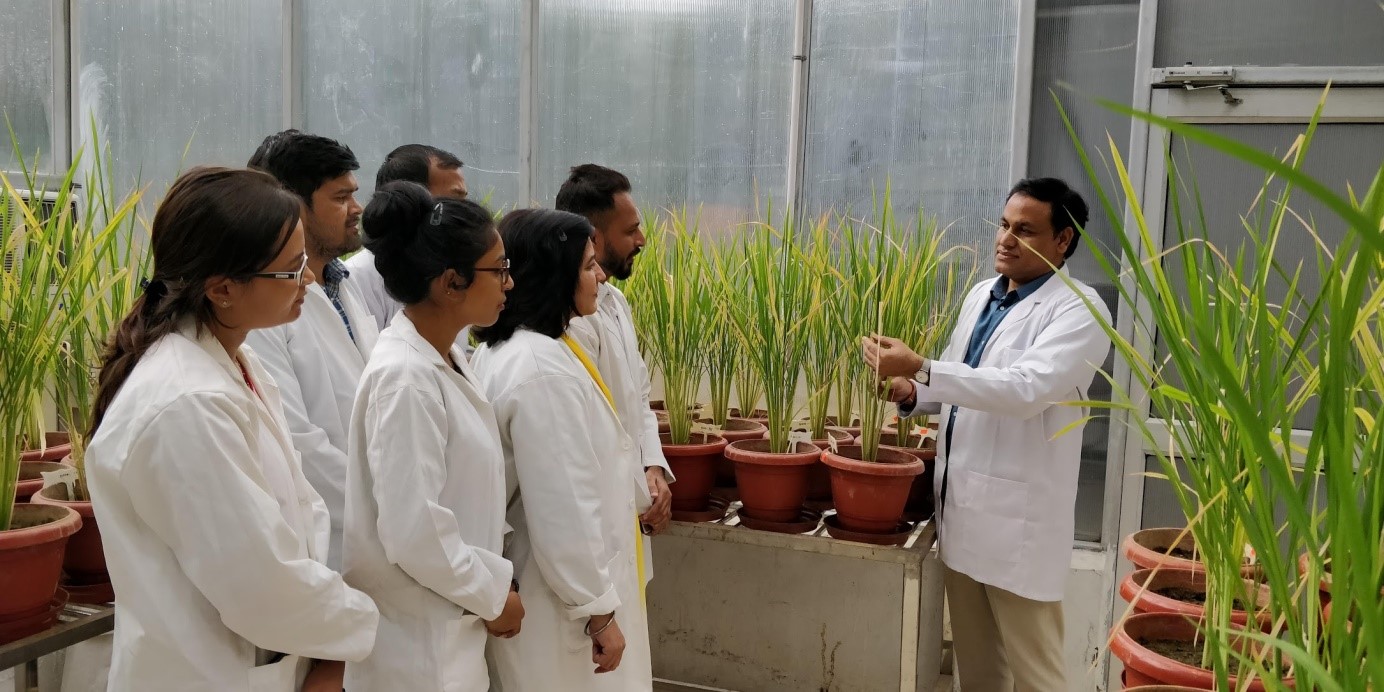
A group of researchers from Jawaharlal Nehru University (JNU), International Centre for Genetic Engineering and Biotechnology (ICGEB) and University of Illinois have developed transgenic rice that promises to generate high yields even under conditions of high salinity, high temperature, and drought.

The scientists hit upon the idea while studying a wild rice variety, Pokkali, grown in coastal regions of Kerala. When they tried to figure out its ability to survive and thrive in the highly saline environment, it emerged that it had a very high level of a gene, OsIF. Tests showed that the plant expressed the gene four times more than in traditional plants.

Using this insight, researchers raised another rice plant, IR 64, with OsIF over-expressed in it. They did so by using a promoter derived from cauliflower mosaic virus (CaMV). It was found that over-expression of OsIF improved the growth and yield of this plant significantly in adverse conditions of high salinity, high temperature, and drought. This plant had a yield of 20 percent more than a normal one. Further studies showed that over-expression helped by stabilizing the process of photosynthesis in the plant.

The OsIF gene encodes a protein in rice for cell components called intermediate filaments (IFs). These filaments protect cells from external forces, besides participating in cell adhesion and tissue integrity. They also act as a molecular scaffold that controls intracellular organization and contributes to signaling events in response to cell stress.

The research group has been engaged in understanding the biochemical and molecular basis of salinity tolerance of the Pokkali rice for the past two decades.“Pokkali is a beautiful example of how new stress tolerant genotypes have evolved under natural selection pressure.

It posed a challenge before us to find out as to how it is able to survive and set seeds under salinity stress, though relatively less in number,” said Dr. Ashwani Pareek, research team leader at JNU, while speaking to India Science Wire.

Besides OsIF, he said, “we have identified and functionally validated over one dozen stress responsive genes from the plant. Our study has shown the unique involvement of intermediate filaments in cellular protection against abiotic stress in rice.”

Besides Dr. Pareek, the research team included Neelam Soda, Khalid Anwar, Ashutosh Sharan (School of Life Sciences, JNU); Brijesh K.Gupta and Sneh Lata Singla-Pareek (ICGEB); and Govindjee (University of Illinois). The research results have been published journal Scientific Reports. (India Science Wire)

By Sunderarajan Padmanabhan

If you liked this article, then please subscribe to our YouTube Channel for the latest Science & Tech news. You can also find us on Twitter & Facebook.

The OsIF gene encodes a protein in rice for cell components called intermediate filaments (IFs). These filaments protect cells from external forces, besides participating in cell adhesion and tissue integrity. They also act as a molecular scaffold that controls intracellular organization and contributes to signaling events in response to cell stress.

The research group has been engaged in understanding the biochemical and molecular basis of salinity tolerance of the Pokkali rice for the past two decades.“Pokkali is a beautiful example of how new stress tolerant genotypes have evolved under natural selection pressure.

It posed a challenge before us to find out as to how it is able to survive and set seeds under salinity stress, though relatively less in number,” said Dr. Ashwani Pareek, research team leader at JNU, while speaking to India Science Wire.

Besides OsIF, he said, “we have identified and functionally validated over one dozen stress responsive genes from the plant. Our study has shown the unique involvement of intermediate filaments in cellular protection against abiotic stress in rice.”

Besides Dr. Pareek, the research team included Neelam Soda, Khalid Anwar, Ashutosh Sharan (School of Life Sciences, JNU); Brijesh K.Gupta and Sneh Lata Singla-Pareek (ICGEB); and Govindjee (University of Illinois). The research results have been published journal Scientific Reports. (India Science Wire)

By Sunderarajan Padmanabhan

If you liked this article, then please subscribe to our YouTube Channel for the latest Science & Tech news. You can also find us on Twitter & Facebook.
" }
New Technology to Boost Production of Geranium

New Technology to Boost Production of Geranium

The geranium plant has huge medicinal value and its essential oil works as an anti-inflammatory and anti-septic agent. The production of Geranium has got a boost under the Aroma mission

  • News
  • 4.2K
Read more

Indian Scientists Develop Mechanism to Rejuvenate Aged Stem Cells

Bone marrow transplantation involves transplantation of hematopoietic stem cells or those stem cells that give rise to other types of blood cells. In such cases, the age of the donor is important as younger donor age results in better outcome.

  • News
  • 1.7K
Read more

Indian Scientists Find Out How Zika Virus Causes Microcephaly in Infants

Researchers at the National Brain Research Centre (NBRC) at Manesar have carried out detailed investigations to understand cellular and molecular mechanisms that may help to understand how zika causes microcephaly in babies.

  • News
  • 2.1K
Read more

Internet is huge! Help us find great content

Newsletter

Never miss a thing! Sign up for our newsletter to stay updated.

About

Research Stash is a curated collection of tools and News for S.T.E.M researchers

Have any questions or want to partner with us? Reach us at [email protected]

Navigation

Submit