CSIR Transfers Technology for Disinfecting Water

CSIR Transfers Technology for Disinfecting Water

  • Research Stash
  • News
  • 1.6K

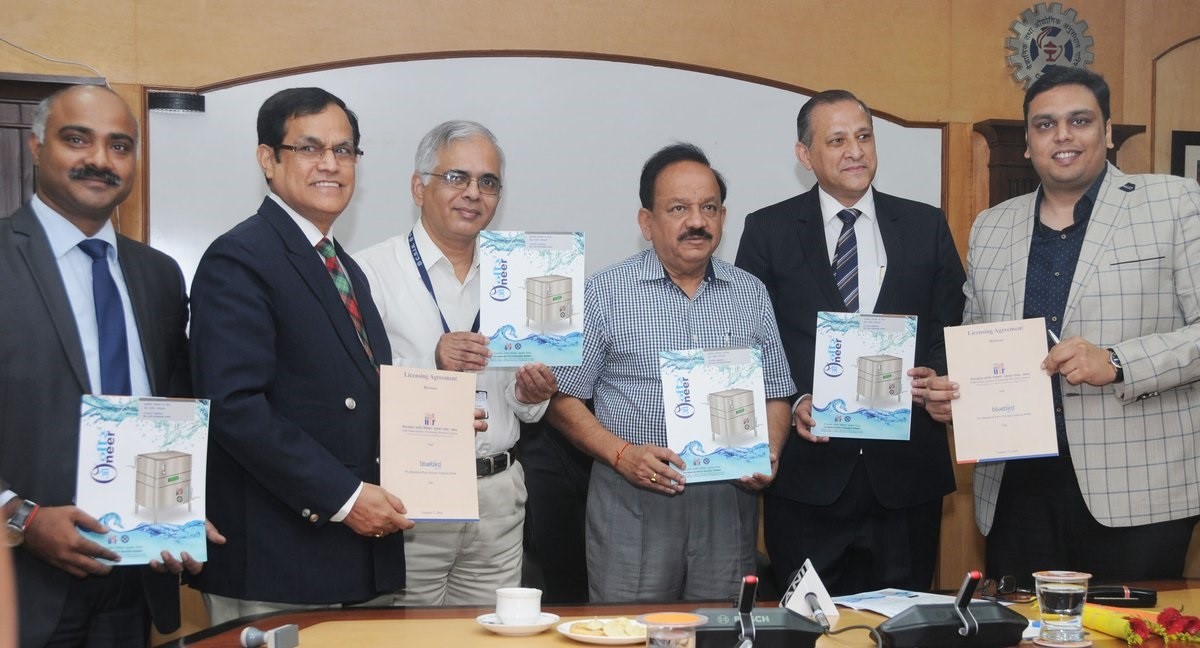
Scientists at the Council of Scientific and Industrial Research’s Lucknow-based Indian Institute of Toxicology Research (CSIR-IITR) have developed a technology for disinfecting water that promises to provide safe and clean drinking water at a cost of just two paise per liter.

The technology is based on the principle of anodic oxidation. Raw water is passed through a chamber and disinfection occurs with the help of singlet oxygen species generated at the anode. The technology has been named Oneer – ‘O’ for singlet oxygen species and `neer’ for water.

The know-how has been transferred to a Delhi firm, Bluebird Water Purifiers. The technology is modular in design and can be used both at domestic and community level.

Speaking on the occasion, Science and Technology Minister Dr. Harsh Vardhan said the domestic model can provide 10 liters of water in just five minutes and one full charge of the battery. It is designed to last four cycles totaling 40 liters. The community model, at present, has a capacity of 450 liters per hour. It can be scaled up to one lakh liter per day and beyond.

A senior CSIR official noted that a key feature of the technology is that purified water will retain all essential minerals and there will be no wastage as it happens in reverse osmosis (RO)-based purifiers. In addition, there will be no need to add any chemical and the water can be stored for around 30 hours without the risk of any recontamination.

The community model will have an inbuilt smart sensor system that will provide real-time information of all operational steps. It also provides for auto self-cleaning of the system after a fixed number of cycles depending on water quality.  The system consumes only around one unit of electricity per 5000 liters of water and can be operated with solar power as well.

The domestic model can be used at homes, street food vendors and small shops, while the community model is suitable for schools, hospitals, restaurants, bus/railway stations, and rural community centers.

The water purifier can eliminate disease-causing pathogens such as virus, bacteria, fungi, protozoa, and cyst to provide safe drinking water as per national and international standards, CSIR officials said.

CSIR Director-General Dr. Shekhar C Mande noted that a large proportion of India’s rural community still consumed water of poor quality and expressed the hope that the device will go a long way in addressing the issue. (India Science Wire)

By Sunderarajan Padmanabhan

If you liked this article, then please subscribe to our YouTube Channel for the latest Science & Tech news. You can also find us on Twitter & Facebook.
Rate

Speaking on the occasion, Science and Technology Minister Dr. Harsh Vardhan said the domestic model can provide 10 liters of water in just five minutes and one full charge of the battery. It is designed to last four cycles totaling 40 liters. The community model, at present, has a capacity of 450 liters per hour. It can be scaled up to one lakh liter per day and beyond.

A senior CSIR official noted that a key feature of the technology is that purified water will retain all essential minerals and there will be no wastage as it happens in reverse osmosis (RO)-based purifiers. In addition, there will be no need to add any chemical and the water can be stored for around 30 hours without the risk of any recontamination.

The community model will have an inbuilt smart sensor system that will provide real-time information of all operational steps. It also provides for auto self-cleaning of the system after a fixed number of cycles depending on water quality.  The system consumes only around one unit of electricity per 5000 liters of water and can be operated with solar power as well.

The domestic model can be used at homes, street food vendors and small shops, while the community model is suitable for schools, hospitals, restaurants, bus/railway stations, and rural community centers.

The water purifier can eliminate disease-causing pathogens such as virus, bacteria, fungi, protozoa, and cyst to provide safe drinking water as per national and international standards, CSIR officials said.

CSIR Director-General Dr. Shekhar C Mande noted that a large proportion of India’s rural community still consumed water of poor quality and expressed the hope that the device will go a long way in addressing the issue. (India Science Wire)

By Sunderarajan Padmanabhan

If you liked this article, then please subscribe to our YouTube Channel for the latest Science & Tech news. You can also find us on Twitter & Facebook.

" }
Surprise! India and China Are Greening Faster Than Rest of the World

Surprise! India and China Are Greening Faster Than Rest of the World

China and India – two economic powerhouses of Asia – are contributing significantly to the greening of the planet, a new global study released on Monday has found

  • News
  • 2.8K
Read more
NRDC to Develop ASEAN Technology Data Bank

NRDC to Develop ASEAN Technology Data Bank

The National Research Development Corporation (NRDC) will establish a technology data bank for ASEAN (Association of Southeastern Asian Nations) region as part of ASEAN-India Innovation Platform.

  • News
  • 2K
Read more

India May Not Achieve SDG Targets on Reducing Child Mortality

A new study has warned that over two-thirds of the districts in the country are unlikely to achieve the UN Sustainable Development Goal (SDG) target of reducing deaths to 25 or less per 1000 live births in under 5-year old children and 12 or less per 1000 live births for newborns by 2030

  • News
  • 2K
Read more

Internet is huge! Help us find great content

Newsletter

Never miss a thing! Sign up for our newsletter to stay updated.

About

Research Stash is a curated collection of tools and News for S.T.E.M researchers

Have any questions or want to partner with us? Reach us at hello@researchstash.com

Navigation

Submit