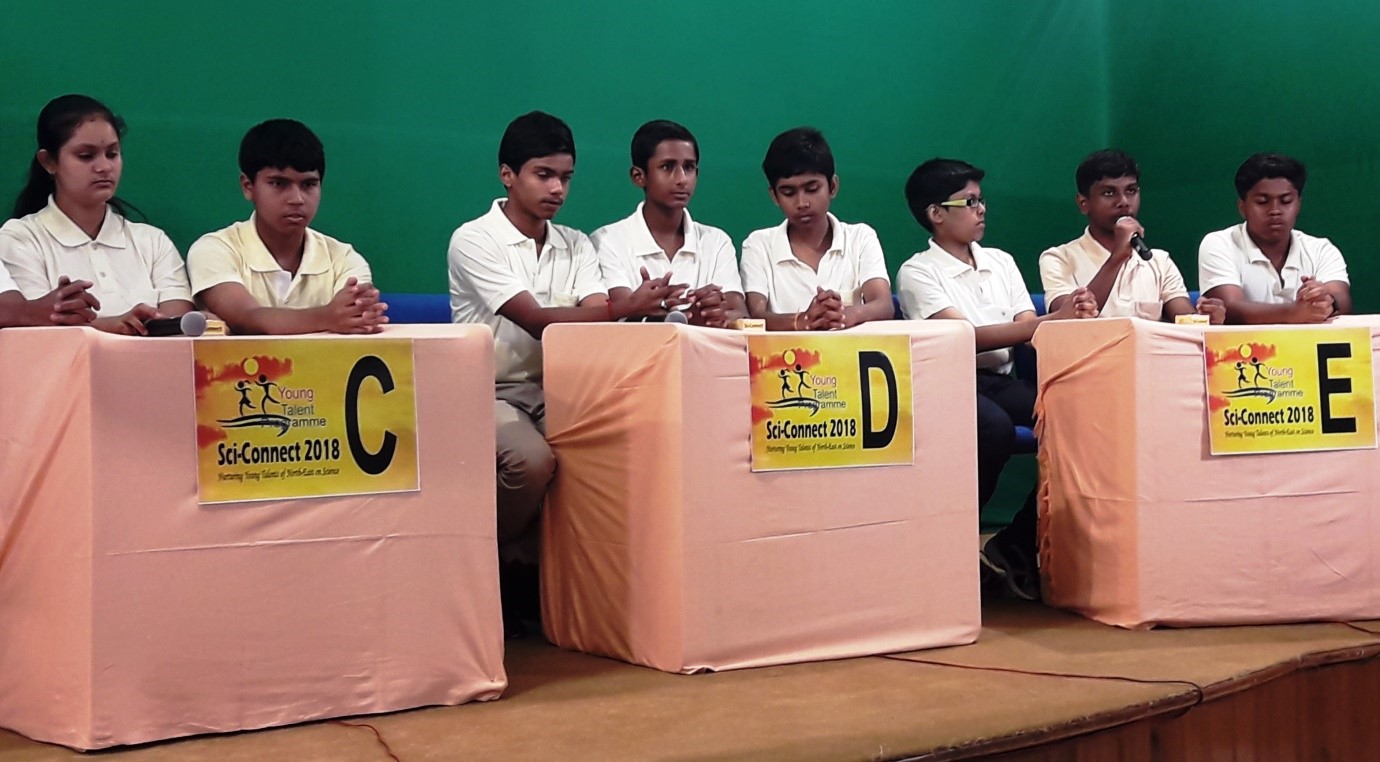
Children participating in quiz during Sci-Connect in Gangtok this week

Making Science Education Fun for Schools Kids in NE India

  • Research Stash
  • News
  • 2.1K

How do insects fly? Why does ginger have wrinkles? Why does chili cause so much pain? Questions like these often crop up in the minds of young school children, but they may not find answers to such questions in their textbooks. Addressing such questions not only satisfies their curiosity but also sensitizes them about science in everyday life.

In order to promote scientific temper and original thinking in school kids, a programme is underway in remote areas of the Northeast. Children are shown a series of short films on a range of subjects, and then a quiz competition is held along with hands-on activities. The initiative called, Sci-Connect, has been undertaken in all the states in the region by Vigyan Prasar.
Making Science Education Fun for Schools Kids in NE

Sixty students from four northeast states participated in the level two of Sci-Connect programme which concluded here on Thursday. The three-day programme was attended by students from Nagaland, Tripura, Manipur, and Sikkim. The children were from upper primary to secondary levels of 42 government and private schools. The quiz included questions from school curriculum as well.

The students were registered through the respective State Science and Technology Councils, which were provided with the resource material produced by Vigyan Prasar. In the first level, 9000 students participated and out of the 60 were selected for level two. Then 15 students from each state were selected to participate in level three, according to Sandeepan Dhar, resource person for the programme.

After competing in level four, students will be invited for the final round to be held in Tripura in September. Top three winners will be awarded cash prize and trophy.

Along with the quiz, parallel sessions were held for hands-on activities on different topics such as biodiversity, earthquake, physics, and chemistry. A nature walk was also organized for students where they went out and learned more about biodiversity. There was a lecture on career prospects in science by Dr. Shibaji Raha, former director, Bose Institute, Kolkata.

“Though the competition is tough, I am enjoying both the quiz as well as hands-on activities, talk with scientists and nature walk. This program came as a full fun package with lots of learning,” said Bipasha Chakraborty, a student from Sri Sri Ravi Shankar Vidya Mandir, Tripura. Brikchana Karki from Government Girls Senior Secondary School, Sikkim said, “it is a good exposure and a great learning experience.”

“The programme has been designed keeping four components in mind – excitement, entertainment, knowledge, and orientation towards science,” explained Sachin C Narwadiya, scientist, Vigyan Prasar. Last year, he said, 6000 students had participated while the number has gone up to 9000 this year. This shows that the northeast is responding well to the programme and to science education.

“Sikkim is spending 30 percent of its budget on education despite various challenges. We are committed to giving quality education to students with a special focus on science education. We are educating teachers also under various programmes,” said K JayKumar, Principal Secretary, Sikkim State Council of Science and Technology, while speaking with India Science Wire.

He also said students need to go for experimental learning. Textbooks can be seen as a framework to arouse curiosity but the learning is more out of books. (India Science Wire)

By Jyoti Singh

If you liked this article, then please subscribe to our YouTube Channel for the latest Science and Tech news. You can also find us on Twitter and Facebook

Rate

Sixty students from four northeast states participated in the level two of Sci-Connect programme which concluded here on Thursday. The three-day programme was attended by students from Nagaland, Tripura, Manipur, and Sikkim. The children were from upper primary to secondary levels of 42 government and private schools. The quiz included questions from school curriculum as well.

The students were registered through the respective State Science and Technology Councils, which were provided with the resource material produced by Vigyan Prasar. In the first level, 9000 students participated and out of the 60 were selected for level two. Then 15 students from each state were selected to participate in level three, according to Sandeepan Dhar, resource person for the programme.

After competing in level four, students will be invited for the final round to be held in Tripura in September. Top three winners will be awarded cash prize and trophy.

Along with the quiz, parallel sessions were held for hands-on activities on different topics such as biodiversity, earthquake, physics, and chemistry. A nature walk was also organized for students where they went out and learned more about biodiversity. There was a lecture on career prospects in science by Dr. Shibaji Raha, former director, Bose Institute, Kolkata.

“Though the competition is tough, I am enjoying both the quiz as well as hands-on activities, talk with scientists and nature walk. This program came as a full fun package with lots of learning,” said Bipasha Chakraborty, a student from Sri Sri Ravi Shankar Vidya Mandir, Tripura. Brikchana Karki from Government Girls Senior Secondary School, Sikkim said, “it is a good exposure and a great learning experience.”

“The programme has been designed keeping four components in mind – excitement, entertainment, knowledge, and orientation towards science,” explained Sachin C Narwadiya, scientist, Vigyan Prasar. Last year, he said, 6000 students had participated while the number has gone up to 9000 this year. This shows that the northeast is responding well to the programme and to science education.

“Sikkim is spending 30 percent of its budget on education despite various challenges. We are committed to giving quality education to students with a special focus on science education. We are educating teachers also under various programmes,” said K JayKumar, Principal Secretary, Sikkim State Council of Science and Technology, while speaking with India Science Wire.

He also said students need to go for experimental learning. Textbooks can be seen as a framework to arouse curiosity but the learning is more out of books. (India Science Wire)

By Jyoti Singh

If you liked this article, then please subscribe to our YouTube Channel for the latest Science and Tech news. You can also find us on Twitter and Facebook

" }
Europe-Origin Pathogen Poses Big Threat to Potato Crop in India

Europe-Origin Pathogen Poses Big Threat to Potato Crop in India

A rapidly evolving pathogen from Europe may spell doom for India’s potato yield, an essential staple crop that also fetches good income to millions of farmers.

  • News
  • 2.6K
Read more
Kerala Botanists Discover Two New Ginger Species in Arunachal

Kerala Botanists Discover Two New Ginger Species in Arunachal

Ginger not only adds some spice to Indian food but is also an important medicinal plant. Now a team of researchers from Kerala has discovered two new species of ginger in the biodiversity hotspot of the Northeast.

  • News
  • 3.4K
Read more

Understanding Positioning System of Cells May Help Unravel Key Diseases

A team of researchers led by Dr. Padinjat Raghu at National Centre for Biological Sciences, Bengaluru have shown that signals present within RDGB protein determine if it will remain in a specific compartment of the cell for it to function normally

  • News
  • 2.3K
Read more

Internet is huge! Help us find great content

Newsletter

Never miss a thing! Sign up for our newsletter to stay updated.

About

Research Stash is a curated collection of tools and News for S.T.E.M researchers

Have any questions or want to partner with us? Reach us at hello@researchstash.com

Navigation

Submit