
Metal-Organic Nano Sheets May Help Develop Novel Lens Material

Metal-Organic Nano Sheets May Help Develop Novel Lens Material

  • Research Stash
  • News
  • 2.3K

Photochromic materials can change color under stimulation of light. They are of high commercial importance for ophthalmic lens industry as also in sectors like optoelectronic switching devices, data storage, and optical transmission.

Photochromic materials change colors on account of changes in the arrangement of atoms in materials. Atoms in photochromic materials are arranged in a certain manner and change when exposed to sunlight or UV light. We can observe this reversible behavior in sunglasses. However, there are challenges associated with polymers. It is restricted by what features are desired in polymers in terms of rigidity, hardness and scratch resistance. Presently, researchers achieve photoswitching by linking photo chromes covalently to soft low-molecular-weight polymers.
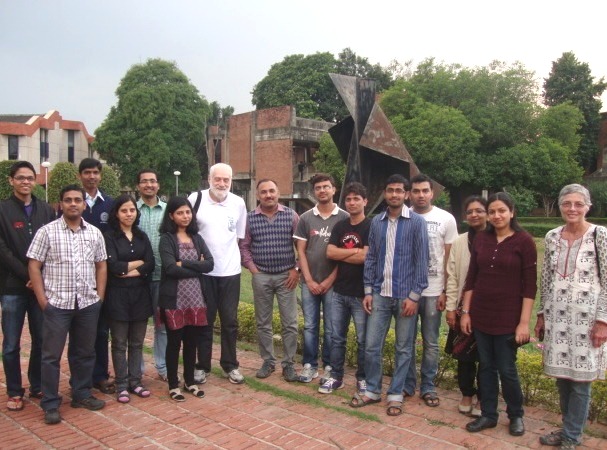
Prof. J N Moorthy and his team

Prof. J N Moorthy and his team

A team of researchers at Indian Institute of Technology (IIT), Kanpur have demonstrated that porous 2-dimensional metal-organic nanosheets (MONs) constructed from photochromic building blocks can also be employed as agents or dopants in polymers to bring out the desired optical properties in photochromic polymers.

Three-dimensional porous metal-organic framework materials (MOFs) have been used for various applications like photo-controlled gas storage, separations, sensing, and catalysis in recent years. However, they are not suitable for use in thin films and polymeric matrices to develop photo-responsive materials, as they pose problems like leaching and poor photoswitching.

The new photochromic 2D metal-organic nanosheets (MONs) are envisaged to be applicable not only in ophthalmic lenses but also in other related applications, where light-induced switching between two or more species with different optical properties must occur smoothly.

Speaking to India Science Wire, leader of the team Prof. J. N. Moorthy said, “Photo-responsive MONs can find applications in ophthalmic industry. As photo-chromes distributed in polymeric 2D nanosheets can be impregnated in rigid polymeric matrices, leaching of photo-chromes can be overcome, besides providing practical simplicity in terms of fabrication. The concept can also be exploited for photo-controlled sieving of organic molecules.”

Commenting on the work, Prof. Rahul Banerjee from Indian Institute of Science Education and Research (IISER), Kolkata, who was not involved in this study, said, “this is an interesting finding in which researchers could show that exfoliation of layered porous metal-organic frameworks (MOFs) using a top-down approach can help produce 2D metal-organic nanosheets (MONs). This type of crystal engineering approach is quite novel and could bring in a novel and new applications in the field of MOFs.”

Prof. Gautam R. Desiraju, Indian Institute of Science, Bangalore, who too was not involved in the study, said, “MOFs as a field is getting saturated and plateauing out. It may require a new vision over the next five to ten years. This subject is not associated with organic chemistry alone. Multi-disciplinary study of MOFs may move in advantageous directions in the future. Chemistry is looking for new paradigms, where the essence of the old is clubbed with a whole new superstructure, combining vertical and horizontal ways of thinking.”

The study has been published in the latest issue of journal CHEM. Besides Prof. Moorthy, the research team included Arindam Mukhopadhyay, Vijay Kumar Maka, and Govardhan Savitha. The study was funded by Science and Engineering Research Board (SERB) of the Department of Science and Technology (DST). (India Science Wire)

By Ratneshwar Thakur

Journal Article

Photochromic 2D Metal-Organic Framework Nanosheets (MONs): Design, Synthesis, and Functional MON-Ormosil Composite

For the latest Science, Tech news and conversations, follow Research Stash on TwitterFacebook, and subscribe to our YouTube channel

Rate

Prof. J N Moorthy and his team

A team of researchers at Indian Institute of Technology (IIT), Kanpur have demonstrated that porous 2-dimensional metal-organic nanosheets (MONs) constructed from photochromic building blocks can also be employed as agents or dopants in polymers to bring out the desired optical properties in photochromic polymers.

Three-dimensional porous metal-organic framework materials (MOFs) have been used for various applications like photo-controlled gas storage, separations, sensing, and catalysis in recent years. However, they are not suitable for use in thin films and polymeric matrices to develop photo-responsive materials, as they pose problems like leaching and poor photoswitching.

The new photochromic 2D metal-organic nanosheets (MONs) are envisaged to be applicable not only in ophthalmic lenses but also in other related applications, where light-induced switching between two or more species with different optical properties must occur smoothly.

Speaking to India Science Wire, leader of the team Prof. J. N. Moorthy said, “Photo-responsive MONs can find applications in ophthalmic industry. As photo-chromes distributed in polymeric 2D nanosheets can be impregnated in rigid polymeric matrices, leaching of photo-chromes can be overcome, besides providing practical simplicity in terms of fabrication. The concept can also be exploited for photo-controlled sieving of organic molecules.”

Commenting on the work, Prof. Rahul Banerjee from Indian Institute of Science Education and Research (IISER), Kolkata, who was not involved in this study, said, “this is an interesting finding in which researchers could show that exfoliation of layered porous metal-organic frameworks (MOFs) using a top-down approach can help produce 2D metal-organic nanosheets (MONs). This type of crystal engineering approach is quite novel and could bring in a novel and new applications in the field of MOFs.”

Prof. Gautam R. Desiraju, Indian Institute of Science, Bangalore, who too was not involved in the study, said, “MOFs as a field is getting saturated and plateauing out. It may require a new vision over the next five to ten years. This subject is not associated with organic chemistry alone. Multi-disciplinary study of MOFs may move in advantageous directions in the future. Chemistry is looking for new paradigms, where the essence of the old is clubbed with a whole new superstructure, combining vertical and horizontal ways of thinking.”

The study has been published in the latest issue of journal CHEM. Besides Prof. Moorthy, the research team included Arindam Mukhopadhyay, Vijay Kumar Maka, and Govardhan Savitha. The study was funded by Science and Engineering Research Board (SERB) of the Department of Science and Technology (DST). (India Science Wire)

By Ratneshwar Thakur

Journal Article

Photochromic 2D Metal-Organic Framework Nanosheets (MONs): Design, Synthesis, and Functional MON-Ormosil Composite

For the latest Science, Tech news and conversations, follow Research Stash on TwitterFacebook, and subscribe to our YouTube channel
" }

Extralchromosomal telomere repeat DNA activates cytosolic DNA sensing pathway and influences ALT development

A recent study at the Institute of Molecular Biology, Academia Sinica discovers that extra-chromosomal telomere repeat (ECTR) DNA molecules can activate cytosolic DNA sensing pathways that may inhibit alternative lengthening of telomeres (ALT) cancer development.

  • News
  • 2.4K
Read more
C V Raman Fellowships Bring African and Indian Researchers Closer

C V Raman Fellowships Bring African and Indian Researchers Closer

At the Indian Agricultural Research Institute (IARI) here, Abdelkarim Dafalla Elfadil from Sudan is working on a new mechanical device which will help to sow of seeds, irrigate fields and apply fertilizer in one go, using technology developed at the institute’s division of agricultural engineering.

  • News
  • 1.9K
Read more

State Science and Tech Councils Should Work in Synergy

State councils need to be more active in terms of making science accessible to the people,” said Dr. Harsh Vardhan, Minister of Science and Technology while speaking at the S&T ministers’ conclave at the India International Science Festival 2018.

  • News
  • 2.1K
Read more

Internet is huge! Help us find great content

Newsletter

Never miss a thing! Sign up for our newsletter to stay updated.

About

Research Stash is a curated collection of tools and News for S.T.E.M researchers

Have any questions or want to partner with us? Reach us at hello@researchstash.com

Navigation

Submit