
Glycogen in Neurons of Degenerating Brains Is Beneficial

Glycogen in Neurons of Degenerating Brains Is Beneficial

  • Research Stash
  • News
  • 2.4K

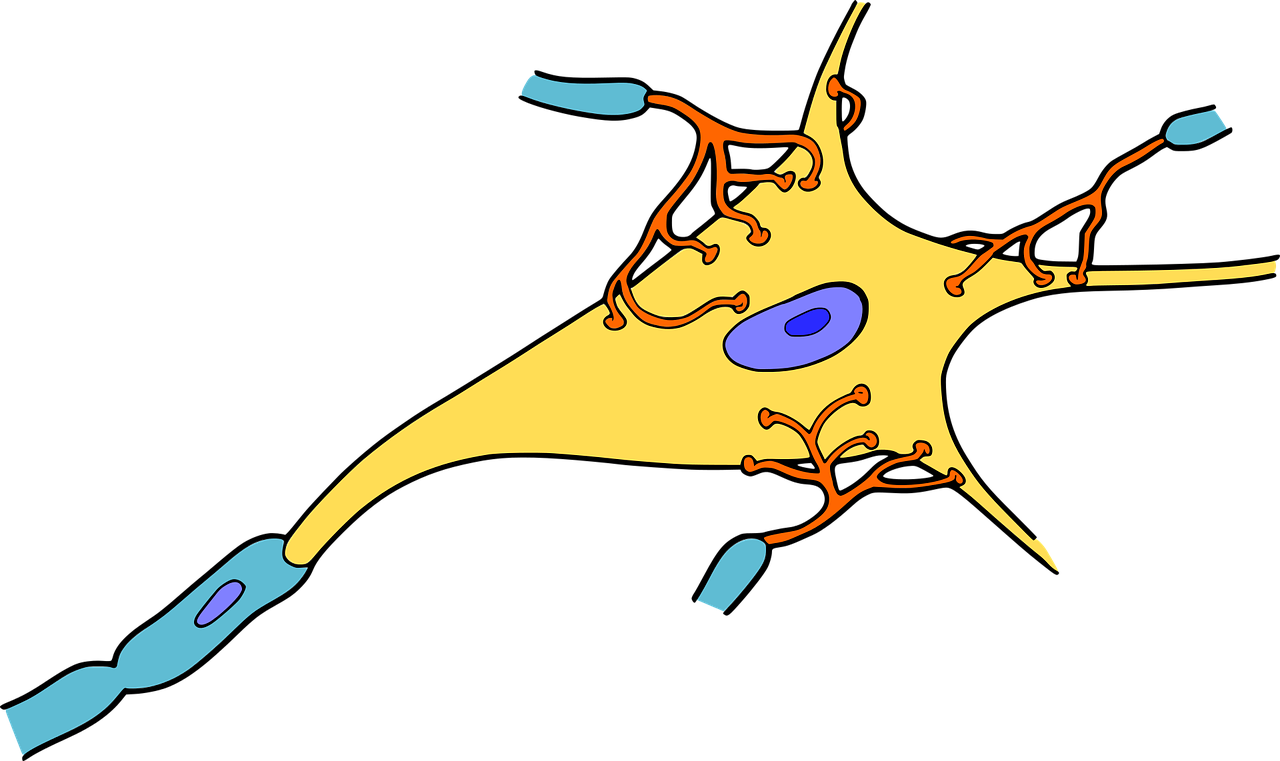
Healthy neurons do not store glycogen – the main source of energy storage for cells – while they do possess the machinery for glycogen synthesis in an inactive state. At the same time, neurons in degenerating brains are known to accumulate glycogen. A team of Indian scientists has figured out that glycogen in neurons actually has a protective role in patients with neurodegenerative disorders like Alzheimer’s and Huntington’s.
Dr. S. Ganesh and his team members

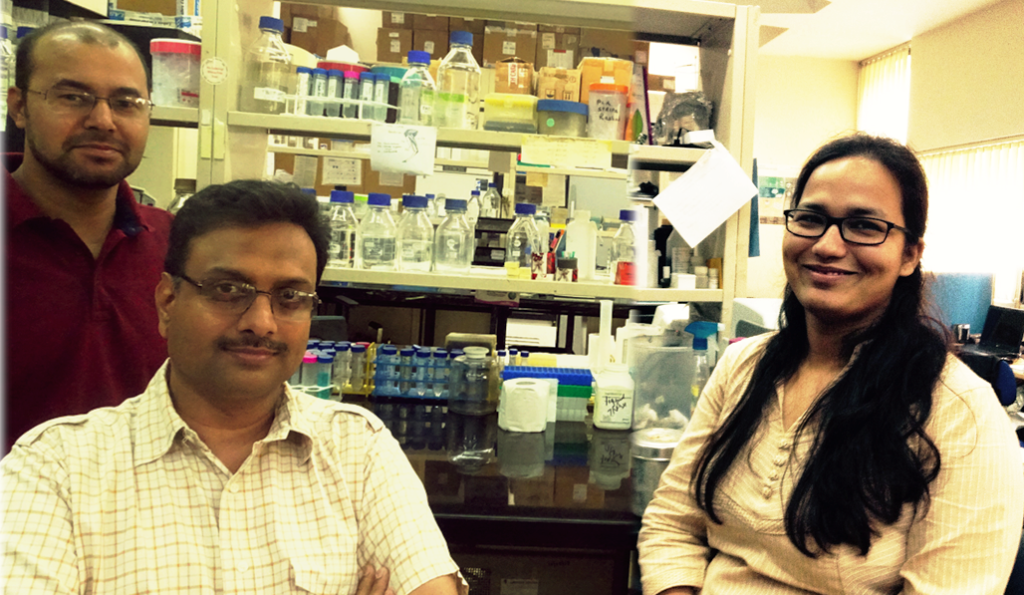
Dr. S. Ganesh and his team members

For long, scientists have been trying to find the specific role of glycogen in neurons, especially in brain diseases like Huntington’s, Lafora, Alzheimer’s etc. with some believing it be neurotoxic. The new study led by Prof.  Subramaniam Ganesh of Indian Institute of Technology, Kanpur (IIT-K) suggests that glycogen has a protective role in neurons of patients suffering from neurodegenerative disorders.

Glycogen synthetic machinery in healthy neurons usually remains in an inactive state. In this machinery, an enzyme called glycogen synthase catalyzes the formation of glycogen. Using cellular and animal models of Huntington’s disease, the researchers have shown that a high level of cytotoxic mutant Huntingtin protein triggers more glycogen synthesis in neurons by activating glycogen synthase. They observed that increased level of glycogen synthase protects neurons from the cytotoxicity of the mutant Huntingtin protein.

“Our findings establish that glycogen synthase is required for neurons to survive during stress. We also show that glycogen thus synthesized prevents aggregation of abnormal proteins, and helps in their clearance. These findings might open up new avenues of therapeutic interventions,” explained Dr. Ganesh.

The activation of glycogen synthase is harmful to healthy and happy neurons, and this may explain why glycogen granules are not seen in normal neurons. This means glycogen accumulation in degenerating brain could possibly represent a failed attempt of neurons to survive during the stress. “Our work establishes the neuroprotective role of glycogen synthase in Huntington’s disease models and thus discovers a previously unknown function of glycogen synthase in neuronal physiology”, he added.

“It is an important finding on the protective role of glycogen synthase in neurodegenerative diseases which may have translational relevance,” commented Prof. Sathees C. Raghavan from Indian Institute of Science, who is not connected with this study.

“These findings may open exciting possibilities for developing new therapeutic approaches for the neurodegenerative diseases which are becoming serious health issues in human populations in recent times,” said Prof. S. C. Lakhotia from Banaras Hindu University, who is not a part of this study.

The study has been published in journal Cell Death and Disease. The research team included Anupama Rai, Pankaj K. Singh, Virender Singh, Rohit Mishra, Ashwani K. Thakur, and Subramaniam Ganesh (IIT-Kanpur); Vipendra Kumar, Nihar R. Jana (National Brain Research Centre, Manesar); Anita Mahadevan, Susarla K. Shankar, (NIMHANS, Bengaluru). This research work was funded by Department of Biotechnology. (India Science Wire)

By Ratneshwar Thakur

Journal Article

Glycogen synthase protects neurons from cytotoxicity of mutant huntingtin by enhancing the autophagy flux

If you liked this article, then please subscribe to our YouTube Channel for the latest Science and Tech news. You can also find us on Twitter and Facebook.

 

Rate

For long, scientists have been trying to find the specific role of glycogen in neurons, especially in brain diseases like Huntington’s, Lafora, Alzheimer’s etc. with some believing it be neurotoxic. The new study led by Prof.  Subramaniam Ganesh of Indian Institute of Technology, Kanpur (IIT-K) suggests that glycogen has a protective role in neurons of patients suffering from neurodegenerative disorders.

Glycogen synthetic machinery in healthy neurons usually remains in an inactive state. In this machinery, an enzyme called glycogen synthase catalyzes the formation of glycogen. Using cellular and animal models of Huntington’s disease, the researchers have shown that a high level of cytotoxic mutant Huntingtin protein triggers more glycogen synthesis in neurons by activating glycogen synthase. They observed that increased level of glycogen synthase protects neurons from the cytotoxicity of the mutant Huntingtin protein.

“Our findings establish that glycogen synthase is required for neurons to survive during stress. We also show that glycogen thus synthesized prevents aggregation of abnormal proteins, and helps in their clearance. These findings might open up new avenues of therapeutic interventions,” explained Dr. Ganesh.

The activation of glycogen synthase is harmful to healthy and happy neurons, and this may explain why glycogen granules are not seen in normal neurons. This means glycogen accumulation in degenerating brain could possibly represent a failed attempt of neurons to survive during the stress. “Our work establishes the neuroprotective role of glycogen synthase in Huntington’s disease models and thus discovers a previously unknown function of glycogen synthase in neuronal physiology”, he added.

“It is an important finding on the protective role of glycogen synthase in neurodegenerative diseases which may have translational relevance,” commented Prof. Sathees C. Raghavan from Indian Institute of Science, who is not connected with this study.

“These findings may open exciting possibilities for developing new therapeutic approaches for the neurodegenerative diseases which are becoming serious health issues in human populations in recent times,” said Prof. S. C. Lakhotia from Banaras Hindu University, who is not a part of this study.

The study has been published in journal Cell Death and Disease. The research team included Anupama Rai, Pankaj K. Singh, Virender Singh, Rohit Mishra, Ashwani K. Thakur, and Subramaniam Ganesh (IIT-Kanpur); Vipendra Kumar, Nihar R. Jana (National Brain Research Centre, Manesar); Anita Mahadevan, Susarla K. Shankar, (NIMHANS, Bengaluru). This research work was funded by Department of Biotechnology. (India Science Wire)

By Ratneshwar Thakur

Journal Article

Glycogen synthase protects neurons from cytotoxicity of mutant huntingtin by enhancing the autophagy flux

If you liked this article, then please subscribe to our YouTube Channel for the latest Science and Tech news. You can also find us on Twitter and Facebook.

 

" }
Scientists Develop High-Efficiency Rapid Test for Hepatitis B Diagnosis

Scientists Develop High-Efficiency Rapid Test for Hepatitis B Diagnosis

In a new study, teams of researchers from DBT-Translational Health Science and Technology Institute, DBT-International Centre For Genetic Engineering And Biotechnology and University of Turku, Finland, have come together to develop an ultra-sensitive rapid diagnostic test that circumvents the sensitivity gap.

  • News
  • 2.2K
Read more

Researchers From Taiwan Has Discovered A New Mechanism of Memory Formation

There is an old Chinese saying that goes like this: “Once bitten by a snake, you will fear grass rope for ten years”. If a fortunate individual bitten by a poisonous snake managed to survive, the shape of the snake and the sense of danger will be associated together and stored into memory.

  • News
  • 2.4K
Read more
Social Networking Tools

Social Networking To Discuss And Promote Your Research

Social networking tools on Researchstash.com

  • News
  • 2.6K
Read more

Internet is huge! Help us find great content

Newsletter

Never miss a thing! Sign up for our newsletter to stay updated.

About

Research Stash is a curated collection of tools and News for S.T.E.M researchers

Have any questions or want to partner with us? Reach us at hello@researchstash.com

Navigation

Submit