Science Is Not for Children Alone but Is a Way of Life

Science Is Not for Children Alone but Is a Way of Life

  • Research Stash
  • News
  • 2.1K

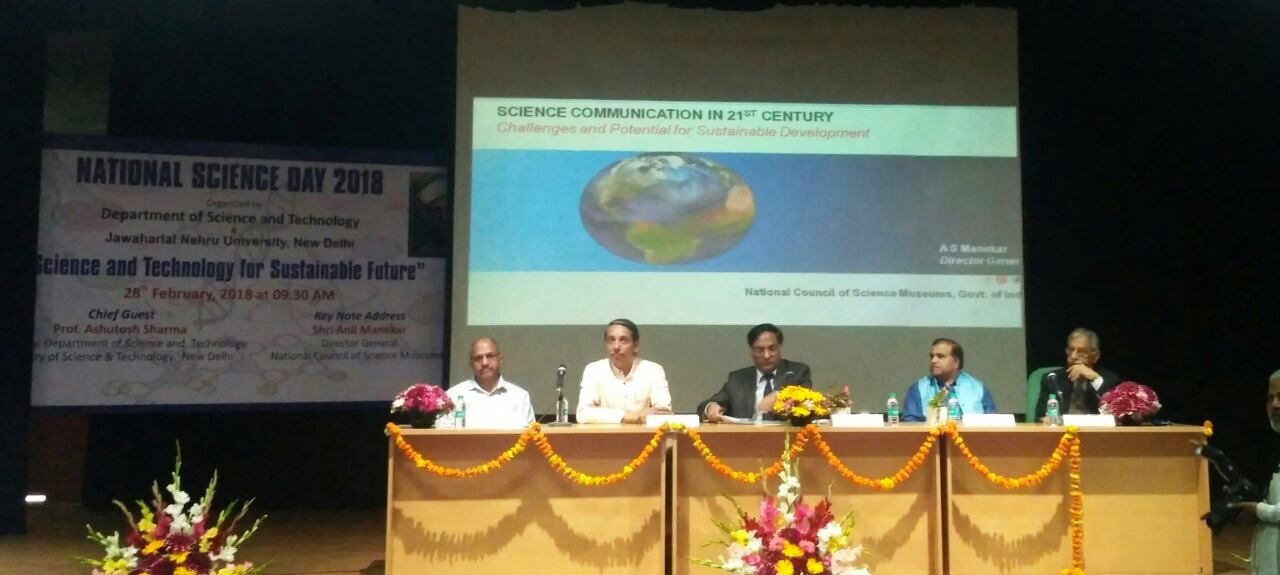
Eminent physicist, Sir C.V.Raman was the toast of the day as Department of Science and Technology (DST) and Jawaharlal Nehru University (JNU) jointly celebrated the National Science Day to mark the discovery of Raman Effect which won him Nobel Prize and helped place India in the global map of science.

Director General of the National Council of Science Museum (NCSM), Anil Manekar, who delivered the keynote address, set the tone for the deliberations by recalling how apart from pursuing cutting-edge science with limited resources, Raman made special efforts to popularize science among the people.

Noting that there was a myth that science was meant for children alone, he said there was a need for efforts to make science a way of life. “There is science in everything we do from morning to night. There is a need to appreciate this and promote the scientific attitude among the common man.”

Emphasising that the scientific community had a great role to play in ensuring a sustainable future for the coming generations, he said there was a need for scientists and technologists to work in unison with policymakers and other sections of the society.

He detailed how NCSM was working to create awareness as to how science could help in solving various problems facing the country such as poverty, health, education and other such social issues through its science centers established across the country.

DST Secretary Dr. Ashutosh Sharma said even while celebrating contributions made by eminent scientists such as Sir C.V. Raman, S.N.Bose, and Meghanad Saha, scientists need to try to excel them. There was a need to combine the eastern philosophy of `learning at the feet of the master’ with the Western thought that focused on `standing on the shoulders of the giants and look far ahead’.

He urged scientists to make use of the government’s latest Programme to encourage young scientists to write popular articles about their research work. “We expect about 5,000 entries every year. Hundred top articles will be shortlisted and rewarded amply. We will also arrange for them to be published in newspapers, magazines, and other popular outlets”.

JNU Vice-Chancellor, Prof. M.Jagdeesh Kumar, emphasized the need for promoting renewable energy to ensure a sustainable future and urged for efforts to develop high capacity battery systems to store power generated by them. “Presently, lithium is the material of choice but it is not available in the country. We have to identify materials that are locally available in abundance”.  (India Science Wire)

By Sundararajan Padmanabhan

For the latest Science, Tech news and conversations, follow Research Stash on TwitterFacebook, and subscribe to our YouTube channel 
Emphasising that the scientific community had a great role to play in ensuring a sustainable future for the coming generations, he said there was a need for scientists and technologists to work in unison with policymakers and other sections of the society.

He detailed how NCSM was working to create awareness as to how science could help in solving various problems facing the country such as poverty, health, education and other such social issues through its science centers established across the country.

DST Secretary Dr. Ashutosh Sharma said even while celebrating contributions made by eminent scientists such as Sir C.V. Raman, S.N.Bose, and Meghanad Saha, scientists need to try to excel them. There was a need to combine the eastern philosophy of `learning at the feet of the master’ with the Western thought that focused on `standing on the shoulders of the giants and look far ahead’.

He urged scientists to make use of the government’s latest Programme to encourage young scientists to write popular articles about their research work. “We expect about 5,000 entries every year. Hundred top articles will be shortlisted and rewarded amply. We will also arrange for them to be published in newspapers, magazines, and other popular outlets”.

JNU Vice-Chancellor, Prof. M.Jagdeesh Kumar, emphasized the need for promoting renewable energy to ensure a sustainable future and urged for efforts to develop high capacity battery systems to store power generated by them. “Presently, lithium is the material of choice but it is not available in the country. We have to identify materials that are locally available in abundance”.  (India Science Wire)

By Sundararajan Padmanabhan

For the latest Science, Tech news and conversations, follow Research Stash on TwitterFacebook, and subscribe to our YouTube channel 
" }

Scientists Shed Light on Cancer Risk Associated With Epigenetic Changes during Aging

The new science of Epigenetics has enabled us to track, how our lifestyle and surroundings affect the behavior of genes in our body, without altering the underlying DNA sequence (commonly called ‘mutations’).

  • News
  • 2.6K
Read more
Low-Cost Method to Help Remove Toxic Dyes in Wastewater

Low-Cost Method to Help Remove Toxic Dyes in Wastewater

Water contamination due to dyes is a major cause of worry. A new study says sawdust from teak wood may help treat wastewater containing dyes and make it reusable.

  • News
  • 4.2K
Read more
Scientists Develop Bio-Fortified Maize to Address ‘Hidden Hunger’

Scientists Develop Bio-Fortified Maize to Address ‘Hidden Hunger’

Researchers at the Indian Agricultural Research Institute (IARI) have developed a maize variety which is rich in both Vitamin A and essential amino acids through the process of plant breeding.

  • News
  • 2.4K
Read more

Internet is huge! Help us find great content

Newsletter

Never miss a thing! Sign up for our newsletter to stay updated.

About

Research Stash is a curated collection of tools and News for S.T.E.M researchers

Have any questions or want to partner with us? Reach us at [email protected]

Navigation

Submit