
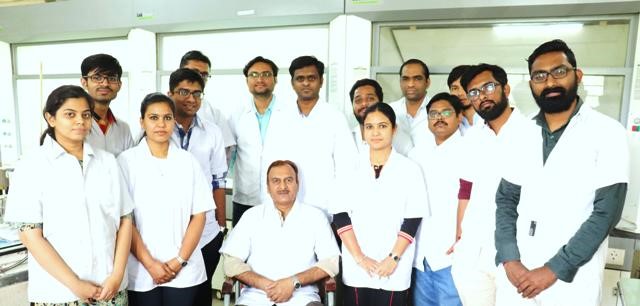
Prof. Yadav with his research team

Potent Anti-Obesity Agent Works In Rats

  • Research Stash
  • News
  • 1.7K

Obesity has emerged as a public health problem, resulting in the significant burden of non-communicable diseases. A team of scientists at Maharaja Sayajirao University (MSU), Baroda have claimed success with a potent anti-obesity agent in studies done in laboratory animals.

The group, led by Prof. Mange Ram Yadav, has designed new molecules that seem to be effective in controlling food intake in preliminary studies done in rats. The researchers screened a database of chemical compounds and identified a chemical moiety, phenothiazine, that can be modified to act as an anti-obesity agent. These compounds containing phenothiazine on Cannabinoid Receptor 1 and inhibit it.

Cannabinoid Receptor 1 (CB1R) is a class of receptors present in the brain and other tissues and organs like eyes, mouth and oral cavity, cardiovascular system, gastrointestinal tract, and immune system. These receptors are involved in various functions like regulating our appetite, pain, and emotions. A receptor is a molecule on the surface of a cell that receives chemical signals from the outside and results in initiating a response inside the cell.

“Activation of CB1R leads to increased food intake, while inhibition of this receptor decreases the feeding,” researchers explained. By exploiting this quality of CB1R, the team designed new molecules that target and inhibit this receptor and thus lead to decreased food intake. They further modified the molecule in such a way that it does not reach the brain and only acts on cells outside the central nervous system. This may help in avoiding side effects like anxiety and depression.

Preliminary studies done in rats showed a significant decrease in food intake as compared to rats in the control group. These study results have been published recently in journal Scientific Reports.

“This group has reported the role of phenothiazine nucleus containing compounds as peripherally acting cannabinoid 1(CB1) receptor antagonists for management of obesity. The investigations have indicated good physiochemical and pharmacokinetic properties suggesting their drug-like behavior”, noted Dr. Gita Chawla, Associate Professor in Department of Pharmaceutical Chemistry, Jamia Hamdard, who was not connected with the study.

“We are currently in the process of chemical modification and optimization of molecule activity that can then be converted in the form of drug”, Prof. Yadav told India Science Wire. He said he has filed a patent application in India for these compounds.

The team included Mayank Kumar Sharma, JatinMachhi, Prashant Murumkar and M R Yadav.  (India Science Wire)

By Shikha T Malik

Journal Article

New role of phenothiazine derivatives as peripherally acting CB1 receptor antagonizing anti-obesity agents

For the latest Science, Tech news and conversations, follow Research Stash on TwitterFacebook, and subscribe to our YouTube channel 
 

Rate

“Activation of CB1R leads to increased food intake, while inhibition of this receptor decreases the feeding,” researchers explained. By exploiting this quality of CB1R, the team designed new molecules that target and inhibit this receptor and thus lead to decreased food intake. They further modified the molecule in such a way that it does not reach the brain and only acts on cells outside the central nervous system. This may help in avoiding side effects like anxiety and depression.

Preliminary studies done in rats showed a significant decrease in food intake as compared to rats in the control group. These study results have been published recently in journal Scientific Reports.

“This group has reported the role of phenothiazine nucleus containing compounds as peripherally acting cannabinoid 1(CB1) receptor antagonists for management of obesity. The investigations have indicated good physiochemical and pharmacokinetic properties suggesting their drug-like behavior”, noted Dr. Gita Chawla, Associate Professor in Department of Pharmaceutical Chemistry, Jamia Hamdard, who was not connected with the study.

“We are currently in the process of chemical modification and optimization of molecule activity that can then be converted in the form of drug”, Prof. Yadav told India Science Wire. He said he has filed a patent application in India for these compounds.

The team included Mayank Kumar Sharma, JatinMachhi, Prashant Murumkar and M R Yadav.  (India Science Wire)

By Shikha T Malik

Journal Article

New role of phenothiazine derivatives as peripherally acting CB1 receptor antagonizing anti-obesity agents

For the latest Science, Tech news and conversations, follow Research Stash on TwitterFacebook, and subscribe to our YouTube channel 
 

" }
Dr. Jitendra Kumar Thakur with his colleagues

Researchers Find A New Possibility to Improve Rice Productivity

Researchers from the National Institute of Plant Genome Research, Indian Agricultural Research Institute, National Rice Research Institute, and University of Delhi South Campus have identified a region in the genome of a rice, which seems to have the potential for improving productivity.

  • News
  • 2.3K
Read more

How Malaria Tricks the Immune System

The new study suggests a possible defense in the battle against this deadly disease Global efforts to eradicate malaria are crucially dependent on scientists’ ability to outsmart the malaria parasite.

  • News
  • 2.2K
Read more
Judicious Use of Bio Insecticide May Help Control Filariasis Vector

Judicious Use of Bio Insecticide May Help Control Filariasis Vector

Filariasis is a public health problem in some parts of India. It is caused by parasitic worms which get deposited on the skin and penetrate on their own or through openings created by mosquito bites to reach the lymphatic system.

  • News
  • 2.3K
Read more

Internet is huge! Help us find great content

Newsletter

Never miss a thing! Sign up for our newsletter to stay updated.

About

Research Stash is a curated collection of tools and News for S.T.E.M researchers

Have any questions or want to partner with us? Reach us at [email protected]

Navigation

Submit