Formosat-5 launches successfully, makes contact with ground station

  • Research Stash
  • News
  • 1.1K

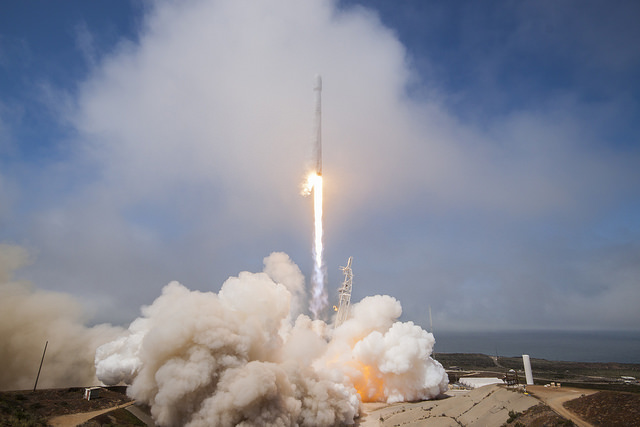
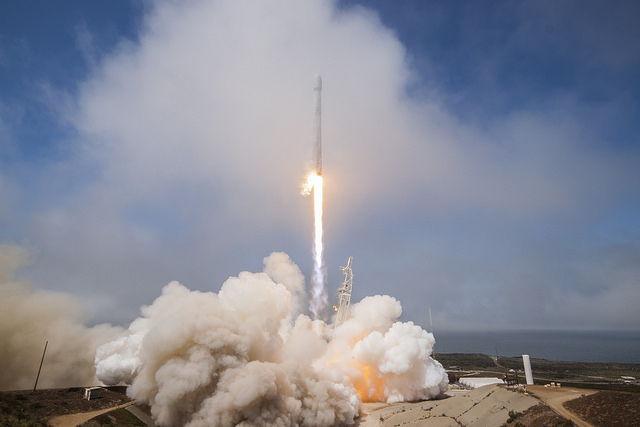
Taiwan’s first indigenously produced ultra-high resolution Earth observation satellite Formosat-5 was launched at 2:51 a.m. Aug. 25 Pacific Daylight Time from Vandenberg Air Force Base in California, representing a milestone in the nation’s space technology industry.
Formosat-5 launches successfully, makes contact with ground station
SpaceX’s Falcon 9 rocket carrying Formosat-5, Taiwan’s first indigenously produced ultra-high resolution Earth observation satellite, blasts off Aug. 25 from Vandenberg Air Force Base in California. (Courtesy of SpaceX)

Operated by National Space Organization in northern Taiwan’s Hsinchu City, the satellite was carried into a low Earth orbit by Space X’s Falcon 9 rocket and established contact 82 minutes later with Svalbard ground station in Norway. It will be put through one month of testing before taking up a sun synchronous orbit at an altitude of 720 kilometers with a 98.28-degree inclination angle.

President Tsai Ing-wen congratulated NSPO on the accomplishment via her official Facebook and Twitter accounts. She said Formosat-5 is the culmination of many years hard work and something the people of Taiwan can truly be proud of.

According to NSPO, which is administered by the National Applied Research Laboratories under the Ministry of Science and Technology, the successful launch and deployment of Formosat-5 is a credit to the more than 50 academic and industrial groups that worked together for six years to take Taiwan to the stars.

Capable of capturing 2-meter resolution panchromatic and 4-meter resolution multispectral images, the satellite’s primary functions include academic research, assisting in disaster relief operations and observing climate and environmental change attributed to global warming. It will take over from Formosat-2, which was decommissioned in August 2016 after 12 years spent recording a steady stream of images over Taiwan, as well as other parts of the Earth.

Another component of the Formosat-5 mission is the Advanced Ionospheric Probe. Developed by Taoyuan City-based National Central University with the support of the Ministry of Education, the world’s smallest all-in-one space plasma sensor will document space weather and seismic precursors associated with strong earthquakes.

The launch was watched live in Taiwan by 200 dignitaries at NSPO, including MOST Minister Chen Liang-gee and NARLABS President Wang Yeong-her. In the U.S., Stanley Kao, head of Taipei Economic and Cultural Representative Office in the U.S., viewed the event with James Moriarty, chairman of the American Institute in Taiwan, and around 300 Taiwan expatriates and guests in the Californian city of Lompoc.

Established in 1991, NSPO is dedicated to becoming a center of innovation for space technology, working to establish indigenous space technology and conducting domestic and international space programs.

http://taiwantoday.tw/index.php

Rate

According to NSPO, which is administered by the National Applied Research Laboratories under the Ministry of Science and Technology, the successful launch and deployment of Formosat-5 is a credit to the more than 50 academic and industrial groups that worked together for six years to take Taiwan to the stars.

Capable of capturing 2-meter resolution panchromatic and 4-meter resolution multispectral images, the satellite’s primary functions include academic research, assisting in disaster relief operations and observing climate and environmental change attributed to global warming. It will take over from Formosat-2, which was decommissioned in August 2016 after 12 years spent recording a steady stream of images over Taiwan, as well as other parts of the Earth.

Another component of the Formosat-5 mission is the Advanced Ionospheric Probe. Developed by Taoyuan City-based National Central University with the support of the Ministry of Education, the world’s smallest all-in-one space plasma sensor will document space weather and seismic precursors associated with strong earthquakes.

The launch was watched live in Taiwan by 200 dignitaries at NSPO, including MOST Minister Chen Liang-gee and NARLABS President Wang Yeong-her. In the U.S., Stanley Kao, head of Taipei Economic and Cultural Representative Office in the U.S., viewed the event with James Moriarty, chairman of the American Institute in Taiwan, and around 300 Taiwan expatriates and guests in the Californian city of Lompoc.

Established in 1991, NSPO is dedicated to becoming a center of innovation for space technology, working to establish indigenous space technology and conducting domestic and international space programs.

http://taiwantoday.tw/index.php
" }
Time Stamping with IST Can Help Crack Cybercrimes

Time Stamping with IST Can Help Crack Cybercrimes

All digital transactions being carried out in India could soon have to timestamp with Indian Standard Time (IST). The National Physical Laboratory (NPL) – the official timekeeper of IST – has signed an agreement with the Department of Telecommunication (DoT) to establish a nationwide network for time stamping and time synchronization and to ensure traceability of time signals.

  • News
  • 2.2K
Read more

Top 10 STEM Breakthrough Technologies Of 2017 – MIT Technology Review

The 'MIT Technology Review' has recently shared its top 10 breakthrough technologies of 2017.

  • News
  • 2.7K
Read more
Man-Made Earthquakes Triggered by Fracking and Dams Are Not Localized

Man-Made Earthquakes Triggered by Fracking and Dams Are Not Localized

Seismic activity triggered by human actions like the construction of large dams or injection of wastewater into the ground for oil and gas production can have far greater implications than previously thought, a new study has revealed

  • News
  • 2.5K
Read more

Internet is huge! Help us find great content

Newsletter

Never miss a thing! Sign up for our newsletter to stay updated.

About

Research Stash is a curated collection of tools and News for S.T.E.M researchers

Have any questions or want to partner with us? Reach us at hello@researchstash.com

Navigation

Submit