
Taiwanese Students Shine at Intel Science Fair

  • Research Stash
  • News
  • 2.4K

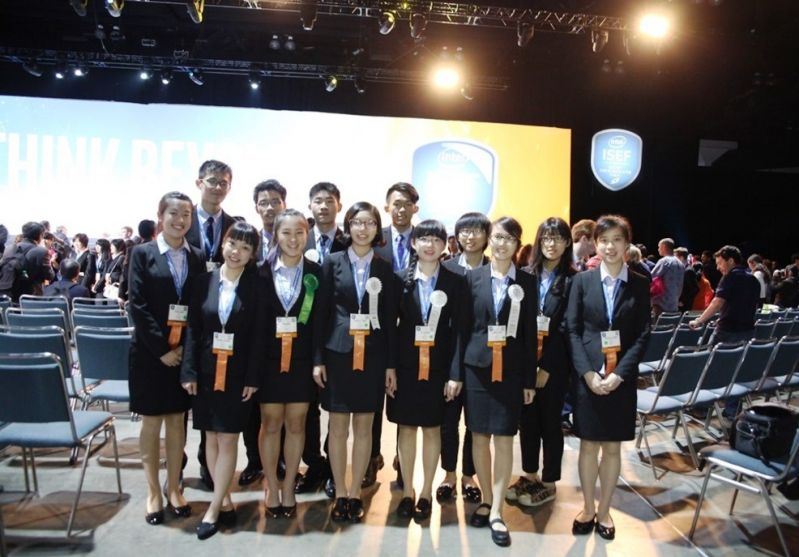
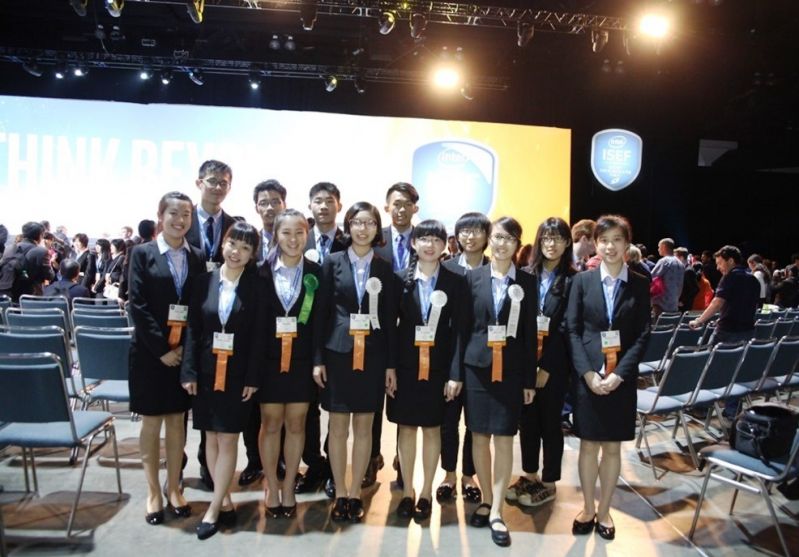
Taiwan high school students won three third-place awards, one fourth-place award and one special award for their outstanding performances at the prestigious Intel International Science and Engineering Fair May 19 in Los Angeles.
Taiwan students shine at Intel science fair

Staged annually by Washington-based Society for Science and the Public since 1950 and sponsored by Intel Corp., the 2017 edition of the world’s largest pre-college science competition attracted around 1,300 entries from nearly 1,800 students in 78 countries and territories worldwide.

According to the Taipei City-based National Taiwan Science Education Center, which is the major sponsor of the country’s representation at the ISEF, the local team comprised 13 members, who submitted nine projects this year. They were selected from winners of the Taiwan International Science Fair held in early February.

One of the local winners was Yeh Chia-yu of Chung Shan Industrial & Commercial School in southern Taiwan’s Kaohsiung City. He took home a third-place award, along with a cash prize of US$1,000, in the Embedded Systems category for his Eco Paper Circuit Printer and Its Applications.

Yeh’s proposal outlines a new method for producing paper-based printed circuit boards that are more cost-effective and environmentally friendly than the traditional approach. He is the first Taiwan student from a vocational high school to take part in the ISEF and win an award.

Equally impressive were the results for Lin Juei-yin of Taipei First Girls High School, who picked up a third-place award in the Math category for her project Which Maps Are 4-list Colorable? The research can be applied for better resource allocation and scheduling at education institutions.

Chen Yi-chen and Wu Yu-ching, both from Taipei First Girls High School, received a third-place award in the Chemistry category for their High Efficiency TADF-based Transparent OLEDs. The pair said their research can be used to produce transparent displays for consumer electronics and a variety of wearable devices.

In the category of Biomedical and Health Sciences, Angel Huang of Taipei American School claimed fourth place and a cash award of US$500 for her project, titled Imbalanced Folate Status Promotes Metabolic Stress, Cancer Stem Cell Phenotype, and Proteomic Signatures of Human Breast Cancer Cells.

In addition to the grand awards, Chuan Yuan-jung of National Tainan Girls’ Senior High School in the southern Taiwan city earned a special award and US$500 presented by the American Mathematical Society for her research on the Thue-Morse sequence and its applications in bio-mathematics and cryptography.

According to the NTSEC, Taiwan won eight grand awards and four special awards at the 2016 ISEF, and three grand awards and four special awards the year before. (SFC-E)
Source: Taiwan Today

Rate

According to the Taipei City-based National Taiwan Science Education Center, which is the major sponsor of the country’s representation at the ISEF, the local team comprised 13 members, who submitted nine projects this year. They were selected from winners of the Taiwan International Science Fair held in early February.

One of the local winners was Yeh Chia-yu of Chung Shan Industrial & Commercial School in southern Taiwan’s Kaohsiung City. He took home a third-place award, along with a cash prize of US$1,000, in the Embedded Systems category for his Eco Paper Circuit Printer and Its Applications.

Yeh’s proposal outlines a new method for producing paper-based printed circuit boards that are more cost-effective and environmentally friendly than the traditional approach. He is the first Taiwan student from a vocational high school to take part in the ISEF and win an award.

Equally impressive were the results for Lin Juei-yin of Taipei First Girls High School, who picked up a third-place award in the Math category for her project Which Maps Are 4-list Colorable? The research can be applied for better resource allocation and scheduling at education institutions.

Chen Yi-chen and Wu Yu-ching, both from Taipei First Girls High School, received a third-place award in the Chemistry category for their High Efficiency TADF-based Transparent OLEDs. The pair said their research can be used to produce transparent displays for consumer electronics and a variety of wearable devices.

In the category of Biomedical and Health Sciences, Angel Huang of Taipei American School claimed fourth place and a cash award of US$500 for her project, titled Imbalanced Folate Status Promotes Metabolic Stress, Cancer Stem Cell Phenotype, and Proteomic Signatures of Human Breast Cancer Cells.

In addition to the grand awards, Chuan Yuan-jung of National Tainan Girls’ Senior High School in the southern Taiwan city earned a special award and US$500 presented by the American Mathematical Society for her research on the Thue-Morse sequence and its applications in bio-mathematics and cryptography.

According to the NTSEC, Taiwan won eight grand awards and four special awards at the 2016 ISEF, and three grand awards and four special awards the year before. (SFC-E)
Source: Taiwan Today
" }
Evolution of Genes, Genomes and Technology

Evolution of Genes, Genomes and Technology – Dr. Wen-Hsiung Li

Dr. Wen-Hsiung Li from the Biodiversity Research Center in Academia Sinica talks about how comparing the genetic codes of different species helps us understand their evolutionary origins and how this fundamental knowledge can be translated into producing important enzymes and hormones

Read more
Massive Exercise Underway To Map Air Pollution Sources in the Indian Capital

Massive Exercise Underway To Map Air Pollution Sources in the Indian Capital

A group of scientists and students are braving heat and dust this summer in the national capital to map all possible sources of air pollution so that by winter this year we can get a fair idea of different sources of pollution in the city.

  • News
  • 2.4K
Read more
Members of the research team at IIT, Roorkee

Researchers Decipher Antibacterial Mechanism of Naturally Occurring Chemical

Researchers at the Indian Institute of Technology, Roorkee, have found out the mechanism that underlies antibacterial properties of a natural compound called Chlorogenic Acid which occurs in several plants including coffee.

  • News
  • 4.3K
Read more

Internet is huge! Help us find great content

Newsletter

Never miss a thing! Sign up for our newsletter to stay updated.

About

Research Stash is a curated collection of tools and News for S.T.E.M researchers

Have any questions or want to partner with us? Reach us at hello@researchstash.com

Navigation

Submit